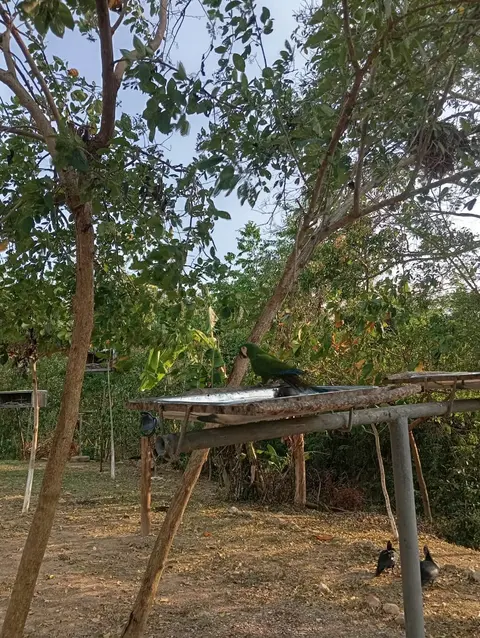
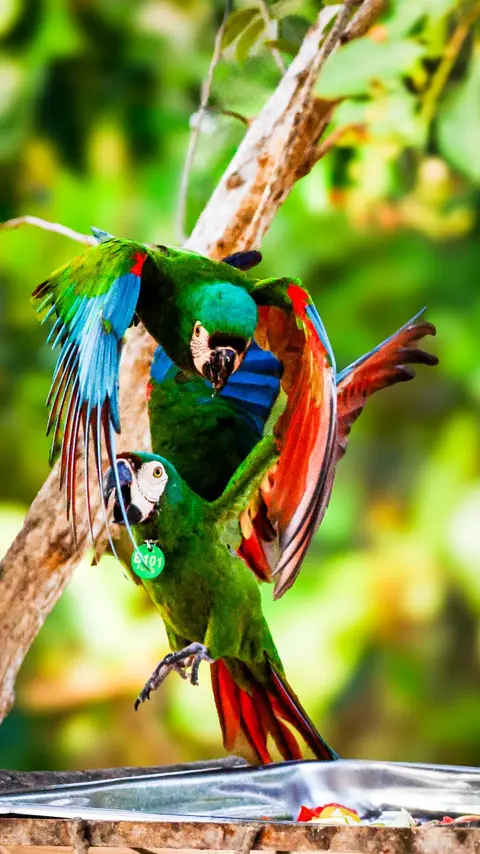
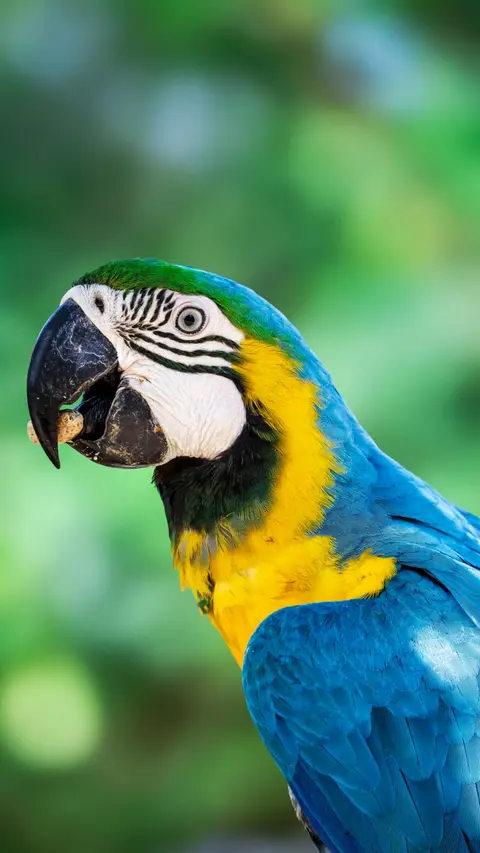
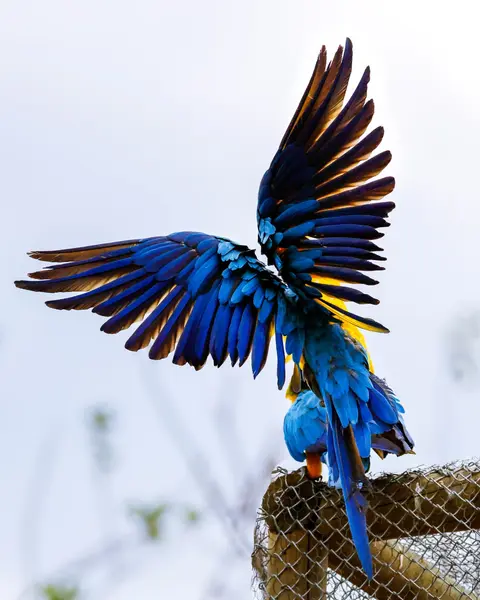
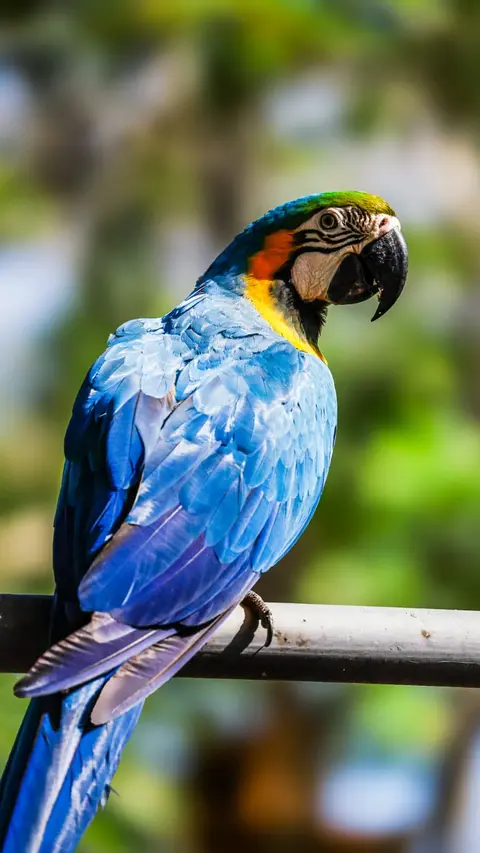
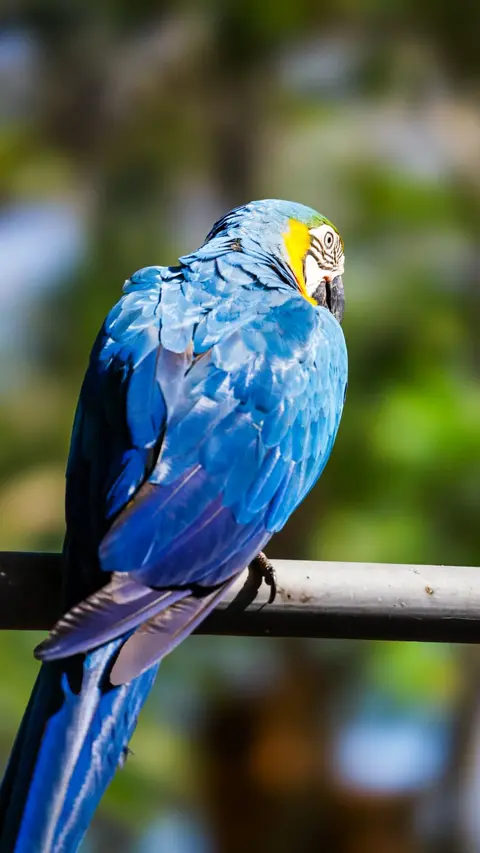
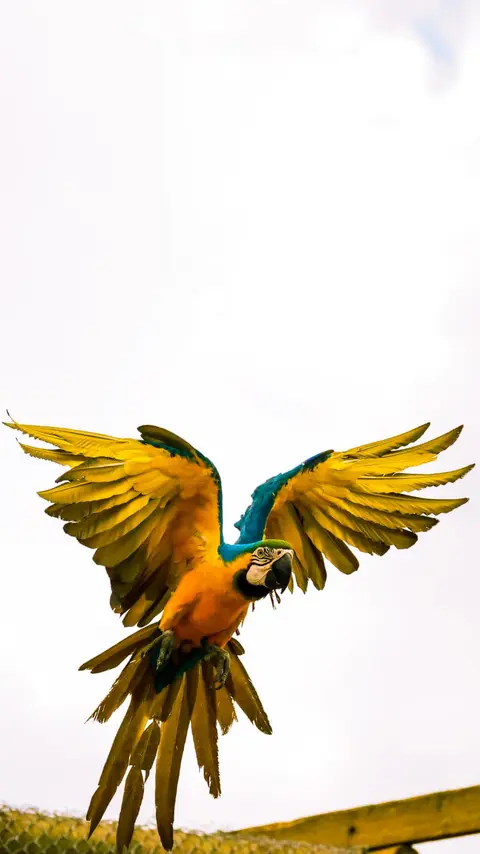
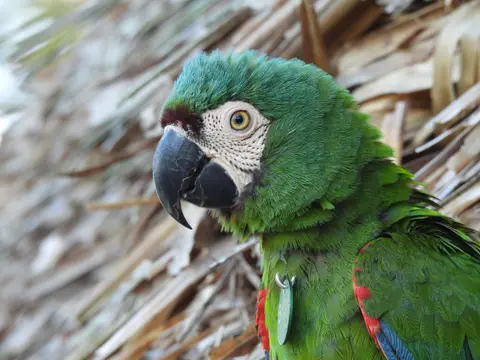
Not every bird finds its way to freedom by the same path. This *Ara severus* — a chestnut-fronted macaw of difficult temperament — left aviary 1 at Fundación Loros not as a quiet triumph of rehabilitation, but as an urgent decision: the bird had developed a sustained aggression the team could no longer ignore, and there was well-founded suspicion that it had killed one of its enclosure companions.
It was Omar and Alberto who carried out the release, on a Sunday in March, in a rural setting surrounded by trees and the packed earth of a country yard. In the photograph that came in from the field, the macaw appears perched on a metal structure — green and still for one brief moment — while in the background a few hens go about their business as though nothing of consequence is happening. There was no ceremony. Only the instant when the bird spread its wings and proved, with a strong and steady flight, that its body at least was ready for what lay ahead.
Sometimes rehabilitation ends this way: without applause, with a loss on the inside and a departure on the outside. The macaw left because it was necessary. And because, by then, it flew well.
One Last Peanut Before Taking Flight
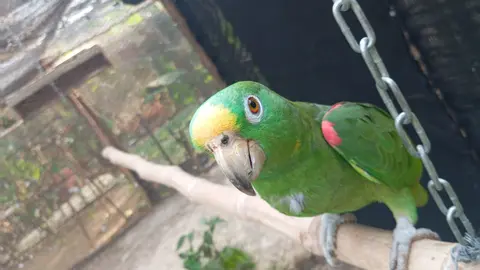
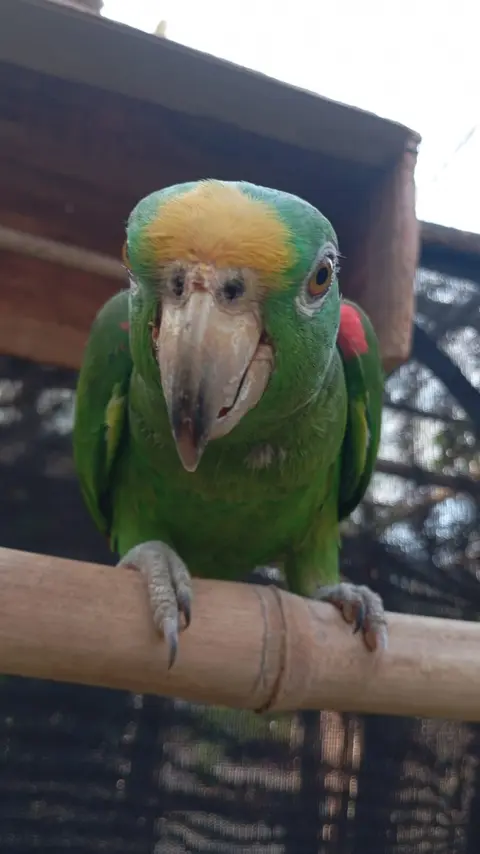
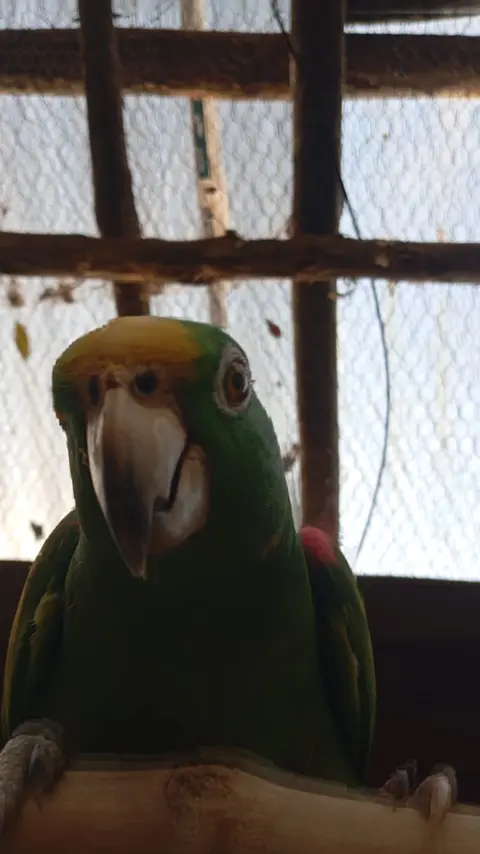
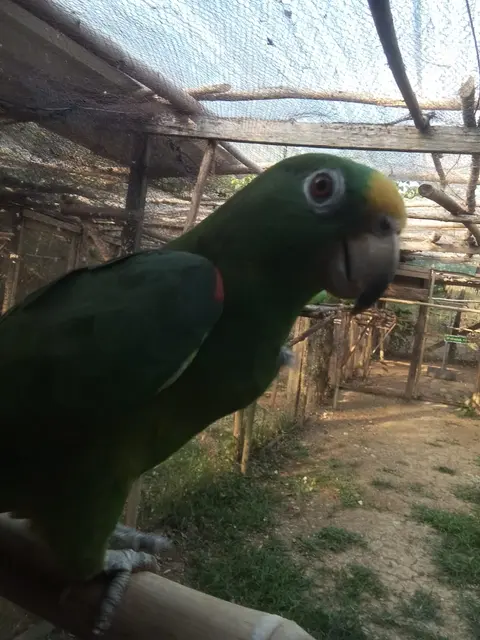
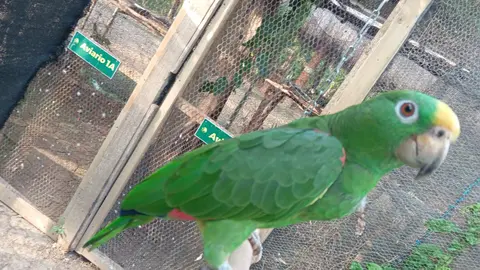
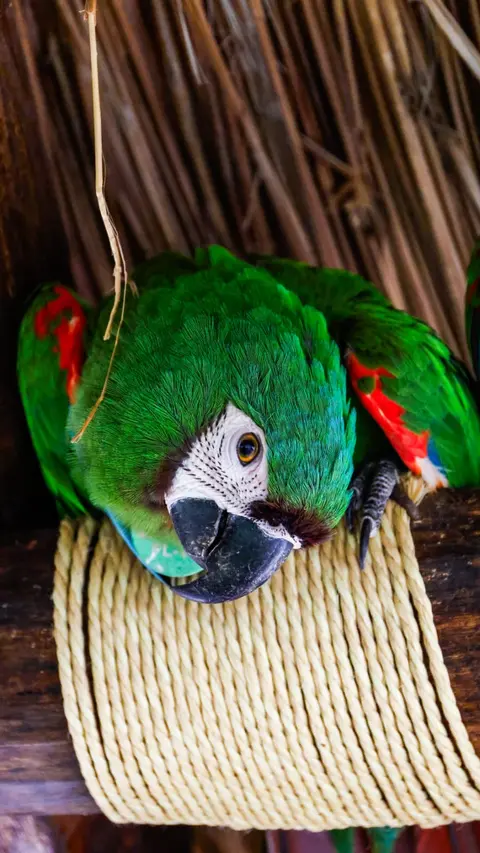
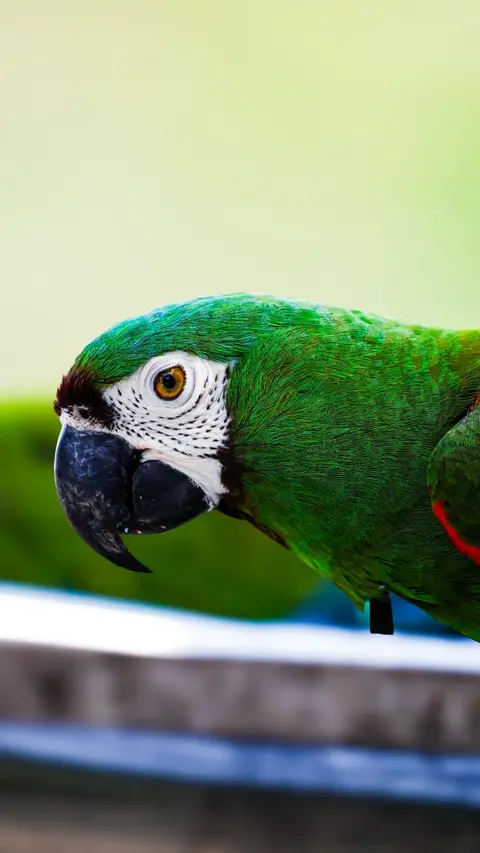
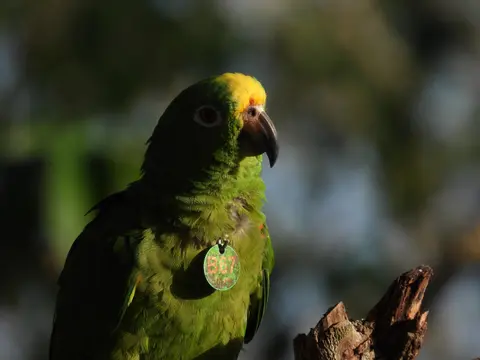
A few weeks earlier, someone in the village had caught this amazon parrot and brought it to the Fundación. It was a large specimen — deep green plumage, a sharply defined yellow crown, red patches blazing across the wings. The kind of bird you look at and sense has already lived a great deal. Its identification band was gone, but the team needed no other signs: this parrot had been free for a long time, and it showed.
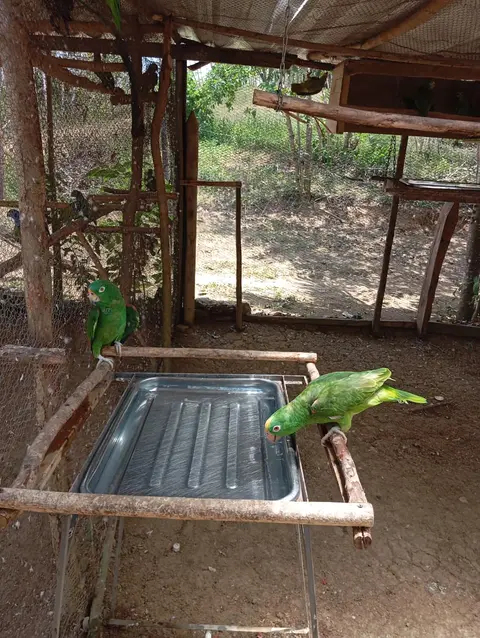
On Sunday, March 29th, Omar lifted him out of Aviario 1A and set him on the outdoor feeding perch. The parrot didn't flinch. He simply stayed there, unhurried, eating a peanut with the quiet composure of someone who knows exactly what comes next. When he finished, he opened his wings and flew off on his own — no coaxing, no ceremony.
And so ended this amazon's time at Fundación Loros — possibly Amazona ochrocephala — without fanfare or fuss. Just a bird who had always known what freedom felt like, taking a moment to eat something before returning to it.
An Amazon Parrot That Could Not Be Identified
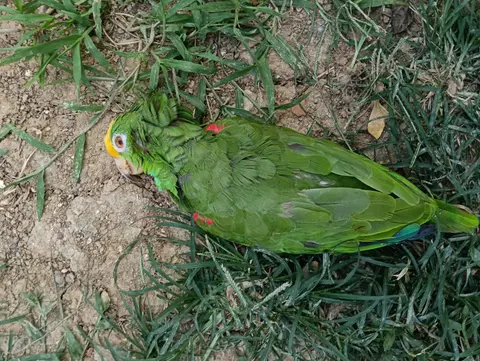
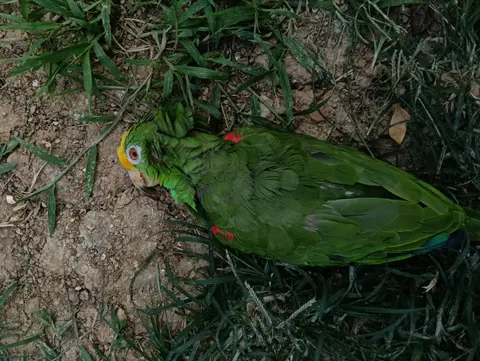
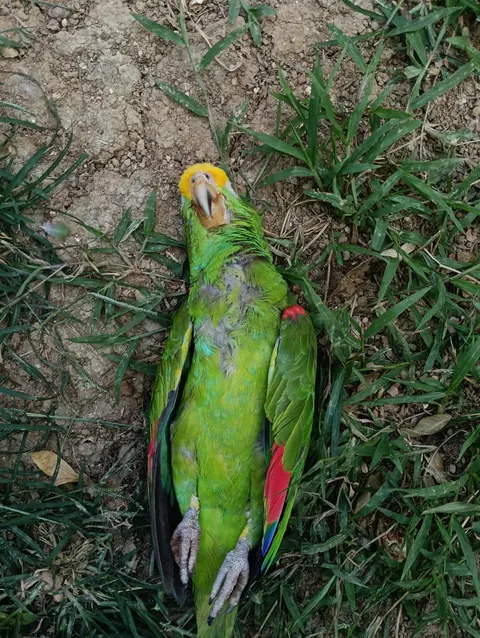
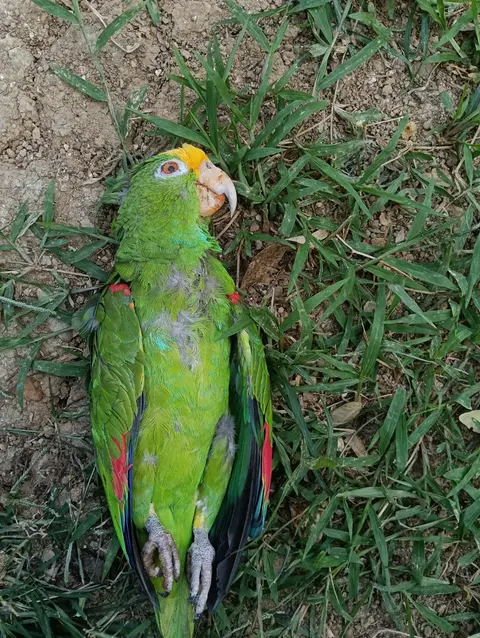
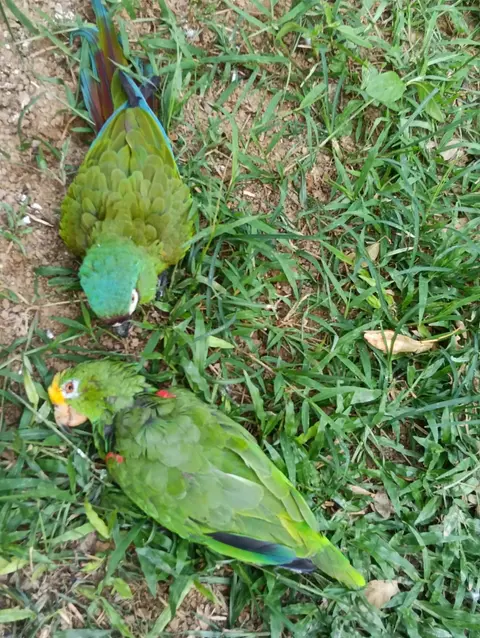
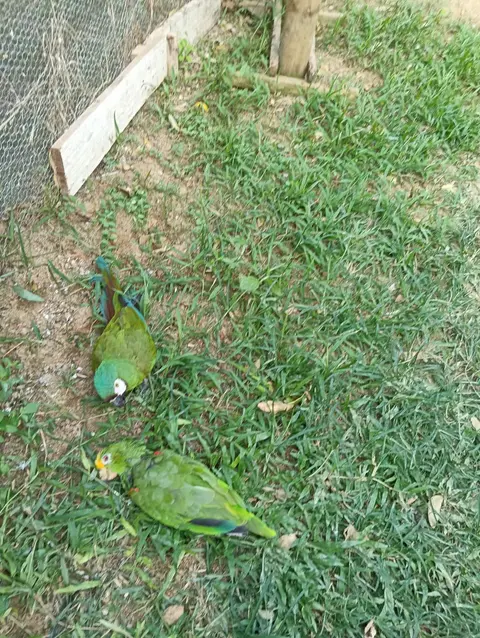
Alberto found the parrot on the floor of Aviario 1. It was an amazon — brilliant green plumage, yellow markings on the head, a red flash across the wings — the kind of bird anyone would have recognized in flight, yet that morning it lay with its beak open and its feet stiffened, bearing no ring or tag to tell its name. The photographs and video the team captured show the signs of trauma: ruffled feathers, an unnatural posture, soil and grass around it like mute witnesses to what must have been a brief and decisive struggle.
Apparently, the Ara severus that shares the enclosure was the other protagonist in this story. Chestnut-fronted macaws are temperamental, territorial birds; living alongside them is never without risk — especially when space is contested with the kind of intensity that only birds who were once wild seem to know. How the conflict began, or how long it lasted, remains unclear.
What remains is Alberto's careful record, and the team's, and the question that always stings a little more when there is no ring: how long had this parrot been with us, and what was its name?
Born Wild in the Forest
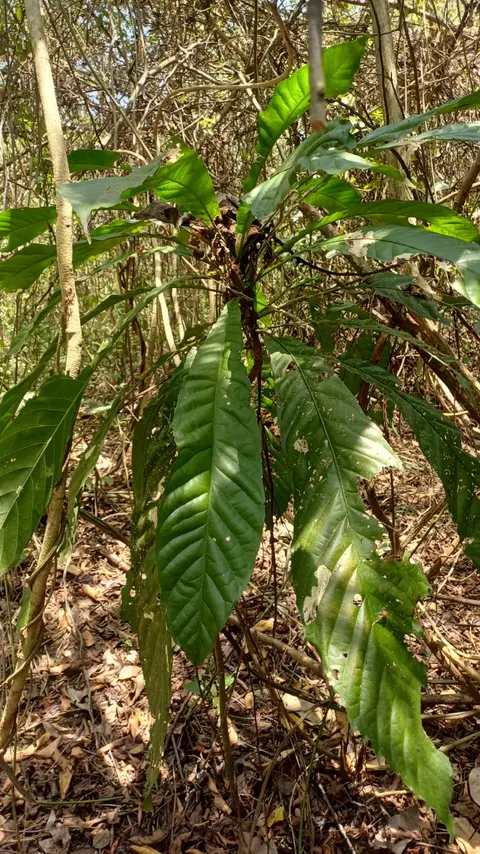
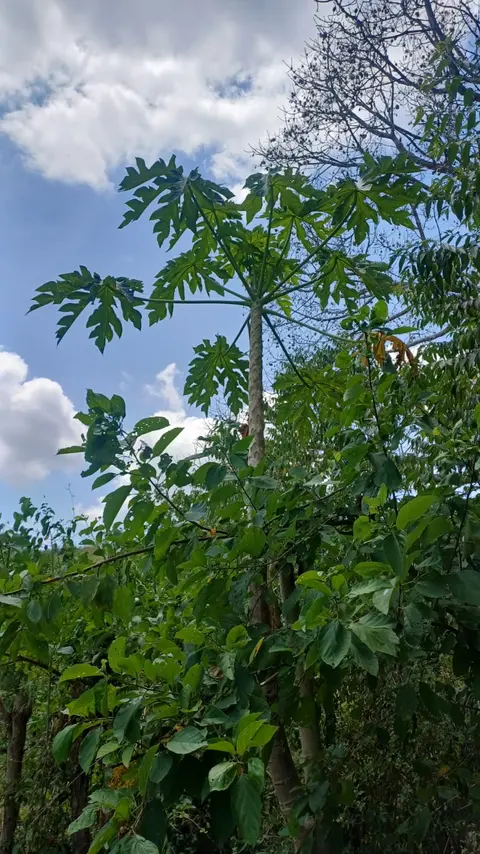
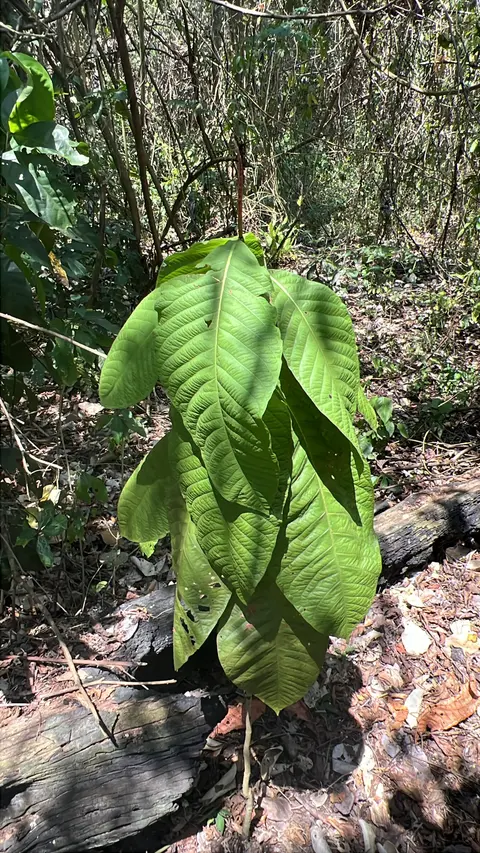
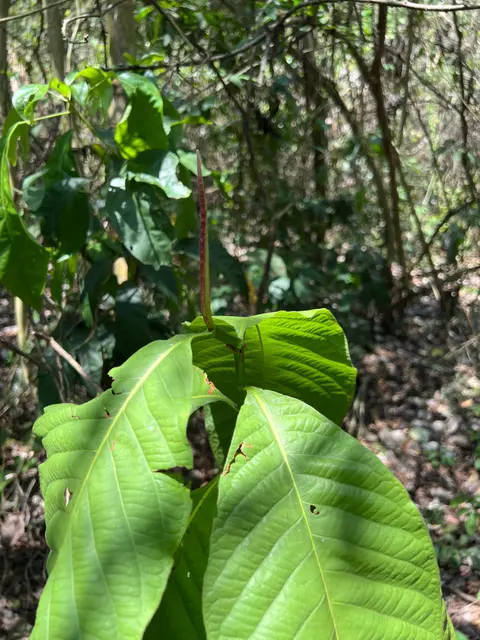
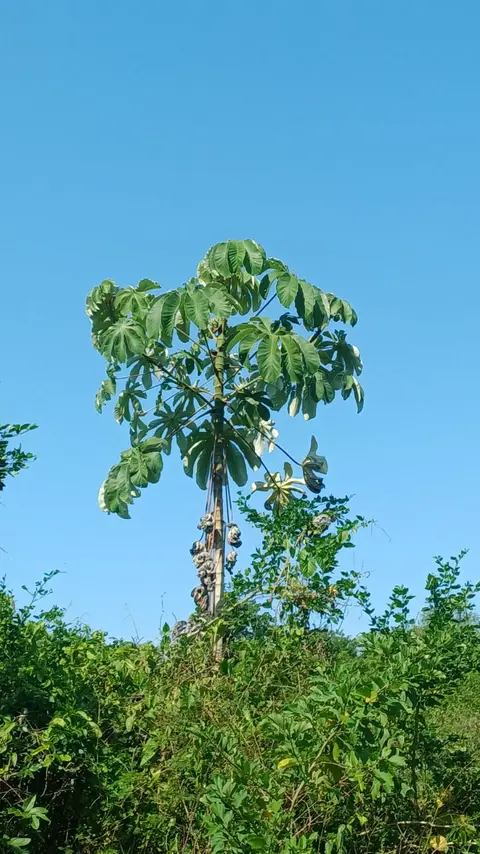
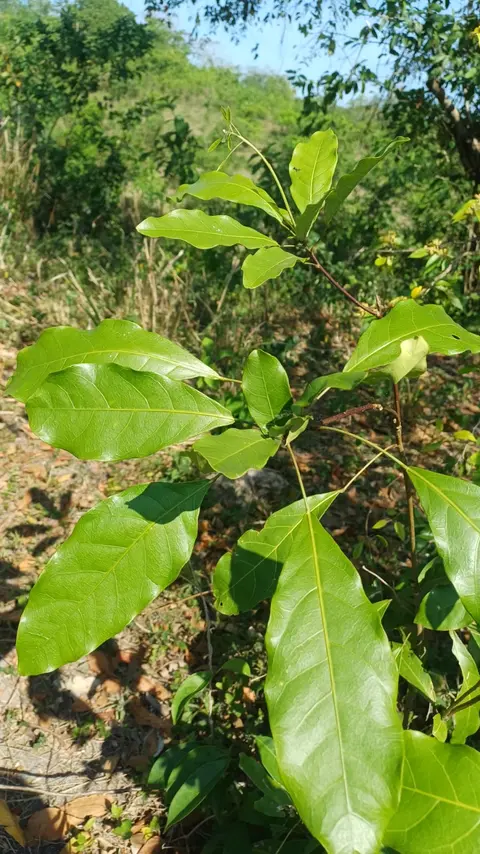
Jorge Alcalá was walking through the sanctuary when something stopped him in his tracks: there, among the shadows of the deciduous understory, upon a carpet of dry leaves and bare trunks, a young shrubby plant with large, deep-green leaves had sprouted without anyone having sown it. A little further on, standing tall amid the dense vegetation, a wild papaya — Carica papaya — spread its crown of lobed leaves toward the blue March sky, slender and upright, as if it had always known exactly which way to grow.
No one planted them. No one prepared the soil to receive them. The sanctuary's earth did it on its own, as it has spent years learning to do. Both plants, recorded in GPS coordinates by Jorge, are a sign that the forest carries its own memory — and knows how to find its way back.
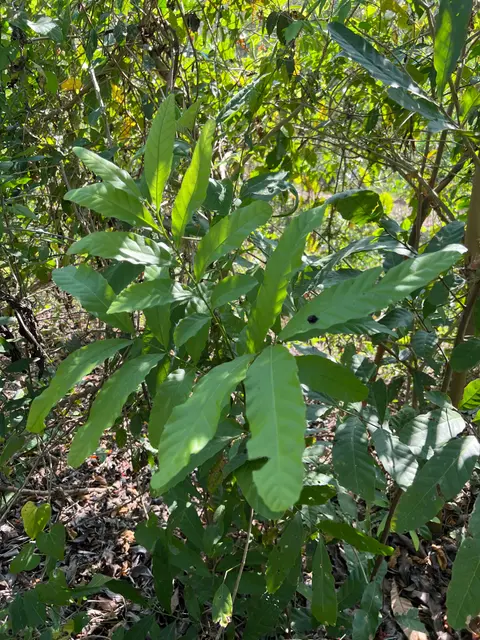
Somewhere in the forest of Fundación Loros, among fallen trunks and dry leaves carpeting the ground, Michel Salas stopped before a plant that barely reached his knees. It was a young Vara Santa —Triplaris sp.— with leaves as green and glossy as if they had just been polished, veins etched across their surface like rivers on a map, and a stem with that deep red-purple hue that plants carry when they are still learning to grow. At first glance, just another understory plant. But Michel looked more closely.
Across the stem and among the leaves, ants moved with that urgency particular to their kind — restless, without any apparent destination. It was no coincidence: the Vara Santa and the ants have been bound by a silent agreement for centuries. The plant offers them shelter within its hollow stems; the ants, in return, defend it. And in this forest, that defense has real value: the Vara Santa's flowers are so striking that without their guardians, someone's hand would have plucked them long ago.
Michel documented the find with photos and video before moving on. A young plant, a colony of tireless ants, and a small pact that has been holding steady for some time now — right there, at coordinates 10.4411, -75.2575.
Two Nightshades and an Insect Without a Name
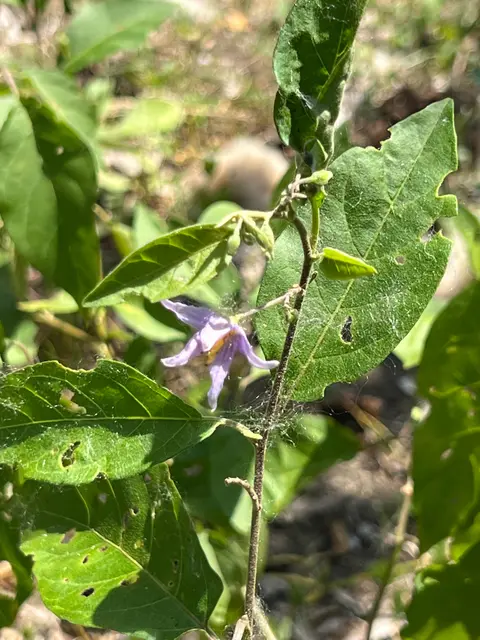
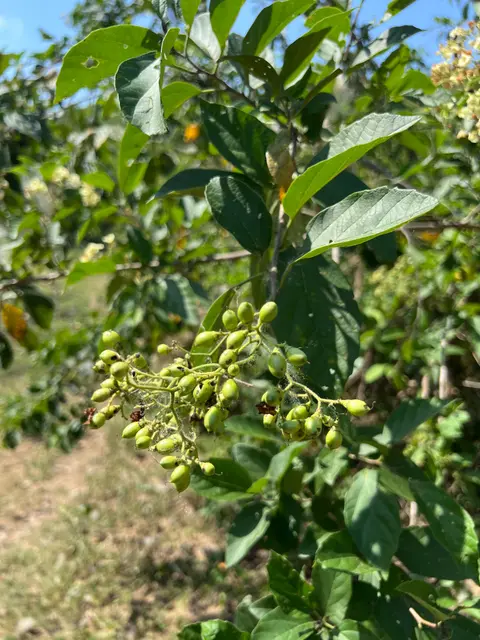
On the Loma del Halcón, Michel Salas found what the dry scrubland keeps without announcing itself: two species of the same genus growing among the leaf litter and bare earth, each speaking its own language of color. The white-flowered one turned out to be Solanum torvum; the purple-flowered, Solanum subinerme. Both rooted in arid ground, both with leaves riddled by insects that fed and moved on without leaving a name.
The six photographs Michel brought back say more than words managed to that day. In one of them, resting on the small green fruits of Solanum torvum, sits an insect of reddish and orange hues that still has no identification in our records. It is there, motionless, as if waiting for someone to give it the name it deserves.
That detail remains open. For now, the Loma del Halcón adds two documented nightshades and a six-legged mystery that the team will have to untangle on the next outing.
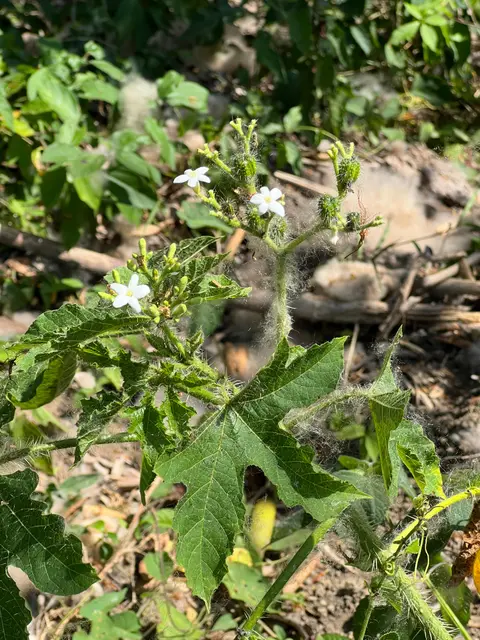
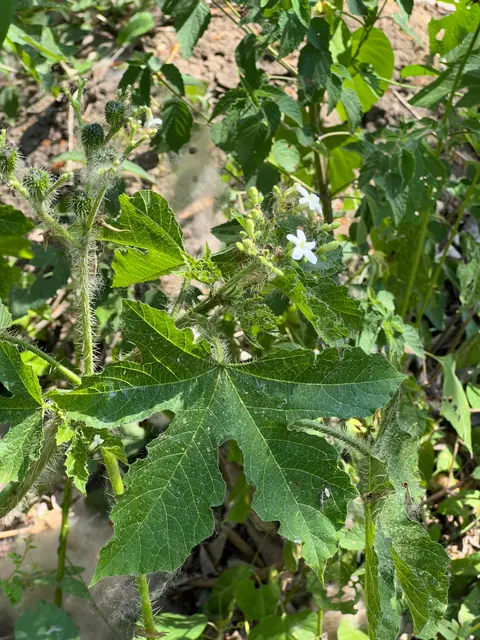
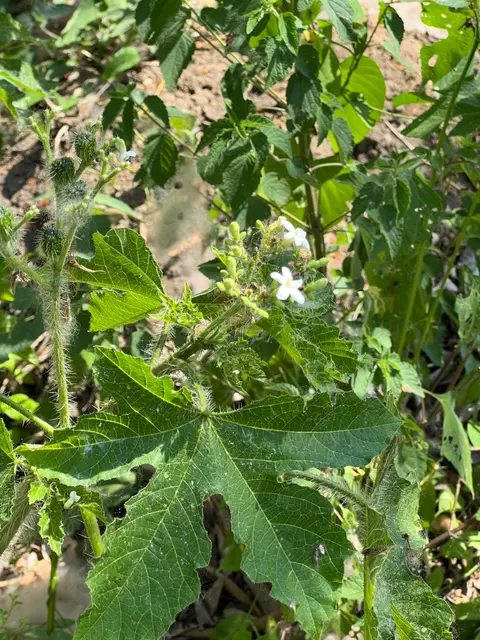
Michel Salas was moving through a scrubland area with dry, dusty soil when he came across it: a pringamosa (*Urtica urens*) well established and in full presence, its broad, toothed leaves and white-trichome-covered stems catching the late afternoon light like something lit from within. The plant grew among fallen branches and tangled vegetation — unassuming at first glance, and yet every warning it needed to give was written plainly across its skin.
Michel documented the plant through four photographs, each one drawing out a different detail: the small white flowers beginning to open near the top of the stem, the green fruits still in their earliest stages of development, and that unmistakable velvety texture that makes the pringamosa a master of its own defense. The location was logged with precise coordinates, in a semi-open stretch of the reserve where vegetation grows in a loose, unhurried mix with no apparent order.
*Urtica urens* is stinging by design: its trichomes function as microscopic syringes, delivering an irritating cocktail at the slightest touch. It is not a plant one overlooks twice. Michel recognized it, gave it its due respect, and recorded it. That, in itself, is enough.
Jorge Alcalá and Michel Salas were walking along the edge of the reserve when they found it: a Rauvolfia littoralis, the glossy-leaved shrub that the campesinos of this Caribbean coast call venenito, or simply solita. It was a new record for that particular spot — one of those discoveries that arrives without fanfare, appearing quietly at the bend of a trail, caught between shadow and the slow heat of the afternoon.
What makes this plant remarkable is not only its presence in the reserve, but the memory it carries. In the traditional knowledge of the region, solita has long been used as a remedy against snakebite — a knowledge that travels by word of mouth, from generation to generation, running parallel to any botanical manual ever written. To find it here, at these coordinates, is also to find a fragment of that living wisdom.
The sighting was recorded on March 29, 2026. No photograph yet — but documented with the precision of those who truly know how to read the forest.
Two Plants Without Full Names on the Loma del Alcón
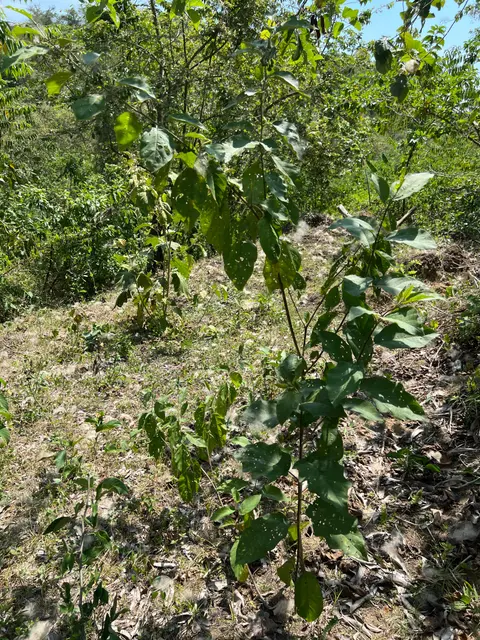
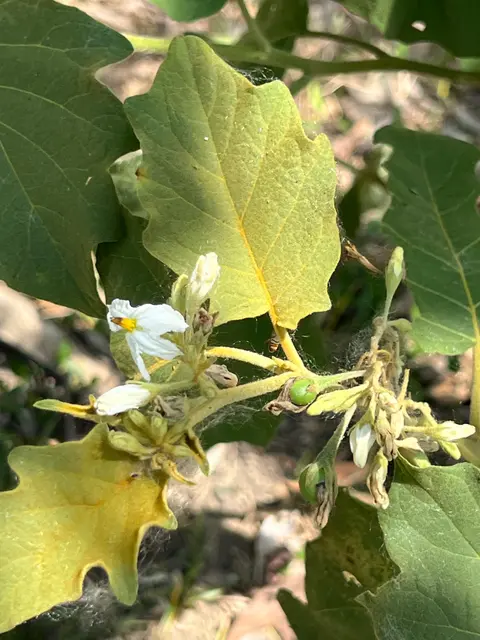
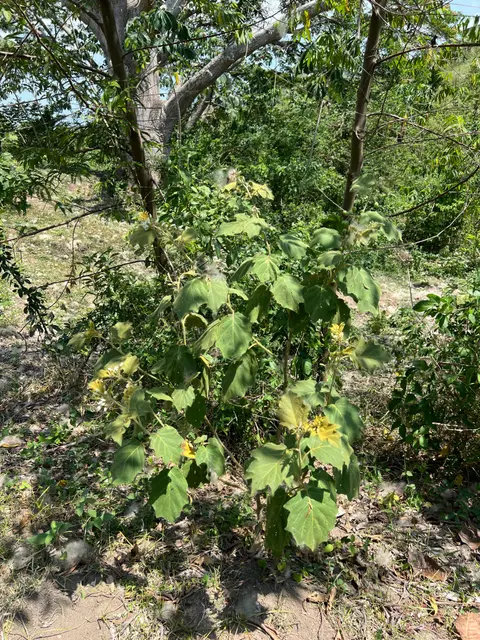
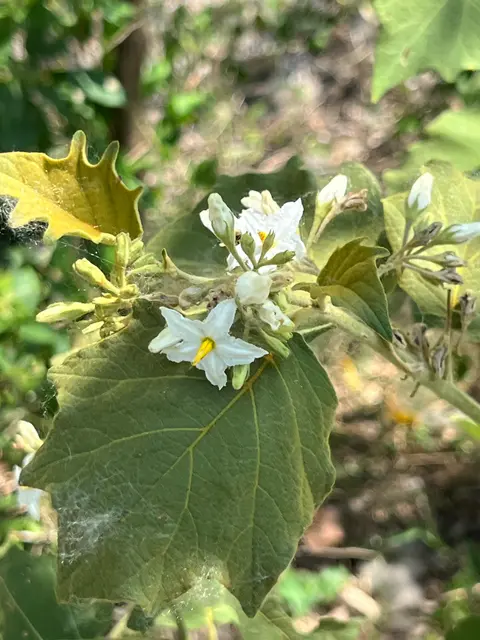
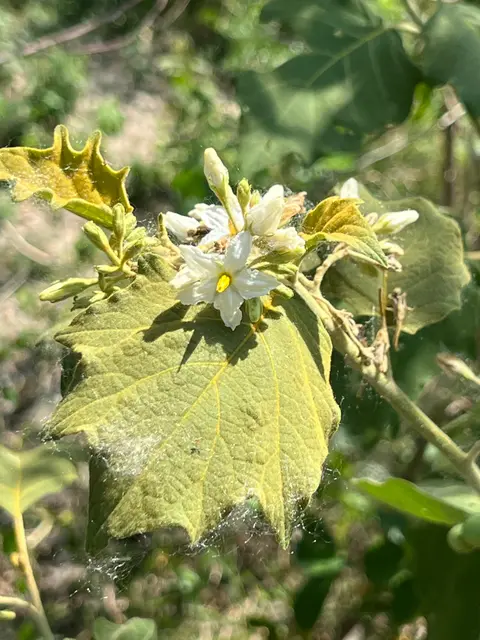
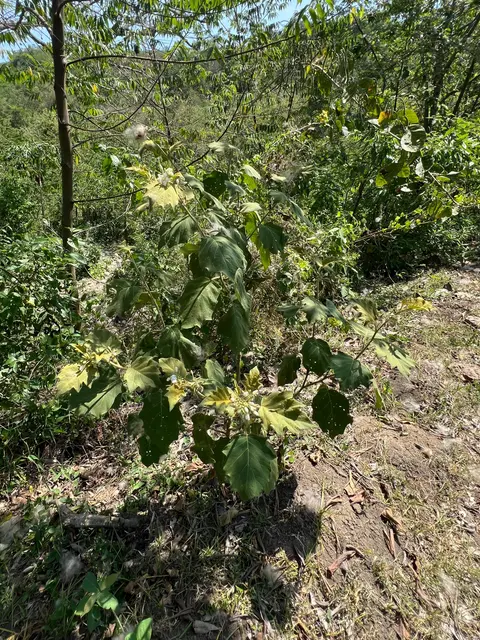
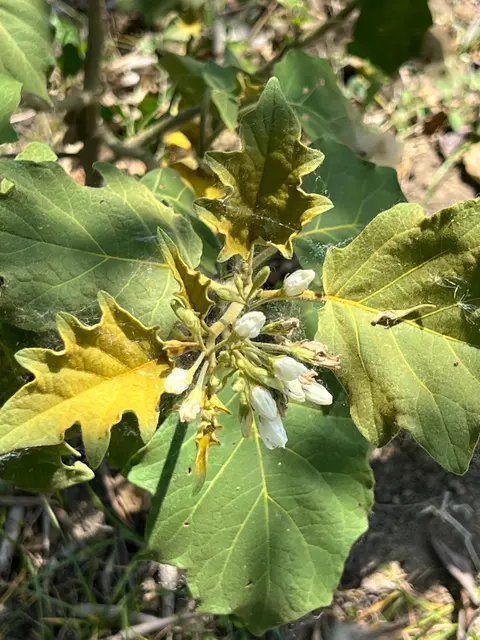
Michel Salas walked the Loma del Alcón yesterday with wide-open eyes. Deep in the dense understory vegetation, where light filters through in fleeting moments and the soil carries the rich scent of damp earth and leaf litter, he came across a plant of the genus Solanum bearing, all at once, small green berries clustered in bunches and white flowers with yellow centers — as though it couldn't quite decide between fruiting and blooming. Large, somewhat velvety leaves laced with threads of spiderweb completed the picture.
Further along, a mid-sized shrubby plant caught his attention, its larger white flowers peeking out between the branches. It's not Datura, Michel noted with certainty, though the resemblance from a distance can easily mislead. For now it remains logged as an unidentified species — one of those open questions that the forest of Fundación Loros holds quietly in reserve, waiting for someone to give it a name.
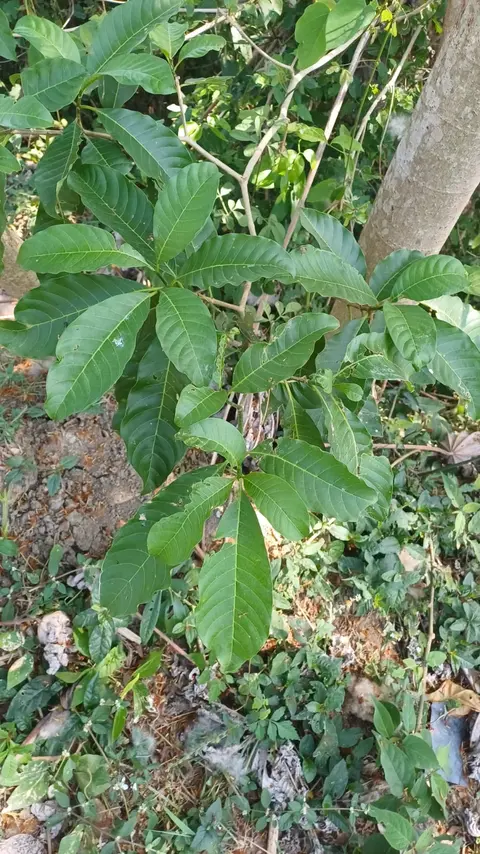
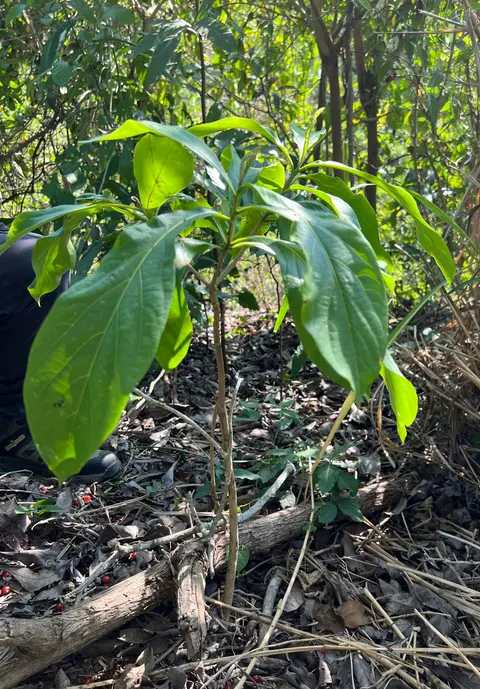
Walking through the dry leaf litter and scattered stones of the forest, Jorge Alcalá and Michel Salas came upon it without warning: a young individual of Cojón de Fraile (*Tabernaemontana cymosa*) growing alone, with no one having planted or tended to it. Its large, oval leaves — a deep green, etched with bold veins — were pushing their way up through the low undergrowth, while behind it rose the broad trunk of a taller tree, as though the forest itself were quietly taking the newcomer in.
This kind of spontaneous growth is a good sign. It means the soil, the shade, and the moisture of this spot are ready to receive new individuals of this native species. The find was recorded on March 29th, with photographs and precise coordinates — a small piece of data, yet one more thread woven into the living map that Fundación Loros builds, walk by walk, across these 520 hectares.
Black Berries with a Reputation for Healing Snakebites
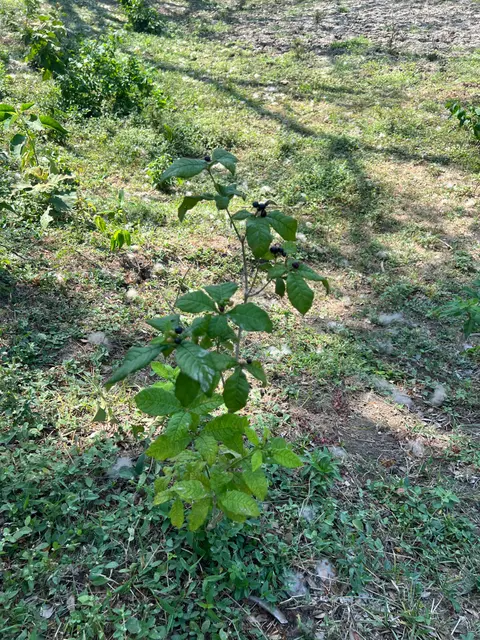
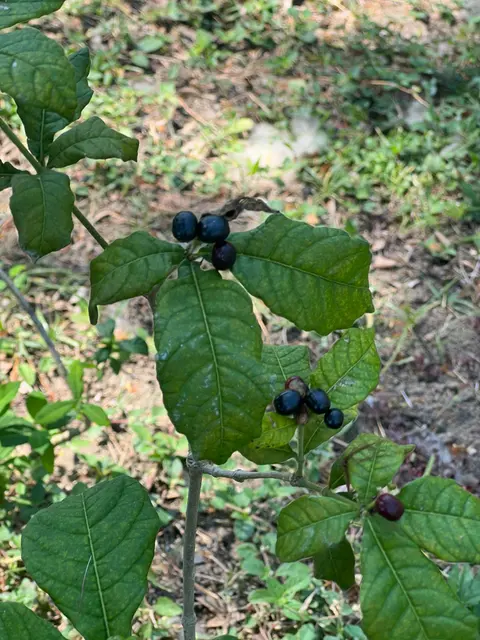
In an herbaceous corner of the reserve, amid the shadows of trees and half-dry grass, Michel Salas and Jorge Alcalá stopped before a plant still in the flush of youth: a single stem, broad green leaves, and a cluster of ripe black berries hanging among the branches like beads on a string. It was a Rauvolfia tetraphylla, a species belonging to the family Apocynaceae, and one that in this region carries a reputation passed from mouth to mouth among the rural communities: they say it can treat snakebites.
The find was recorded on March 29th at coordinates 10.44006, -75.25697, on a semi-open stretch of land where vegetation mingles without apparent order. The plant grew quietly, without announcing itself — as plants with a history tend to do. Rauvolfia tetraphylla is a species native to the American tropics, and while its traditional medicinal use is widespread across various communities, its toxicity demands respect: this is not a plant to handle without knowing what you are dealing with.
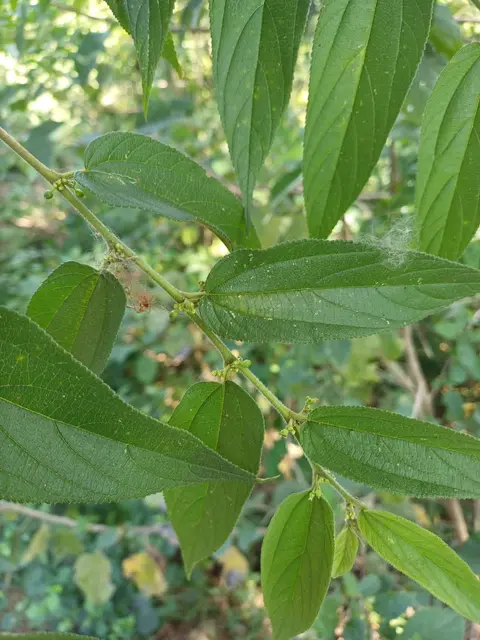
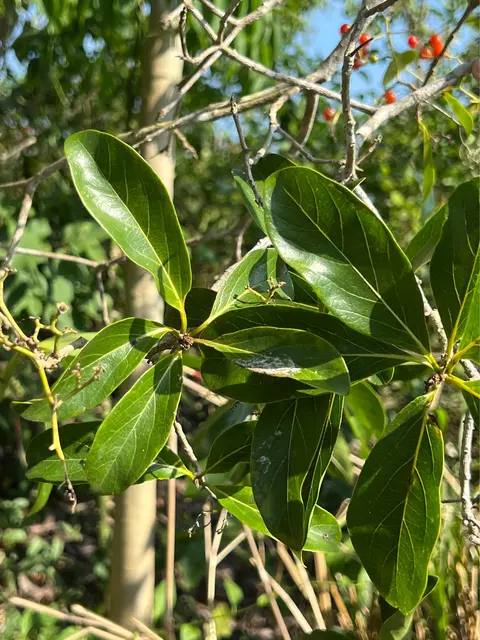
Jorge Alcalá and Michel Salas were making their way through the dense vegetation of the reserve when they came upon a young tree — slender-trunked, its branches reaching out to either side as though trying to embrace the forest around it. It was a Trema micranthum — though no one here calls it that. In this land they call it 'pajarito' or 'periquito,' names the local people have given it over time, surely because they know what comes when the fruits ripen.
That day the little fruits were still green, clustered tight along the stems between toothed-edged leaves and shafts of sunlight filtering down through the canopy. It wasn't time yet. But the name already says everything: this tree has an appointment with the birds of Fundación Loros, and when the season arrives, the Trema will keep it.
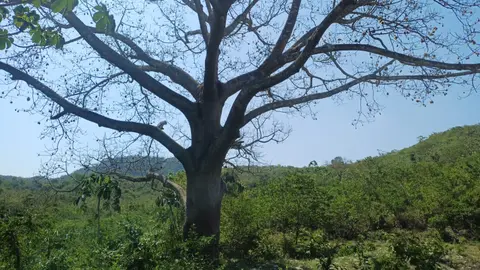
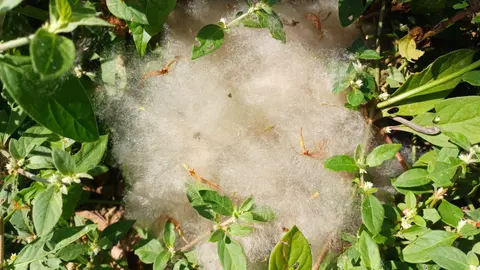
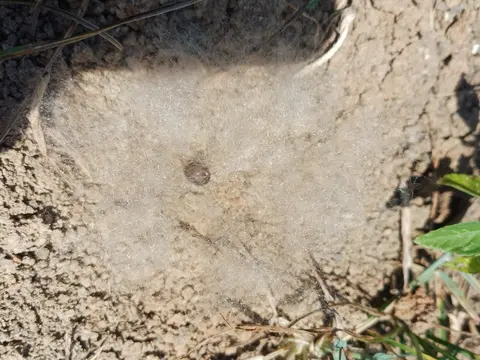
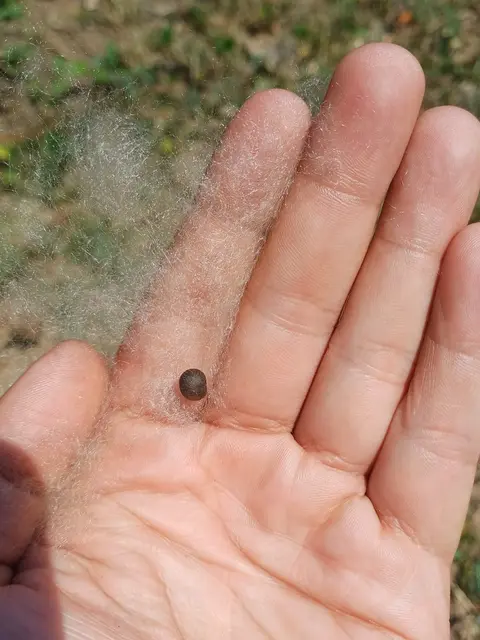
Beneath a clear sky and among branches stripped nearly bare, Jorge Alcalá and Michel Salas came upon a Ceiba pentandra today, deep in the dry season. The tree, imposing even without its leaves, was releasing its fruits — and from them spilled the kapok, that white, cottony fiber that swaddles the seeds and sets them adrift on the wind to travel wherever the air will take them. At first glance, it looked like a tangle of spider webs, but no: it was the ceiba doing what it does, scattering its offspring with the ease of something that has never needed to hurry.
While Jorge and Michel watched the seeds drift past, two Orange-chinned Parakeets — Brotogeris jugularis — had settled into the branches and were pecking at the green fruits with the unhurried confidence of animals who know exactly where to find a good meal. These small orange-throated parrots are regular visitors to fruiting trees, and today the ceiba bonga had set the table for them.
The record came out complete: tree, fruit, fiber, seed, and associated fauna — all found at a single point within the reserve. Sometimes the field offers up its discoveries like that, all at once, without any warning.
The Uvita Mocosa in Two Acts
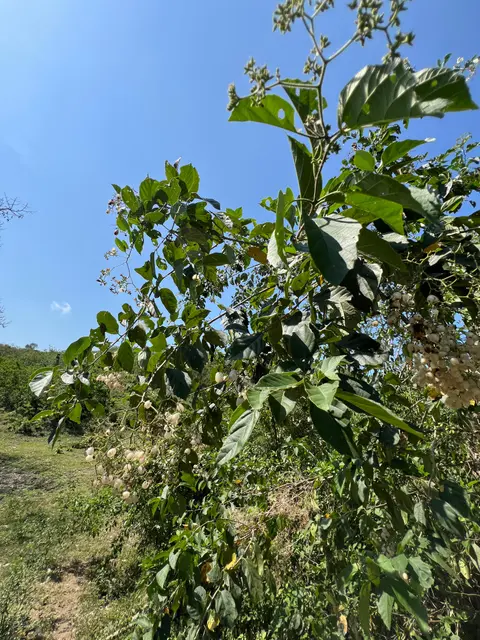
On the Loma del Alcón, Michel Salas and Jorge Alcalá came across a Cordia dentata doing what few trees allow themselves to do at the same time: flowering and fruiting at once. The uvita mocosa, as it is known along these trails, wore two moments of its life on the same branches — tight green fruits clustered together, gleaming under the March sun, and others already further along, carrying that white-cream hue that signals ripeness, hanging loosely among the leaves.
The clear blue sky of that Sunday made for a fine contrast with the greens of the sector, and the tree seemed indifferent to any observer, unhurried in its phenology. There was no fauna that day — no birds, no insects recorded — only the plant going about its business, and two researchers attentive enough to document it. The photographs captured both states with clarity: the green promise of the immature clusters and the pale fruit that had already traveled some distance along its path.
Let it be noted in the logbook: the Loma del Alcón has its Cordia dentata in full swing, and Michel and Jorge were there to witness it.
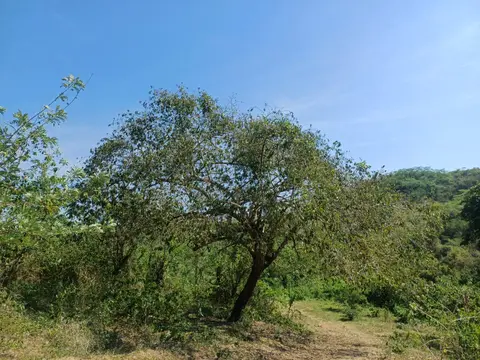
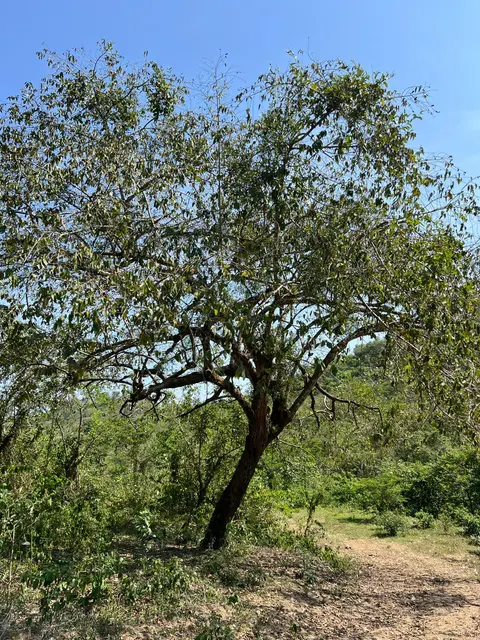
In a corner of sandy soil and low scrub, Jorge Alcalá and Michel Salas stopped before a guácimo growing on its own, branches spread wide like something that has spent years offering shade without anyone asking it to. The tree — Guazuma ulmifolia, for those who appreciate the scientific name — stood robust amid the dryness, its green canopy contrasting against a sky empty of rain clouds.
It's not a spectacular find at first glance, but those who know the bush understand that the guácimo is one of those working trees that makes no fuss: its fruit feeds the avifauna through the hardest seasons, and its roots bind the loose soils that wind and water would otherwise carry away, little by little. In terrain as dry and sandy as this, its very presence tells a story of quiet resistance.
The sighting was documented with photographs and coordinates. One more tree on the Fundación's map — and also a small proof that life holds on here, clinging to this ground.
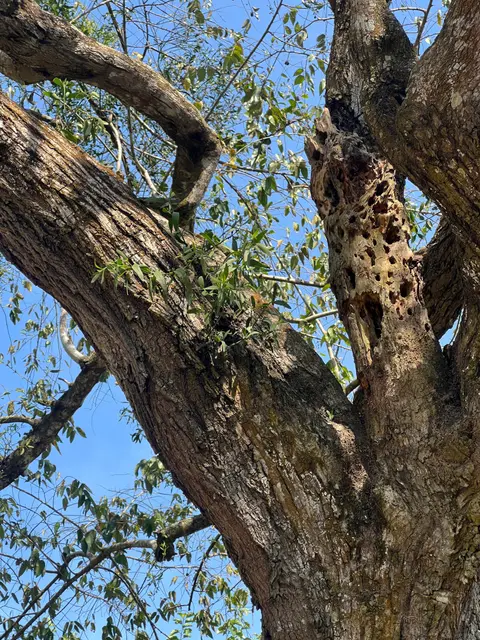
At Loma del Alcón, Michel Salas stopped beneath an old guásimo and looked up: the blue sky filtered through the branches more easily than it should have, because the canopy was thin. From below, everything was visible — the thick, rough trunk riddled with cavities carved out by woodpeckers or wood-boring insects, and tangled among the upper branches, the unmistakable silhouette of a Loranthaceae, that parasitic plant that drives its roots into another's wood and simply stays.
The tree, however, has not yet had its final say. Some branches still hold green leaves — a sign that somewhere inside, a current of life continues to move. But the picture is that of an organism under siege: the parasite claiming the canopy, the cavities hollowing out the trunk, the foliage retreating inch by inch. Michel took two photographs, recorded the coordinates, and noted down the find. Here at Loma del Alcón, this guásimo is now marked — still imposing, still holding on, but clearly under strain — so that the sanctuary knows where it stands and can keep a finger on its pulse.
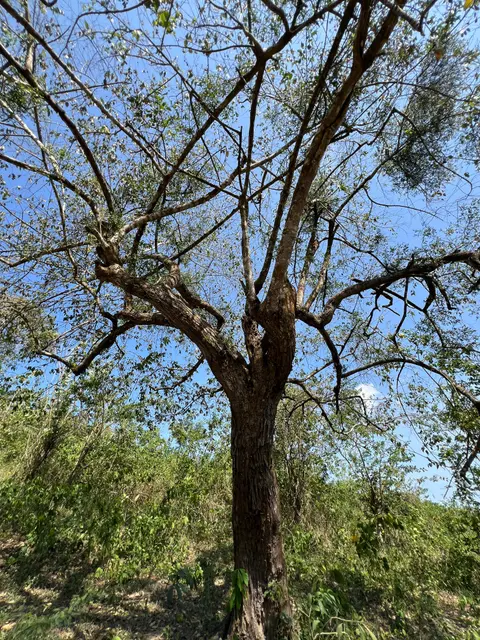
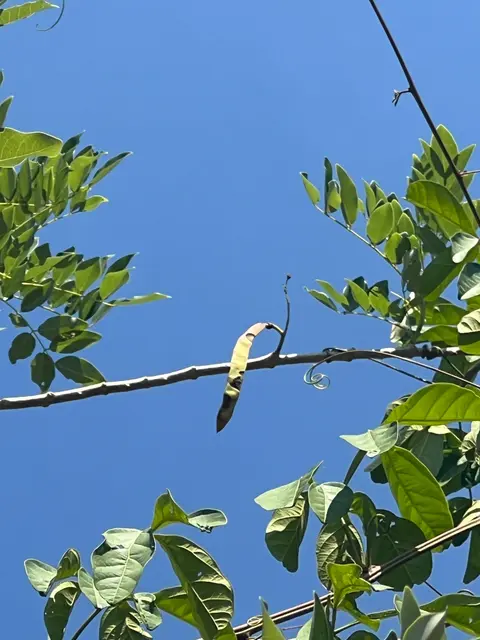
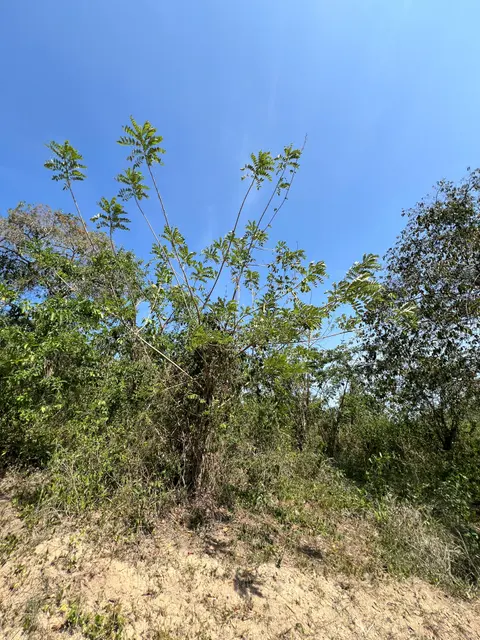
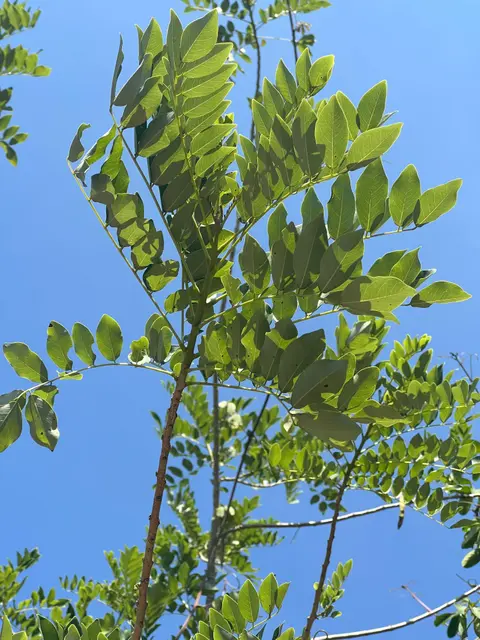
On Sunday, March 29th, Michel Salas ventured into one of the sanctuary's sandy-soiled zones with a clear purpose: to document the flora that grows in quiet communion between dry earth and the blue sky of the region. During that characterization survey, he stopped in his tracks before a well-formed matarratón — Gliricidia sepium — its bright green foliage kindled by the mid-afternoon sun, a single dry seedpod hanging from a slender branch like the last memory of a flowering long past.
With five photographs, Michel captured the tree from different angles: the pinnately compound leaves cut against an open blue sky, the savanna landscape that surrounds it, the branches spreading upward with that quiet generosity so characteristic of this species. The individual recorded was in good vegetative health, rooted firmly in its usual place, indifferent to the heat.
The matarratón is one of those trees the farmers of the coast know well: it serves as living fencing, as shade, as a means of restoring the soil. Finding it established within the area of influence of the Fundación Loros, at coordinates 10.4399, -75.2572, is a piece of knowledge now inscribed in the living map of the sanctuary.
The Shadow of the Guásimo Where the Birds Come to Rest
At a bend in the dirt road, Michel stopped for a moment and pointed: a medium-sized guásimo, its open branches spilling shade over a small bench someone had placed beneath it. The tree — Guazuma ulmifolia, known in these lands for its small fruits and resilient wood — stood alone against a cloudless blue sky, the low tropical undergrowth closing in behind it like a green curtain.
Alejandro noted the location and the species, but what Michel wanted to record was something more than a tree: it was the place itself. He said that many birds perch there, that the view from that spot is beautiful, and he proposed it become an official rest or refuge point within the reserve. That day there were no birds to report — only the still guásimo, the cool shade, and the road pressing on ahead — but the point was logged at coordinates 10.4400°N, 75.2572°W, waiting its turn.
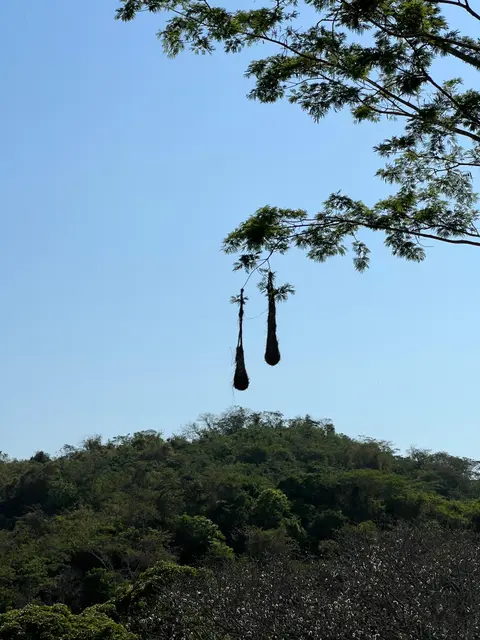
Michel Salas was walking among the hills of the sanctuary when he looked up and found this image: two hanging nests of the crested oropendola (*Psarocolius decumanus*) swaying from the branches of a *Pseudoalbizia neopodoides* — a multi-trunked tree standing in sharp relief against the blue afternoon sky. Higher up, in the uppermost branches of that same tree, a macaw had claimed its own space. One tree, two species, two nesting stories layered one upon the other.
Oropendola nests are unmistakable: long, woven from plant fibers, they hang like wind-filled pouches from the tips of branches. Michel recorded the discovery with two photographs and a video, documenting this uncommon neighborliness between the oropendola and the macaw — sharing, without apparent conflict, the same tree at coordinates 10.4398, -75.2573 within the reserve. This interspecific association in a single tree is precisely the kind of data that Fundación Loros' bird monitoring program seeks to gather: quiet proof that the forest is alive and intricate, and that every tree can be a world unto itself.
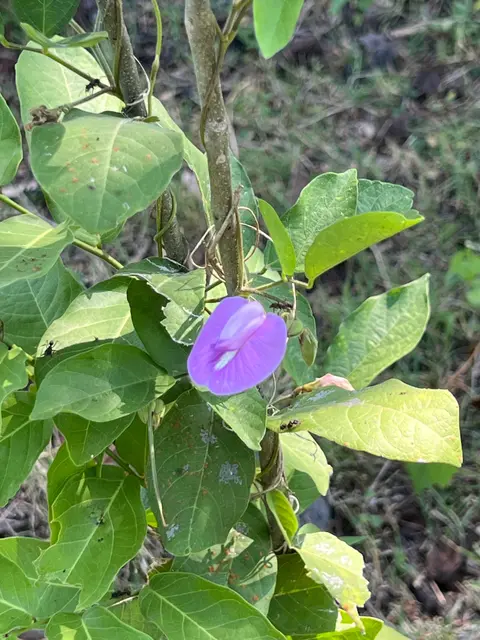
Michel Salas was walking through the reserve when purple stopped him twice. The first time, it was an Ipomoea — morning glory, campanilla, call it what you will — coiled with purpose around a branch, opening its violet flower to the midday sun. The leaves bore the bite marks of some insect that had passed through before him, and a column of black ants patrolled the stem from top to bottom, indifferent to the camera.
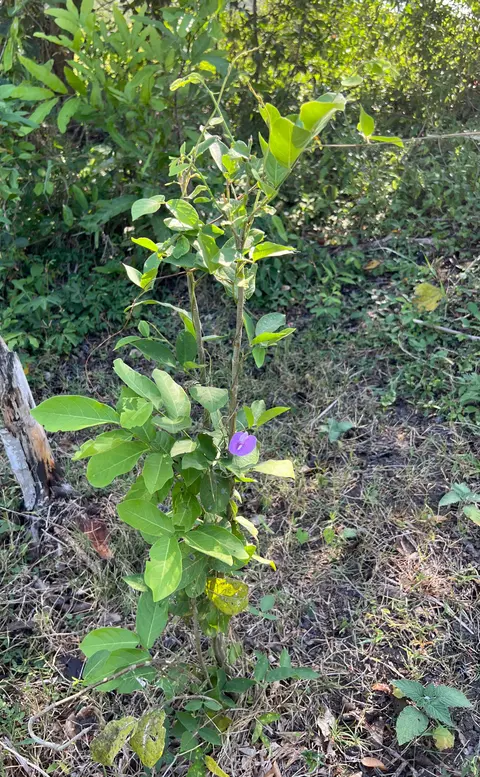
A few steps further along, almost hidden among dry grass and fallen leaves, Michel came across a young plant shyly raising what appeared to be a Clitoria ternatea — butterfly pea — the very same shade of purple, as if both species had agreed on a color without ever having met. The surrounding ground was that dense, untamed scrub that defines the quieter corners of the Fundación Loros' 520 hectares, near Cartagena. Michel photographed them both, sent through the coordinates, and went on his way. Sometimes the field speaks like this: without warning, in purple.
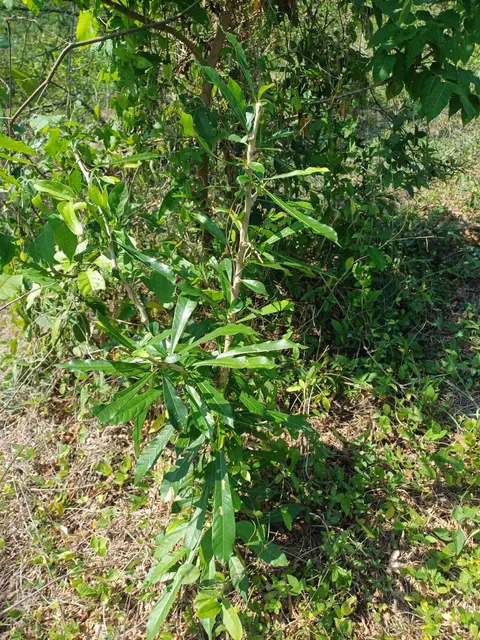
There are things the forest does without anyone asking. Jorge Alcalá and Michel Salas were walking through the understory of the sanctuary, in the northeast corner of the reserve, when they saw it: a young totumo — Crescentia cujete — rising from the earth entirely on its own, with no human hand to sow it or coax it along. Lance-shaped leaves, bright green, standing firm over a bed of dry leaves surrounded by dense vegetation. It was born alone.
The totumo is a tree of deep history in these Caribbean lands. From its round fruits, indigenous peoples carved totumas and maracas; today its seeds travel with the wind and with the animals that carry its fruits. That one should have chosen this corner of the sanctuary to take root is, in itself, a sign that the place holds what life needs to hold on.
Jorge and Michel photographed it, noted the coordinates, and left it exactly as they found it. Sometimes fieldwork is just that: discovering what is already happening, and bearing witness to it.
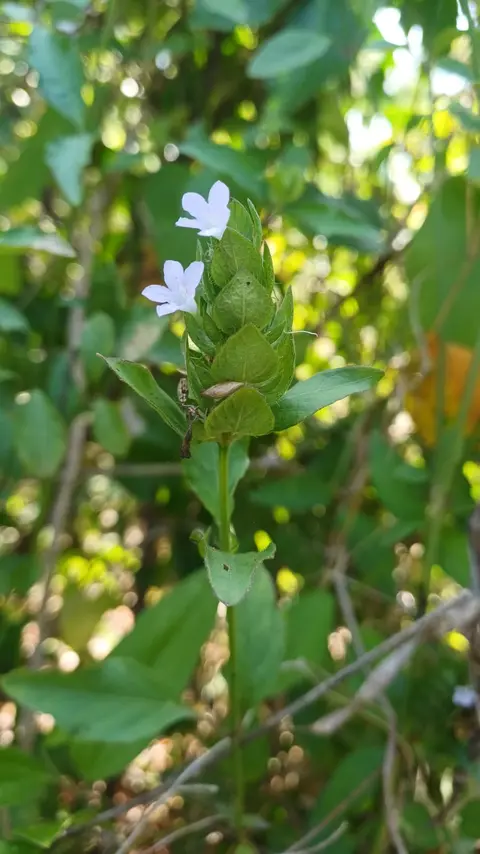
Jorge Alcalá was walking through the understory of the reserve when he found, among the green and humid half-light, a modest cluster of four-petaled white flowers: Ruellia blechum, native to these hills, known better by the bees than by anyone else. It was the 29th of March and the afternoon heat pressed down, but there, in that shaded corner of the Fundación Loros, the plant was blooming without fanfare — as if it had always been waiting, quietly, to be written down.
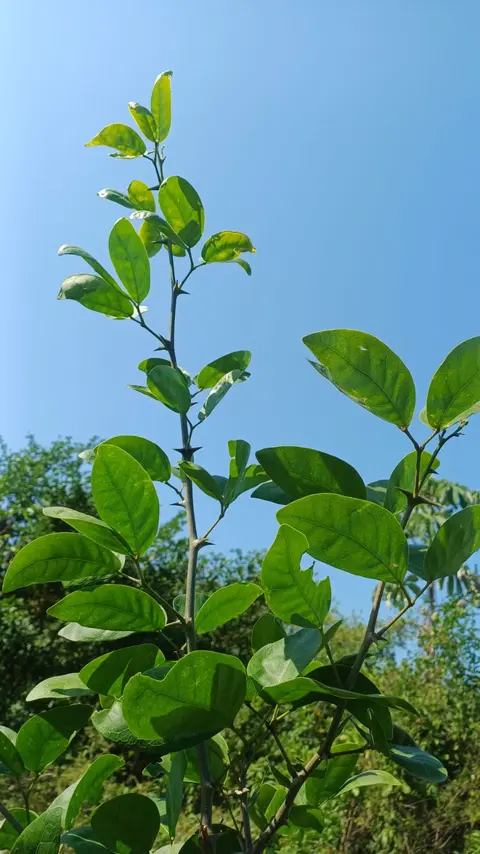
Further along, out in full sunlight, Jorge came upon a different plant: thorny, with oval leaves carrying that particular sheen belonging to plants hardened by relentless sun. There was a moment of uncertainty — Caesalpinia? another genus altogether? — until the team settled on Pithecellobium. The exact species remains open; for now the genus is enough, and the plant is logged with its mystery intact at coordinates 10.43985, -75.2576917.
Two species, one walk, and the Sunday afternoon closing itself slowly over the reserve.
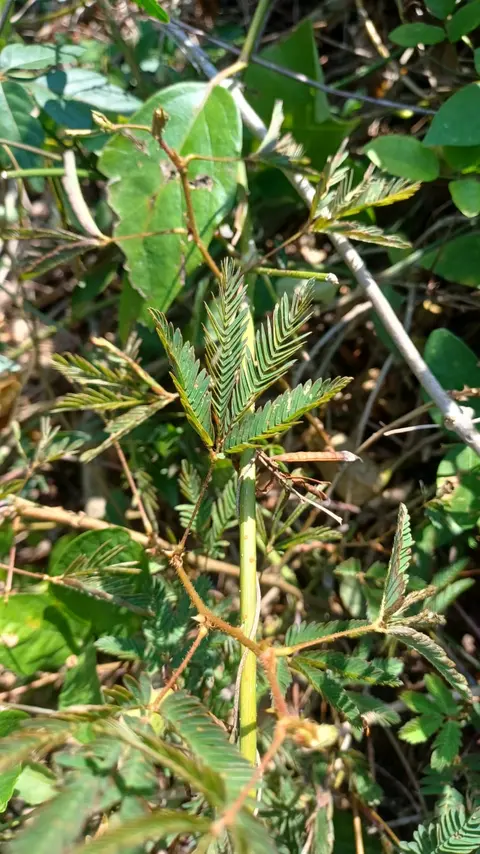
There are plants that prefer silence and the brush of a hand. This Sunday, Jorge Alcalá and Michel Salas were walking through the reserve's dense vegetation when they came upon one of them: the dormidera, that Mimosa pudica whose most famous habit is written into its very name. There it was, woven among other wild plants, its bipinnate leaves spread open like small green feathers, its stems armed with tiny thorns.
Light filtered down through the canopy as Jorge and Michel documented the specimens before them: the symmetrical leaflets, the deep green that seemed almost to glow, the perfect order of that botanical architecture which, at first glance, looks so delicate. The dormidera is a plant of disturbed soils and roadsides, and its presence in this corner of the reserve speaks to how wild life claims every available space — with or without anyone there to witness it.
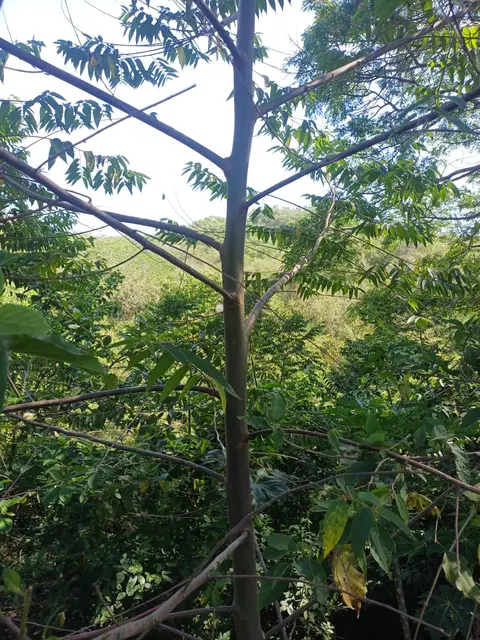
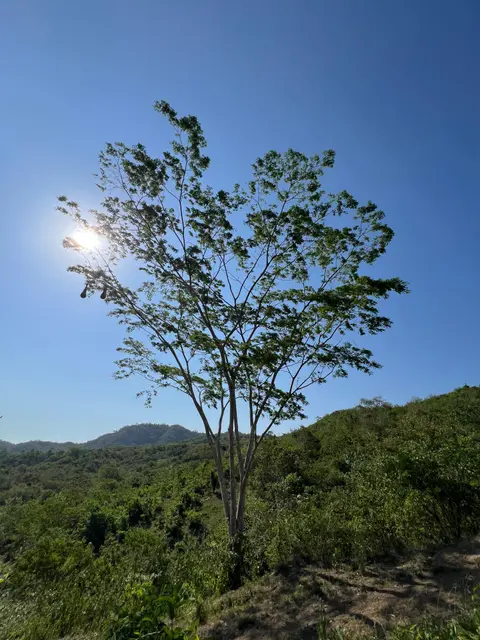
Nobody planted them. Nobody transplanted them, watered them, or fed them fertilizer. The two guarumos that George found at the coordinates in the southern sector simply appeared, the way pioneers do: without warning, blazing a trail. They rise above the scrubland on their enormous umbrella-shaped leaves, cut against a sky of unbroken blue, and from a distance they already stand out above everything else.
The guarumo — Cecropia peltata — has that habit: arriving first when the forest begins to remember that it was once a forest. It is the species that opens the door for all the others, the one that tells the soil it is allowed to come back. And for the birds, it is shelter and pantry alike; several species of the local avifauna depend on its fruit and its shade. That two of them should have sprouted on their own at this particular spot is, for the team at the Fundación, a sign that does not go unnoticed.
Two trees. Coordinates logged, photograph in the record, data saved. Small on the surface — but in the language of spontaneous restoration, this is the beginning of something.
Michel Salas and Jorge Alcalá were out that afternoon doing plant surveys when they found it: a Passiflora climbing unhurried over a Caesalpinia shrub, as if the forest had offered it a ladder made to measure. The sky was clear and the light fell directly on the bright green leaves, catching the slender tendrils the climber had wound around its host's branches.
The fruits were small and still green, far from ripe, but already hinting at what was to come. In the dense vegetation of that section of the sanctuary, where the forest keeps its own kind of order, this meeting between two native species — the one that holds and the one that climbs — is precisely the kind of detail a plant survey brings to the surface: not a spectacular find, but the ordinary life of the forest doing what it has always done.
In the mid-afternoon of Sunday, March 29th, Jorge Alcalá and Michel Salas were walking through one of the secondary vegetation sectors of Fundación Loros when the deep yellow of some flowers stopped them in their tracks. It was Senna fruticosa, a shrub of the legume family, which that day wore its open blossoms and its well-formed green pods all at once — flowering and fruiting simultaneously, as if the plant wished to display everything it was capable of giving.
It was not alone. Moving among the flowers were several bumblebees — genus Bombus — going about their quiet work of foraging, moving from bloom to bloom with that calm, unhurried purpose that defines them. Behind it all, the hillsides lay draped in dense vegetation beneath a blue March sky. Jorge and Michel took five photographs and left a record of this small encounter between plant and pollinator, set within a landscape that continues, slowly and steadily, to heal itself.
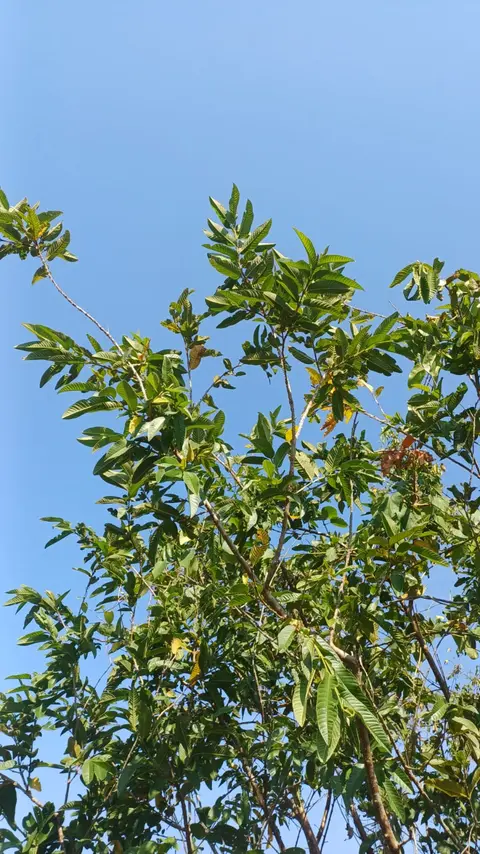
At the coordinates George marked that Sunday in March, there is a guava tree whose fruits have yet to ripen. The green clusters hang among the foliage beneath a sky without a single cloud, while a few yellow and brown leaves on the branches betray the weight of the dry heat. No one was visiting at that moment — no bird, no mammal — but the tree stood there, still and heavy with promise.
The record wasn't made out of urgency or surprise discovery. George noted it as a reference point: a food source that the sanctuary's wildlife will be able to find once those fruits make their passage from green to pale yellow and the sweet scent begins to call. The guayabo (Psidium guajava) is one of those trees that works in silence, building its sugars slowly, until one day it becomes the center of everything.
The point has been marked on the map. When the fruits ripen, we will know where to look.
The Pata e' Vaca That No One Had Ever Written Down
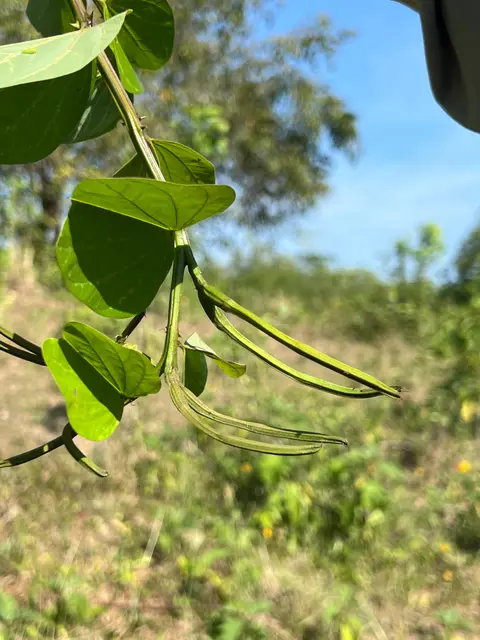
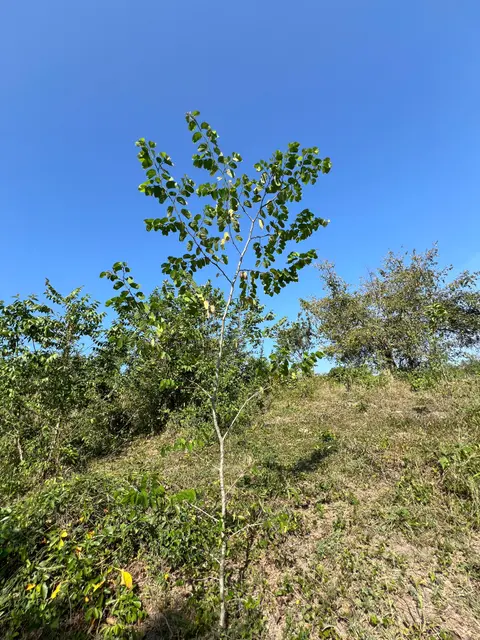
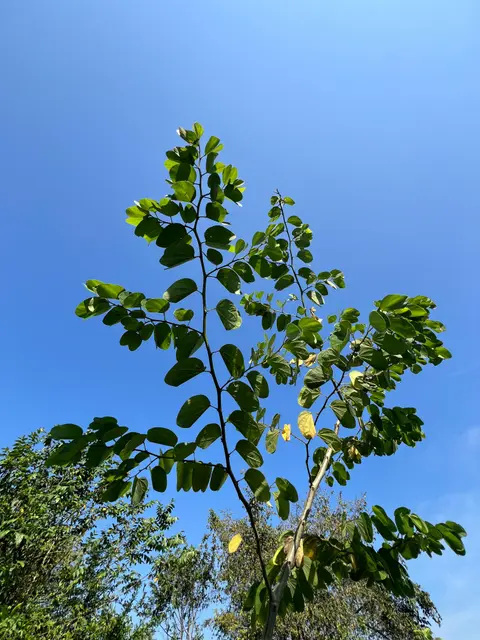
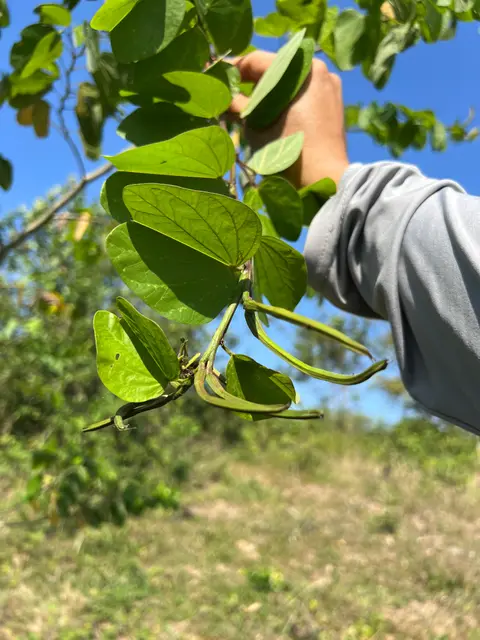
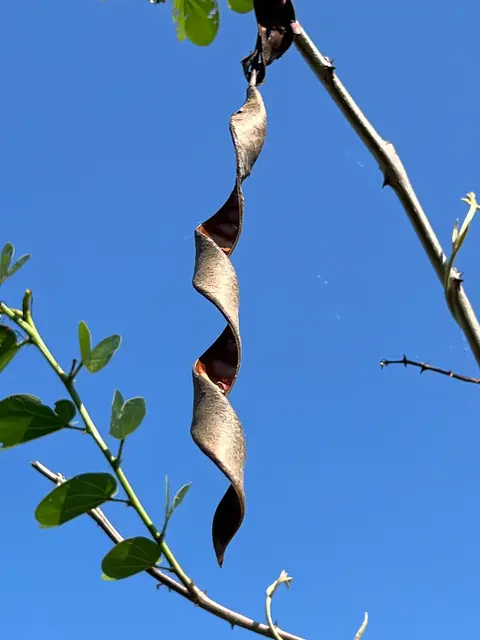
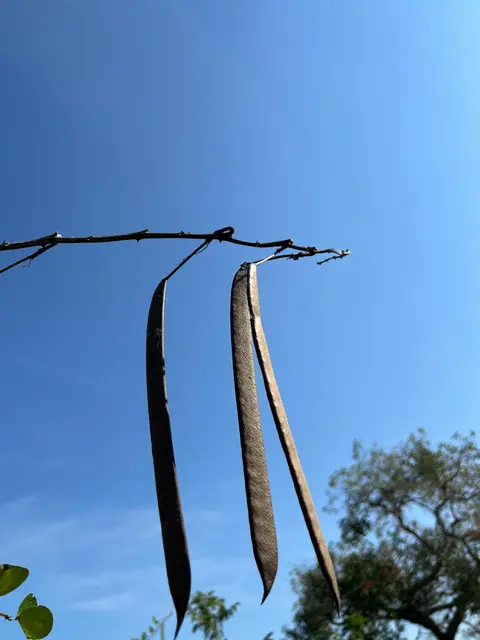
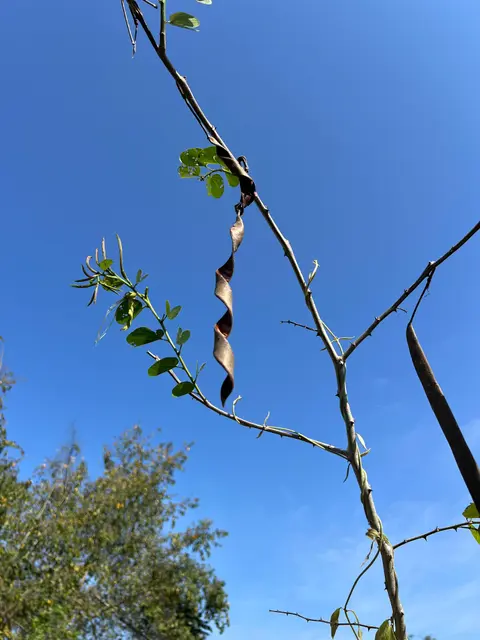
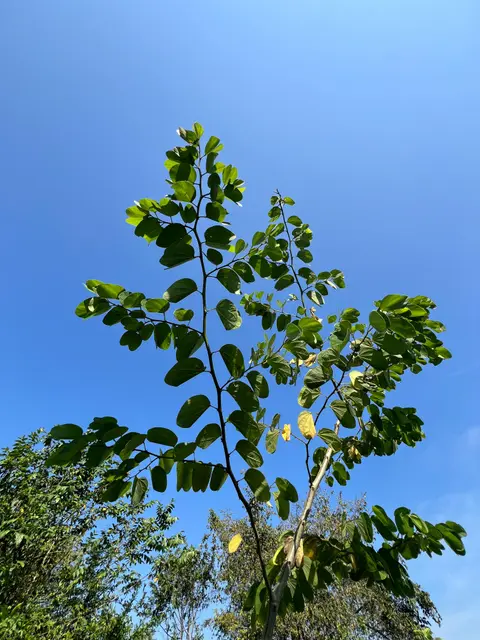
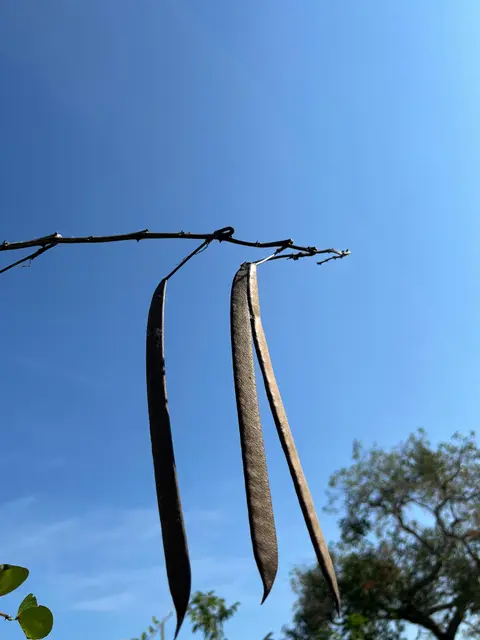
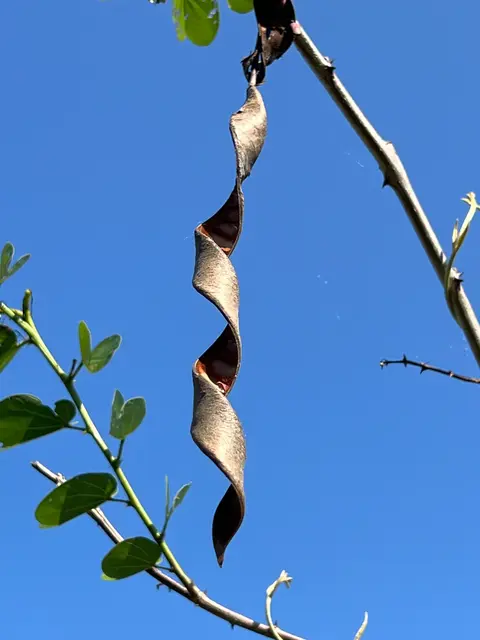
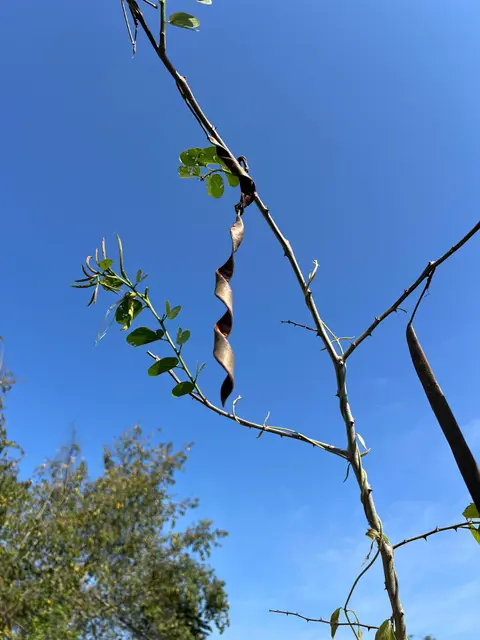
On the morning of March 29th, Michel Salas and Jorge Alcalá made their way into one of the reserve's open pastures, where the dry grass cracks underfoot and the sun bears down without mercy from early in the day. Among the low, scattered vegetation, they found what they were looking for — or perhaps what they never expected to find: several individuals of Pata e' Vaca (Bauhinia sp.), a native legume that has been quietly growing in this corner of the savanna for centuries without anyone ever setting it down in a record.
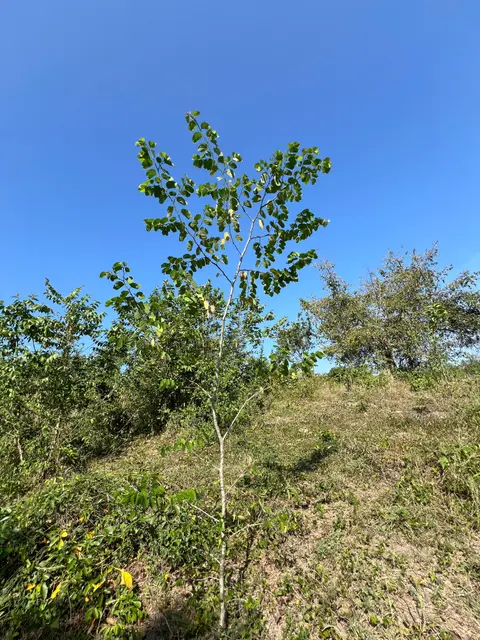
The plant received them in different stages of its life, as if it wanted to show itself whole: slender young trees standing against a blue sky, branches heavy with green leaves and yellow flowers or fruits still fresh, swollen green pods beside dry ones that the heat had twisted into spirals, and branches lined with fine thorns — a quiet reminder that this plant is not only beautiful. Michel and Jorge documented it all in seven photographs taken from different angles, assembling a full portrait of the species across its cycle.
The discovery is now recorded at coordinates 10.4399°N, 75.2575°W, in that open landscape which at first glance seems empty, yet holds — between the grass and the wind — far more life than one might ever imagine.
In a corner of Los Montes de María, amid low shrubs and an open blue sky, Jorge Alcalá and Michel Salas stopped before something they hadn't expected to find: a young individual of Capparidastrum frondosum — the olivo negro — pushing up alone from the dry, rust-colored soil, unplanted by any human hand. Its large, glossy leaves stood in sharp contrast to the parched earth and creeping vegetation around it, as though the plant had simply decided, on its own terms, to take root here.
What makes this discovery remarkable is twofold. On one hand, it is natural regeneration in a tropical dry forest — an ecosystem where every self-seeded plant counts. On the other, the olivo negro is no ordinary species to the people of this region: it is known locally as "contra," holding a place in the surrounding tradition that reaches well beyond the botanical. That story — of a tree that rises unaided from difficult ground and that neighbors recognize by name — is precisely the kind of sign Jorge and Michel came here to document.
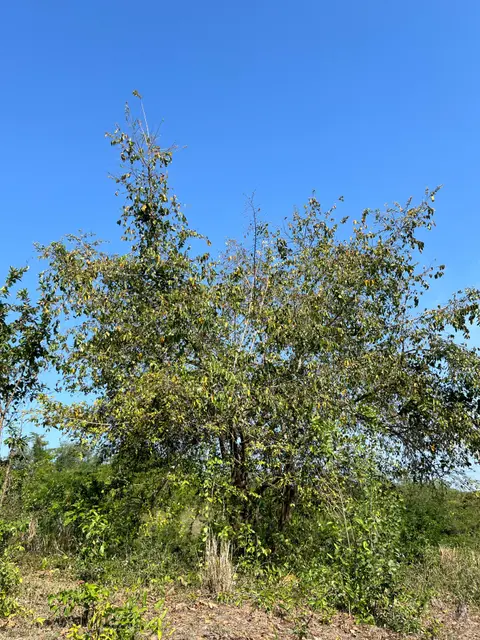
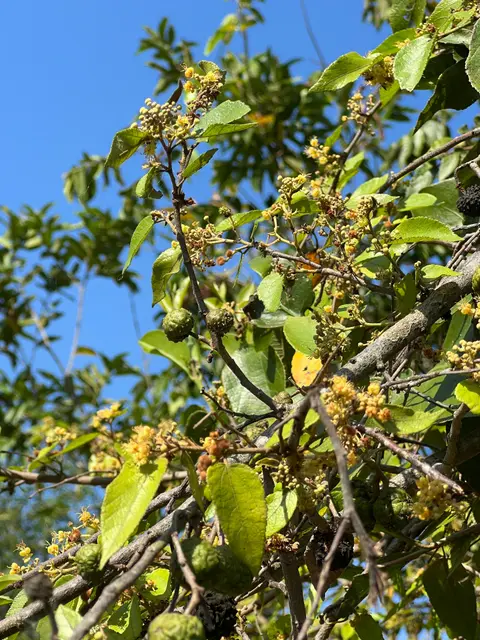
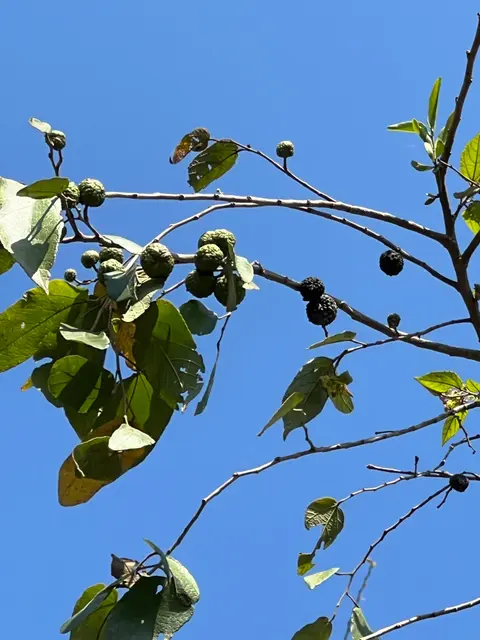
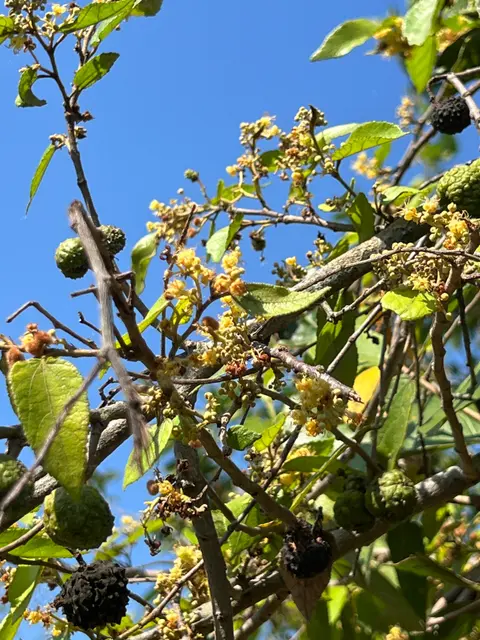
On an afternoon of unbroken blue sky, Michel Salas and Jorge Alcalá stopped before a tree that couldn't quite make up its mind between flowering and fruiting. It was a guásimo — Guazuma ulmifolia — standing alone in open rural land, the earth dry at its feet and its branches laden all at once with tiny yellow blossoms and rough-skinned fruits at every stage of life imaginable: the firm green ones, freshly born, and the black, desiccated ones that had already run their course.
They were not alone in that tree. Michel noted that the flowers draw in the reinitas — that restless little gang of the family Parulidae — while the fruits are a mandatory stop for the psittaciformes, the loros and their kin. One tree, two tables set, two entirely different groups of diners.
Five photographs were taken of the individual and its surroundings. The guásimo was recorded at coordinates 10.4399°N, 75.2576°W, joining the Fundación's living inventory as one of those quiet, unassuming trees that sustain far more life than anyone might guess at first glance.
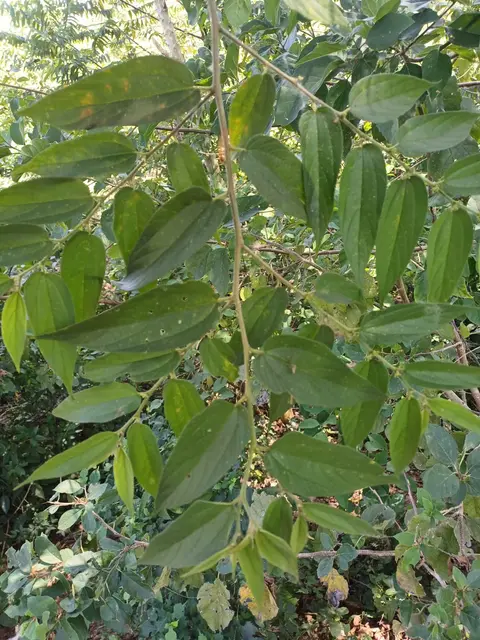
Michel Salas and Jorge Alcalá set out to walk the sanctuary with a botanist's eye. The day was given over to plant characterization — that patient work of stopping, looking, photographing, of giving names and records to what the forest has long known by heart. The coordinates led them to a stretch where vegetation mingles in different ages and forms: young shrubs, already-grown trees, and climbing vines that twist themselves between the two.
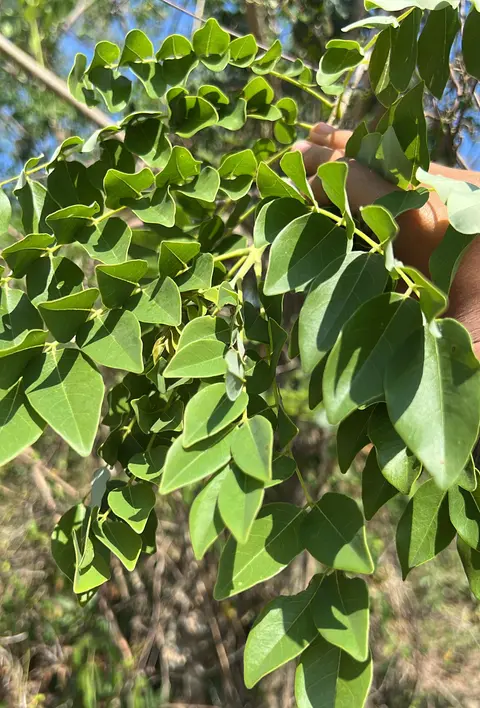
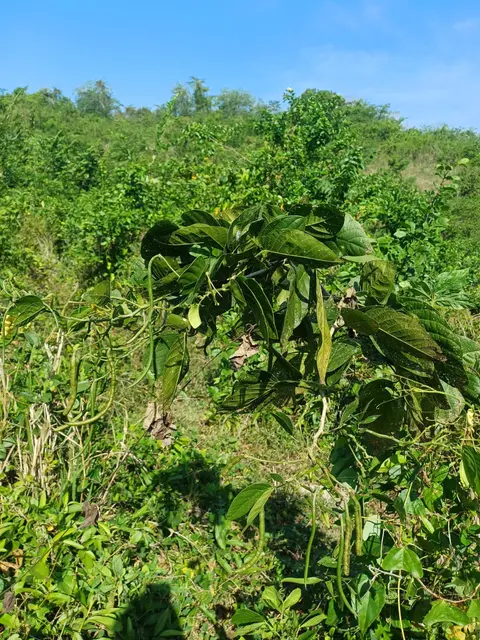
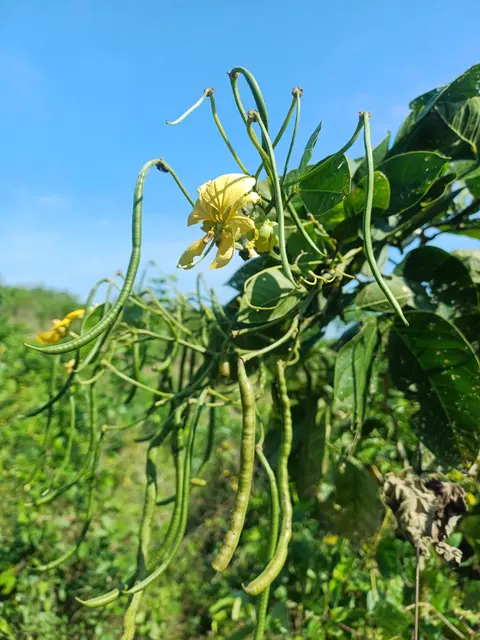
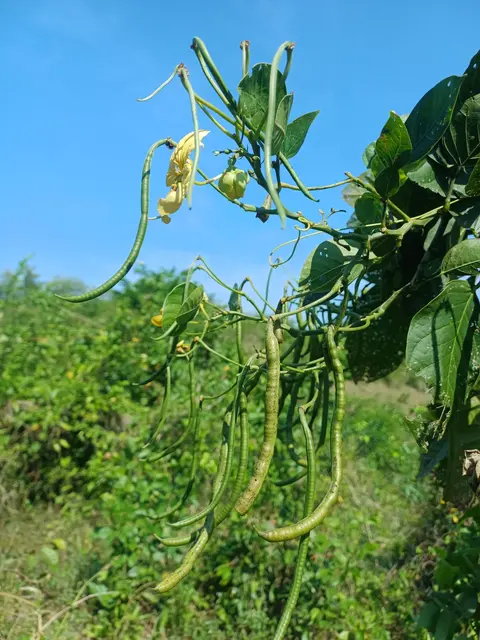
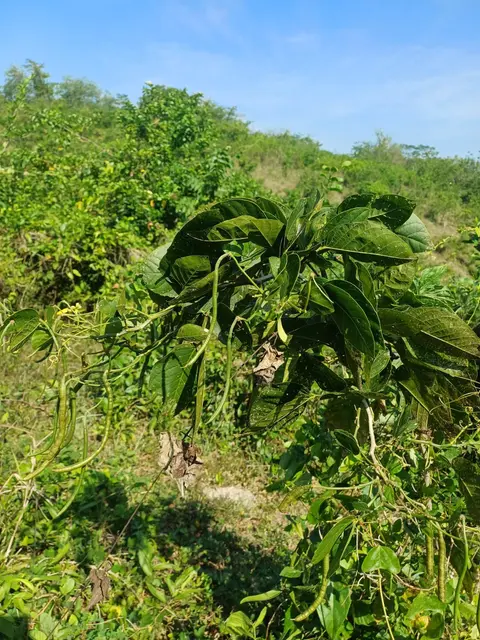
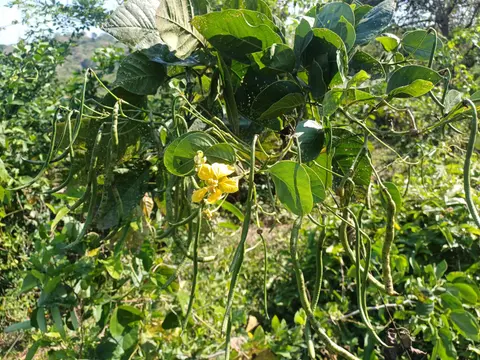
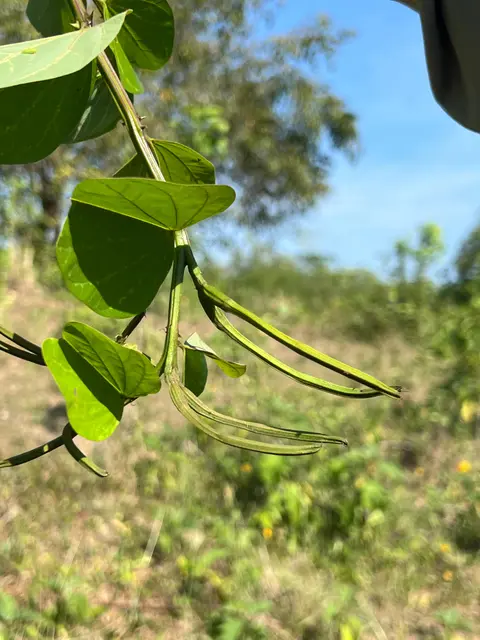
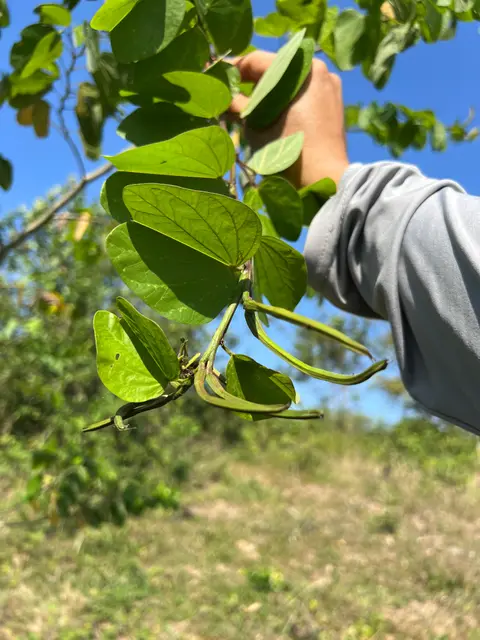
What they found, almost without meaning to, was an entire chapter of the family Leguminosae. There was the Pata e' Vaca (Bauhinia sp.), its leaves split into two lobes like footprints pressed into the air. A little further on, a tree with yellow flowers that seemed a likely Cassia, and a climbing vine bearing long green pods that hung suspended in the foliage. And then, twisted against the blue sky, the dried pods of what could well be a Prosopis or an acacia — hard, coiled in spirals, as though the fruit had learned to unwind on its own as it dried.
Seven photographs remained from the walk: young trees with all their future ahead of them, fruits at different stages of ripeness, and Michel's hand holding a branch to give a sense of scale. A quiet inventory, without fanfare — the kind that speaks to the plant life sustaining this corner of wilderness near Cartagena.
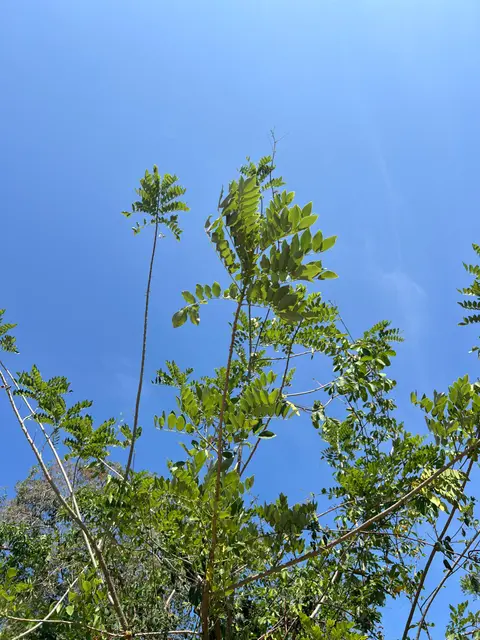
Michel Salas and Jorge Alcalá were walking along a gently sloping hillside, the blue March sky pressing close against the canopy, when they found something nobody had planted: a quebracho — Astronium graveolens — that had decided to return on its own terms. Someone had cut it down before. It doesn't matter when. Whatever was left of that stump held on to just enough to begin again, and there it stood, a mid-sized tree now, surrounded by wild shrubs and dry earth, as though nothing had ever happened.
The quebracho is the kind of wood the old-timers reached for when something had to last — fence posts, enclosures, structures that time wasn't meant to win against. But here, at this point in the reserve, its worth lies elsewhere: in the fact that it can grow to thirty meters tall, and in the fact that it is already finding its way there without anyone guiding it by the hand. The photograph Michel and Jorge took that Sunday shows it standing alone against the blue, no company around it, all the work still ahead.
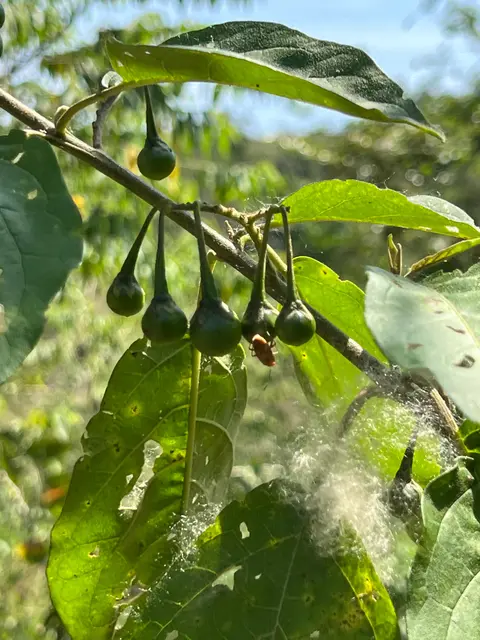
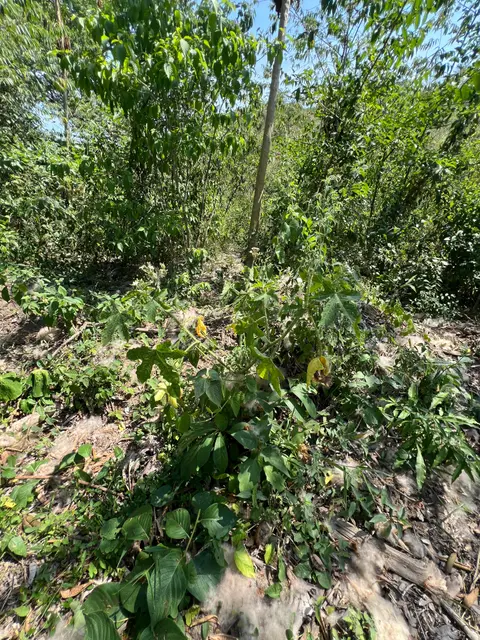
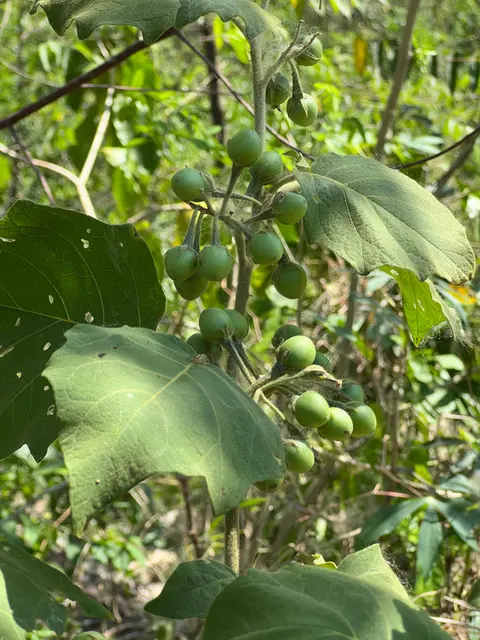
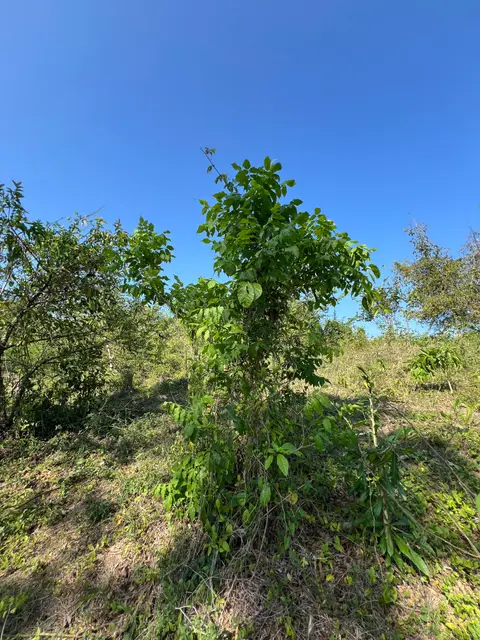
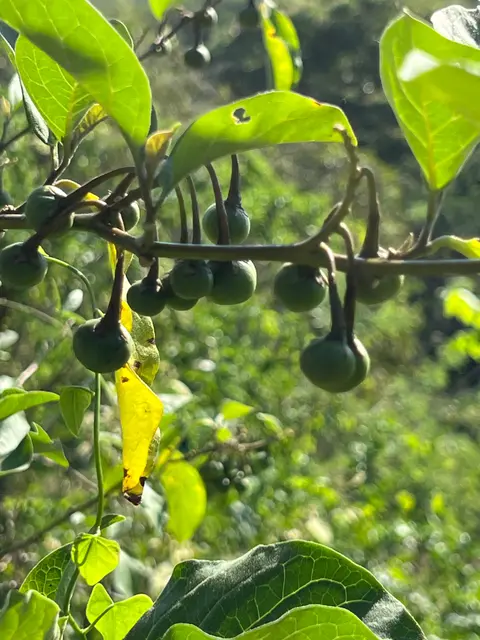
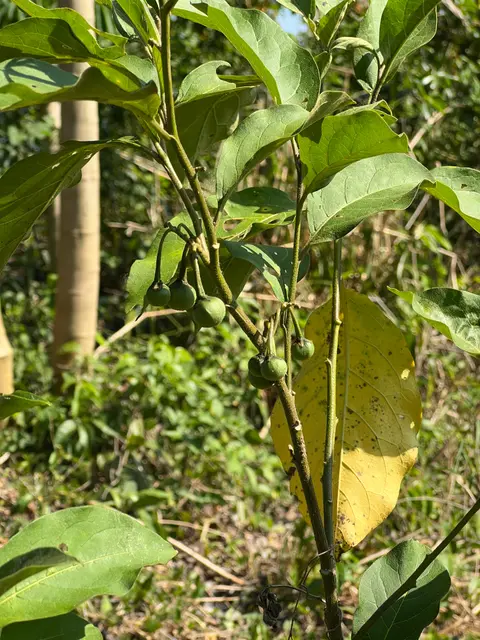
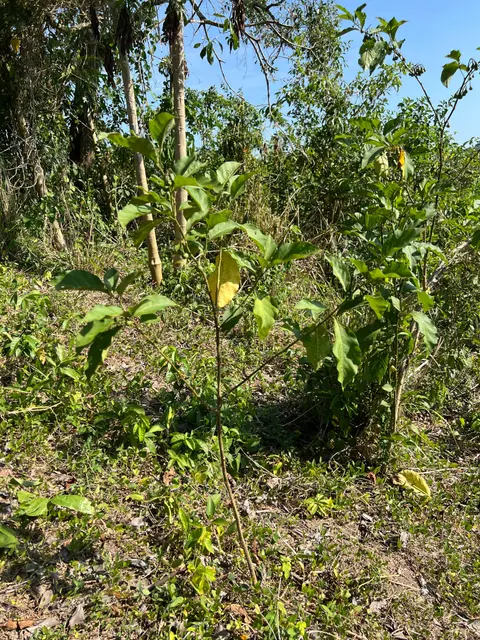
Amid the dense vegetation and the bamboo rising in the background, Michel Salas and Jorge Alcalá paused before an unassuming yet striking shrub: small, round green fruits clustered tightly together, catching the afternoon light as it filtered through the canopy. The dry, earthy ground beneath their feet, the clear blue sky above the treetops — everything pointed to an unrelenting day in the field, the kind where a trained eye finds what others simply walk past.
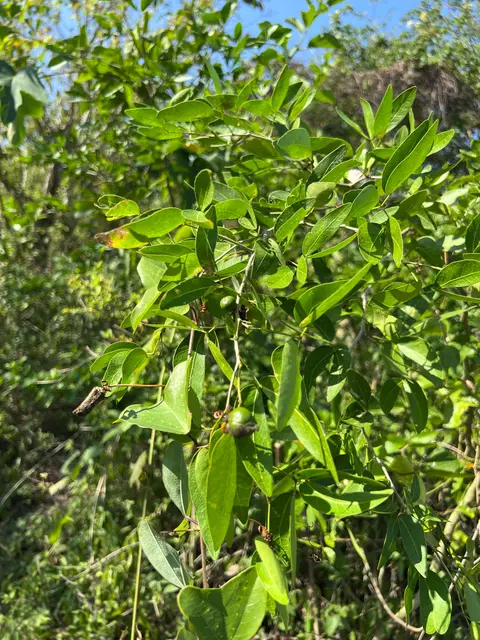
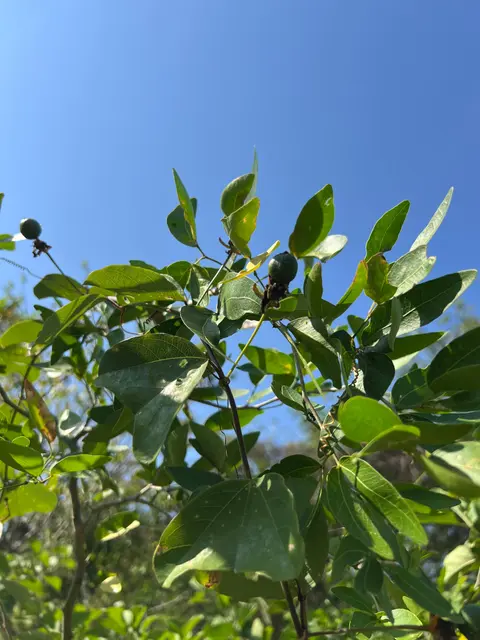
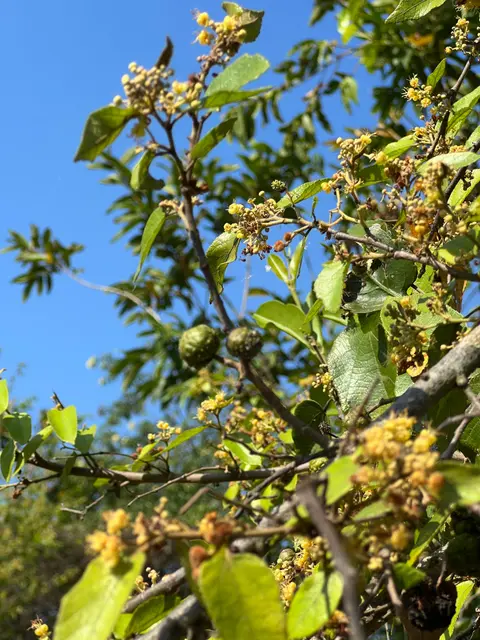
The plant belongs to the genus Solanum, family Solanaceae — a distant relative of the tomato and the potato, though here in this tropical forest near Cartagena it carries its own story. Some leaves showed yellowing at the edges, a possible sign of stress, while others shone with a deep, vigorous green. For now, the record stands at genus level; the exact species remains to be confirmed.
This is how knowledge of a place is built: one shrub at a time, a set of coordinates, two names, and the patience to return when there is more certainty.
Among the damp leaf litter and the half-light of the understory, Michel Salas came across a young specimen of Matayba scrobiculata, its broad, glossy leaves stretching wide to catch the little light that filters down through the canopy. The plant, known in these lands as Culo de Indio, was growing quietly in a dense stretch of woodland within the reserve, cradled by organic matter and the invisible murmur of a forest that is slowly rebuilding itself.
What makes this native tree of the family Sapindaceae so remarkable is not its stature — still young, barely announcing itself — but what it promises: its fruits are a vital resource for the local avifauna, a natural larder that draws birds in and sustains them across the seasons. For this reason, the species is also actively used in ecological restoration efforts, planting, one by one, the small links a forest needs to function again.
This record at coordinates 10.4399, -75.2573 is a welcome sign: the Culo de Indio is there, rooted, waiting to grow.
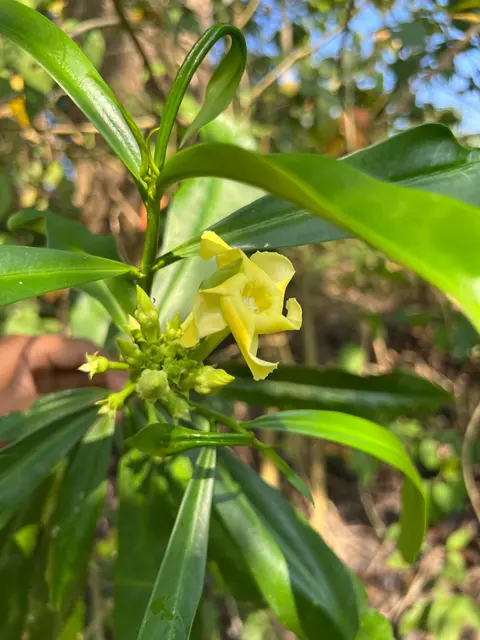
Among the dense vegetation of the sanctuary, Michel Salas paused before a shrub that deserved a closer look: the Bola de Gato, Thevetia ahouai, standing between two and three meters tall, its long, glossy leaves catching the light like green ribbons in the sun. It was a day of active flowering, and the plant made no effort to hide it — buds barely emerging, blossoms half-open, and one flower fully unfurled, all of it a tubular yellow that drew the eye even through the filtered light of the canopy.
It belongs to the family Apocynaceae, a lineage of plants that keeps its secrets: showy and striking on the outside, the Thevetia ahouai is also toxic in nearly every part of itself — hence, perhaps, its folk name Huevo de Gato, that curious blend of tenderness and caution. Michel photographed the find carefully, capturing the different stages of blooming, before logging the coordinates and moving on.
It is the kind of encounter that reminds you that within the 520 hectares of Fundación Loros there is far more than the eye can take in at a glance — sometimes all it takes is pausing where the yellow burns bright against the green.
The Muñeco That Already Has Offspring
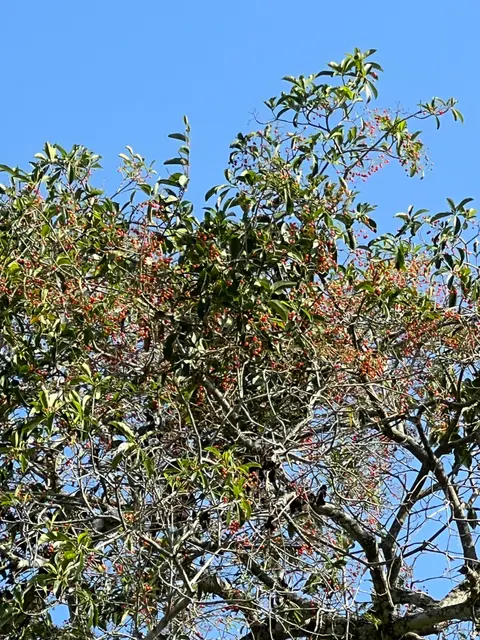
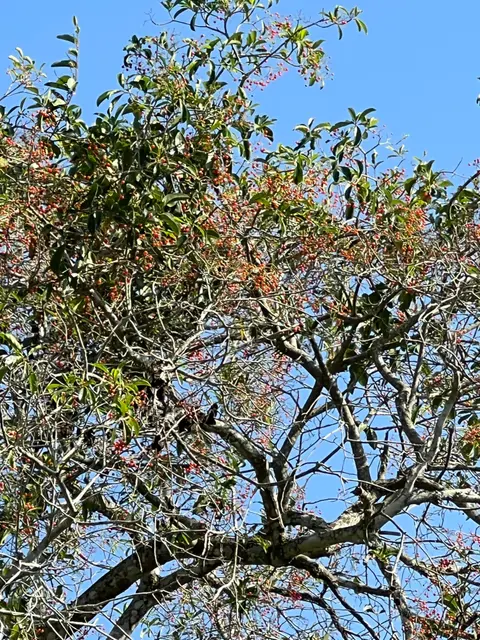
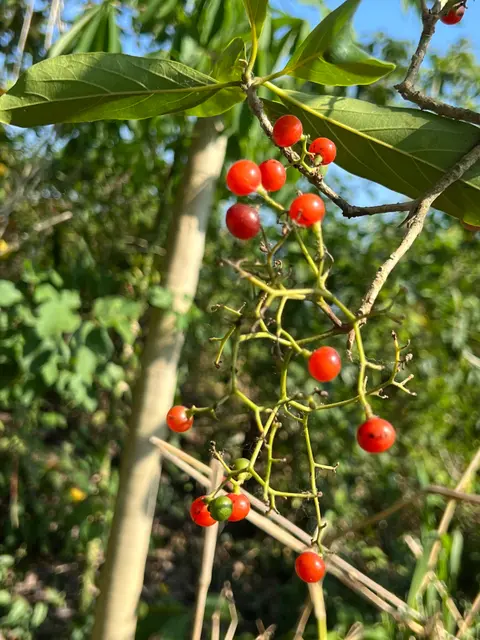
In a corner of dense vegetation within the reserve, beneath a sun filtering down through the canopy, Michel Salas and Jorge Alcalá paused before a Muñeco (*Cordia collococca*) standing some eight meters tall. The tree wore its bright red berries in abundance, and as they photographed it from different angles, a black bird — drawn in by the fruit — revealed itself among the branches. Five photographs remain as testament to that moment: the leafy crown, the cluster burning red, the winged visitor.
But the more understated story was below, among the dry leaves and remnants of the understory: a juvenile individual of the same species, its large green leaves pushing upward from the half-light. No one had planted it. It arrived on its own, the way things arrive when they find the conditions to stay.
The Muñeco is a species native to the Colombian Caribbean, and this record — a fertile adult alongside natural regeneration at the same site — confirms that in this part of the reserve, the species is not merely surviving: it is reproducing on its own terms.
Jorge Alcalá and Michel Salas were walking through the reserve when they stopped before a Muñeco —Cordia collococca— heavy with fruit. The tree, dressed in those small clusters ripening amid the dense green of the forest, stood there offering what it had in silence, as it always has.
The find has been logged at the coordinates marking a precise corner of the Fundación Loros's 520 hectares. It is no small detail: when a species enters fruiting season, the fauna knows before anyone else does. The parrots and other frugivorous birds of the reserve find in the Muñeco a resource well worth watching closely.
This observation, simple enough on paper, is one more piece of the living map that the field team builds record by record.
In a corner of dense vegetation within the sanctuary, Michel Salas and Jorge Alcalá came upon a Muñeco — Cordia collococca — some eight meters tall that seemed to have dressed itself for a celebration. The tree's twisted branches hung heavy with bright red berries, a few still green, scattered through the foliage like small embers glowing beneath a cloudless blue sky.
While Michel documented the fruits up close, a black bird slipped between the branches of the canopy, so absorbed in the feast that it almost ignored the camera entirely. It was confirmation of something botanical records don't always capture: a tree in full fruit is also a communal dining table, and the Muñeco that day had company.
The encounter was recorded in five photographs, ranging from wide shots of the leafy crown to tight close-ups of the berry clusters. The Muñeco belongs to the family Boraginaceae, and its presence in this stretch of dense wild growth is a welcome sign of the health of the native forest in this part of the sanctuary.
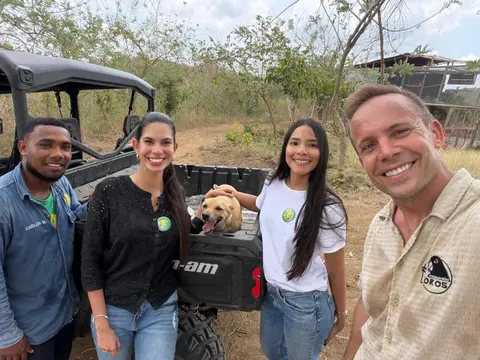
Victoria and Rosa arrived at the reserve ready to dive in headfirst, and the day rose to meet them. Together with Alejandro and Carlos, they made their way through the aviaries early in the morning — preparing food for the loros, running flight exercises, and pausing to assess the rehabilitation progress of several individuals. B177 still hasn't taken off — it moves only along the walls of aviario 1 — while B190 is flying now, but hasn't yet mastered landing and keeps hitting the mesh. These are the slow advances, the ones measured in weeks, the ones that matter most. Loros B11 and B12, on the other hand, greeted the visitors in the parque de niños with all the confidence in the world.
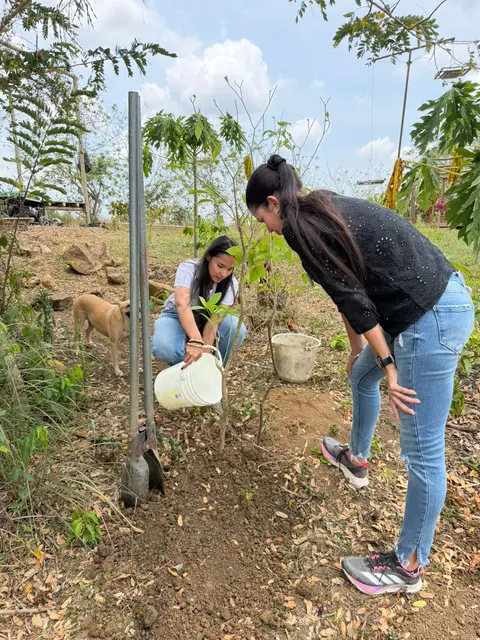
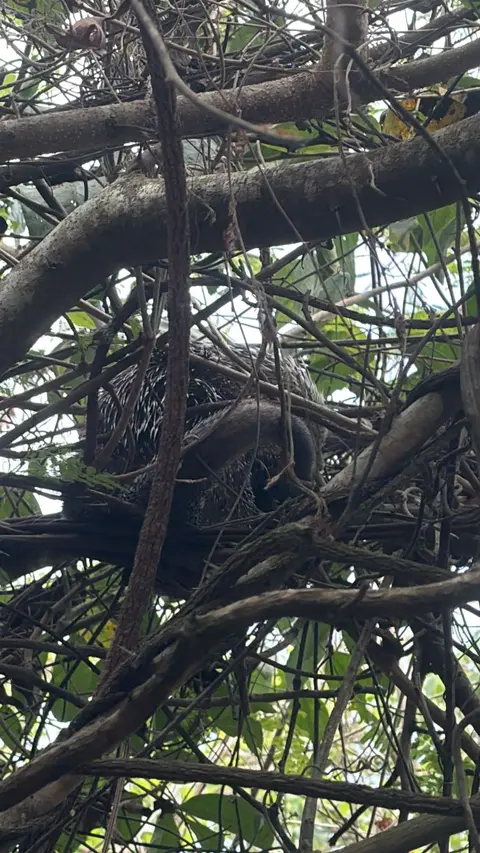
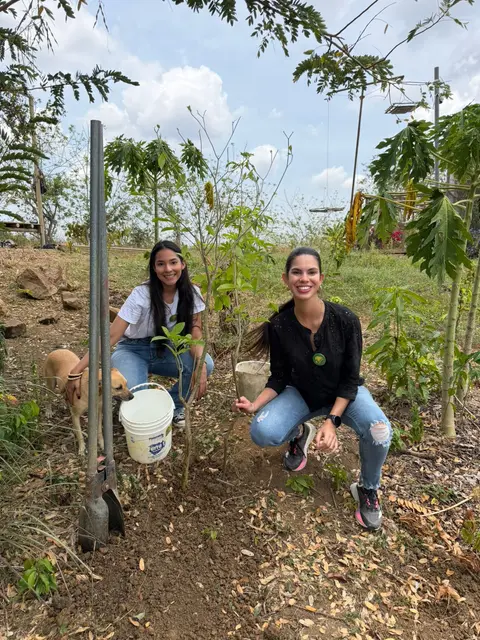
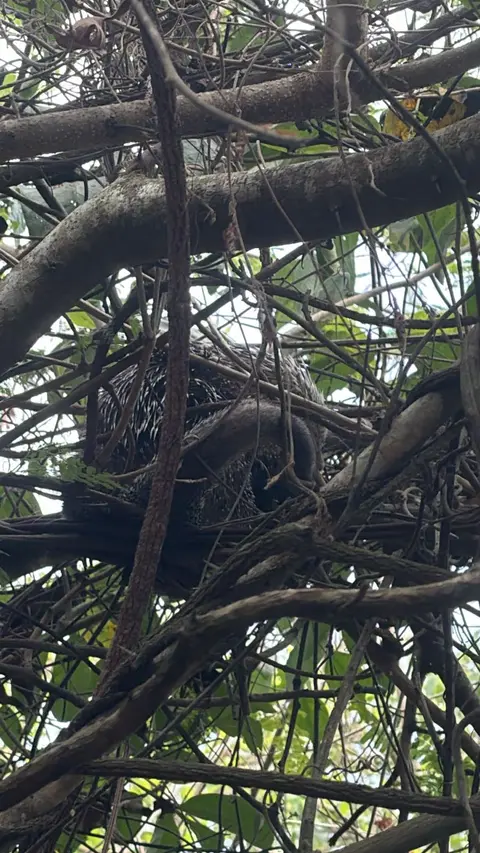
During the ride through the reserve in the Can-Am, Carlos proved he had the eyes of a hawk: moving at speed, he picked out squirrels, iguanas, and tortoises, and then — hidden high in the canopy — a coendú, the arboreal porcupine of these forests, so perfectly camouflaged among the branches it seemed to be part of the tree itself. At the lago de la ceiba, a female tití appeared between the trees with something impossibly small clinging to her body: a newborn, born just the day before. She didn't come down to the feeding stations. She held her position ten meters up and fifteen meters away, watching us with quiet wariness — as it should be. Happy, the reserve's scrappy little mixed-breed dog, kept pace with every step of the journey. At the end of the day, Victoria and Rosa picked up a shovel and planted a tree in the area where the guacamayas learn to fly free.
Carlos and the Spiny Dweller of the Canopy
Among the tangle of branches and lianas that form the canopy of the sanctuary's humid forest, Carlos looked up and found an unexpected visitor: an arboreal porcupine settled high in the treetops, so still and so perfectly concealed within the vegetation that it might easily have been mistaken for just another knot in the wood. He photographed it carefully, without disturbing it, and the animal never stirred.
The arboreal porcupine — known also as coendú — is one of those nocturnal mammals that spend their days curled among the branches, trusting that their quills and their patience will render them invisible. This time, the strategy almost worked. Almost.
This is the first time we have recorded the presence of this species in the sanctuary, reminding us that the 520 hectares of Fundación Loros still hold many surprises within their foliage.
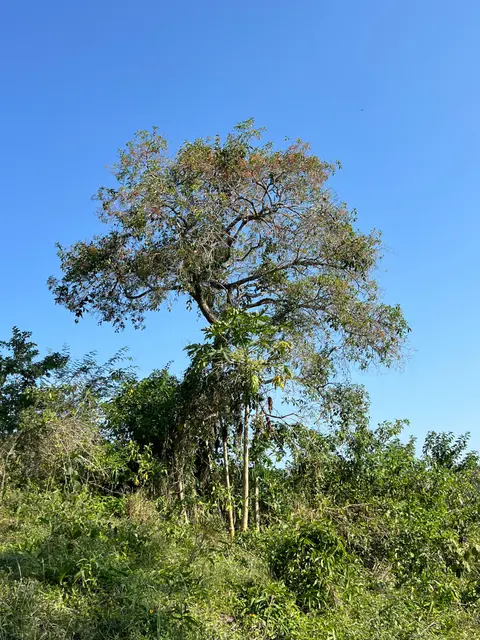
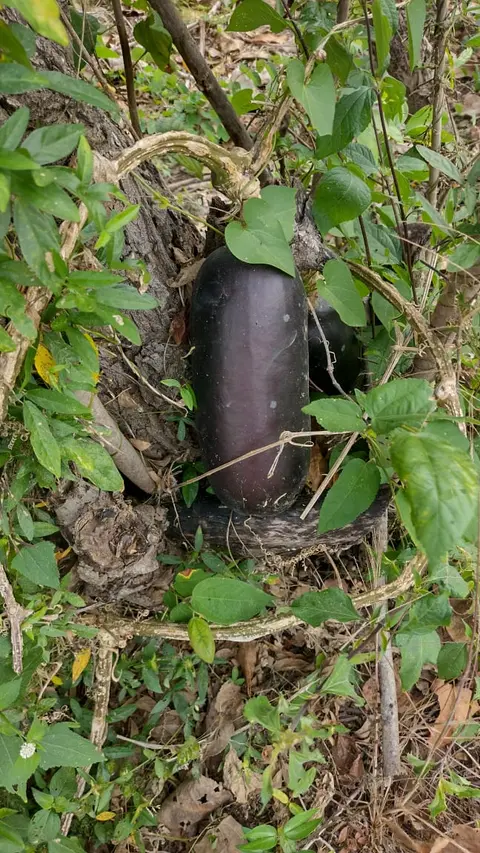
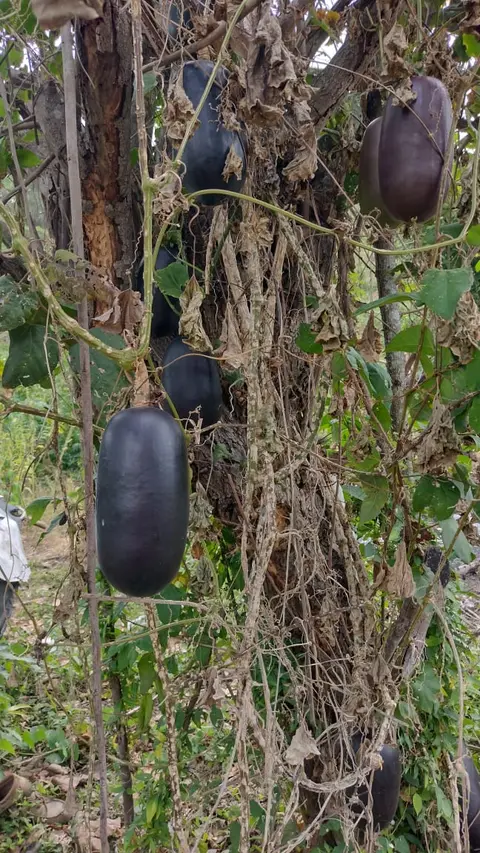
Tangled among the roots of a tree and wound around dry trunks, an unfamiliar climbing plant caught José Marín's eye during his rounds through the El Tamarindo sector. Hanging from the stems, oval and elongated fruits of deep purple-black — like small, darkened gourds — swayed gently in the afternoon heat. Two of them were documented in photographs: one resting on the ground between the roots, another still clinging to the vine.
José didn't recognize the plant by name, but he recorded it carefully. Specialists have provisionally identified it as a possible *Benincasa hispida*, known in other parts of the world as winter melon — though its wild presence in this corner of the sanctuary raises more questions than it answers: did it arrive on its own, carried by some animal, or is there a human story behind that vine growing among the dead wood? For now, El Tamarindo holds its secret beneath its leaves.
Nineteen Bells and an Orange-Chested Intruder
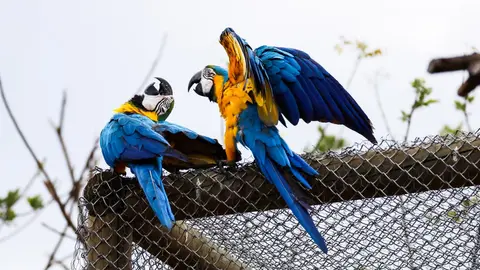
On March 23rd, Omar headed out to the feeding area as he does every morning: he filled the trays and rang the bell. The macaws were already there, restless with anticipation, but it was that metallic clang that finally gathered them all. Within minutes, 17 blue-and-yellow macaws (*Ara ararauna*) and one Cheja (*Ara severus*) had assembled, forming that swirling storm of color and noise we've come to know so well.
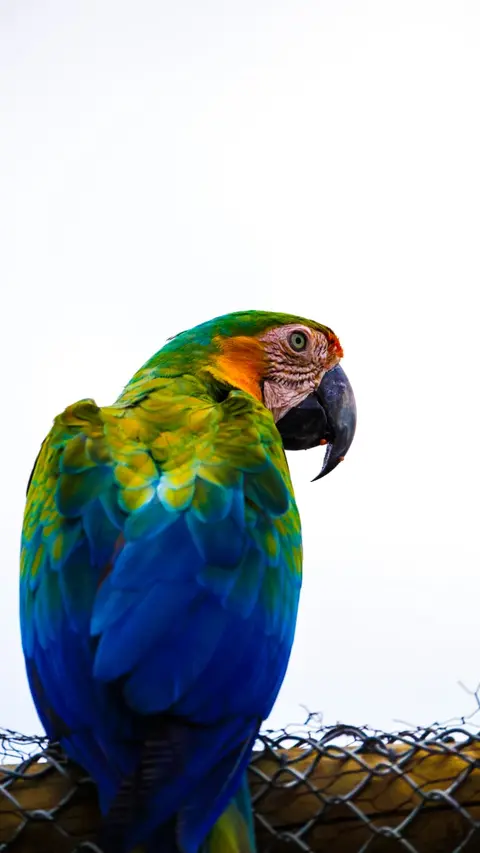
And among them, one more. An individual that doesn't quite fit: a blazing orange chest, a back of green blended with blue — a palette that belongs to no pure species. Likely a hybrid born of trafficking or illegal breeding, he has spent days returning to this same spot, searching for his place within the group. He hasn't found it yet. But he keeps showing up.
Monitor Omar was walking through the Miradores sector, close to the trail, when something stopped him in the undergrowth. There, among tangled lianas and shrubs still soaked from recent rain, a mamón de mico appeared — a species rarely seen within the sanctuary. The largest tree displayed a dense canopy, its broad dark leaves scattered with water droplets, and nestled within the foliage, small white fruits or flowers glimmered faintly against the wet green of the afternoon.
He was not alone in his discovery. A little further on, tucked deep into the brush, Omar found a second specimen — smaller, nearly hidden among branches and climbing vines. "Jefe, there's another one up ahead," he can be heard saying in the audio recording, with the quiet composure of someone who knows what they've just stumbled upon is not an everyday thing. Two mamones de mico in a single outing — one adult, one barely beginning its life — in a corner of the humid tropical forest that had kept them hidden, unrecorded by anyone before.
The find was documented with four photographs, two videos, and an audio clip. The exact location within the sanctuary is still being confirmed, but the coordinates point to the heart of Miradores, where the trail dissolves into the vegetation and the rain wraps everything in silence.
Seven titis and a newborn at Lago 2
Carlos Andrés Matas Contreras was walking through the Lago 2 sector of Finca El Paraíso when he found them: six titi monkeys moving through the vegetation, and set apart from the group, a female with her infant clinging to her body. The little one rode on its mother as if that were the safest place in the world — which it probably was.
Further along, already on Finca Los Guardianes, Carlos Andrés came across another of the reserve's discreet inhabitants: a porcupine. One of those creatures you almost never see but that are always there, moving slow and certain through the leaf litter. All three sightings were captured on video.
Two farms, two different stories in the same morning. That is how the reserve reveals what it holds — a little at a time, to those who know how to walk slowly and look carefully.
Nicolás and His Family Raise a New Home for the Ara
On Friday, March 27th, the grounds of Fundación Loros rang out for the first time with the hammering and rattling that belongs to something being built from scratch. Nicolás arrived that day with his family, hands ready and sleeves rolled up — together, they set in motion the construction of an aviary designed to house macaws of the genus Ara, those birds of blazing plumage that need space, height, and structure to find their strength again before returning to the wild.
Eight chauchau and a single alarm call
In the Los Guardianes sector, near Cameron's enclosure, guardian Omar Enrique Berdugo noticed something out of the ordinary: eight chauchau gathered together, singing without pause, every one of them with their gaze fixed on the ground below. It wasn't the scattered midday chatter or the usual restless fluttering — it was that insistent, coordinated sound these birds reserve for when they have something to say.
Berdugo approached slowly. There, among the leaf litter, lay the reason for all the commotion: a patoco resting on the ground, unhurried, indifferent to the small assembly denouncing it from the branches above. The snake had not gone unnoticed for even a moment — the forest has its own surveillance systems, and the chauchau are among the most efficient.
It was a reminder of something the sanctuary teaches you quickly: you have to know how to listen. It wasn't the guardian's eye that found the patoco first — it was those eight insistent voices that showed him exactly where to look.
There are places in the reserve that the whole team knows by heart — the gates that creak at dawn, the paths memorized through years of walking — but that, until now, existed on no map. The Tamarindo sector was one of them. This afternoon, Nicolás passed along three precise coordinates to Alejandro: the entrance, the exit, and the cage that serves as a reference point within the sector. Three simple points, but enough for Tamarindo to finally have coordinates of its own.
There were no sightings to recount, no releases to celebrate. Only the quiet work of those who build the sanctuary's invisible infrastructure: the data that makes it possible to find your bearings, plan routes, and leave a record of what exists across these 520 hectares near Cartagena. A map that grows — even if only three points at a time.
The Shy Wren That Let Itself Be Seen
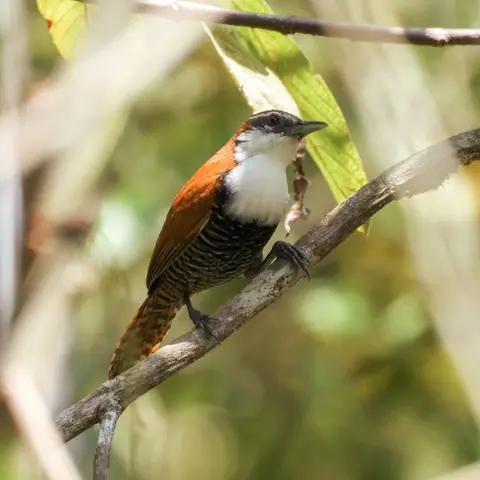
There are birds that live among us like well-kept secrets. The fasciated wren — *Pheugopedius fasciatoventris* — is one of them: always moving through the dense undergrowth of the humid forest, restless, elusive, with no intention whatsoever of posing for anyone. That is why, when Maicol González climbed up to cerro El Peligro on March 26th and found one perched on a slender branch — still, its cinnamon-rufous back lit up by the light filtering through the canopy — he knew this moment was different.
There were two individuals, likely a pair, moving unhurriedly through the vegetation. Maicol raised his camera slowly and pressed the shutter. The image that remained shows the bird face-on: white breast, belly crossed with bold black bars, the green and golden blur of the forest dissolving softly behind it. It is not the first time Maicol has recorded the species in the reserve, but it is the best photograph he has ever managed to capture — and you understand exactly why he says so the moment you see it.
Across 520 hectares of forest like those of the Fundación Loros, these small victories are the ones that matter: a shy bird that, for just one instant, decided to stay.
Electric Blue on the Arroyo Path
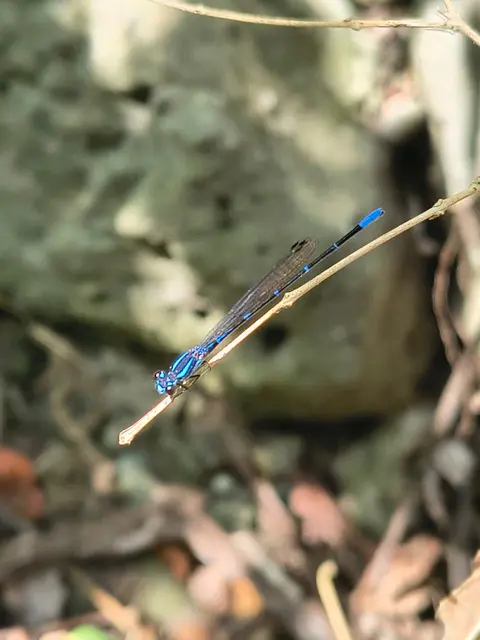
Maicol González was walking the arroyo path on cerro El Peligro when something blue stopped him in his tracks. Perched on a dry twig, nearly still amid the noise of the forest, sat a damselfly of such brilliant blue it seemed lit from some other light entirely. He photographed it right there — rocks and dry leaves just softly out of focus behind it, the insect in absolute command of the frame.
The record belongs to the order Odonata, suborder Zygoptera — the damselflies, more delicate cousins of the dragonflies. Given the intensity of the coloration, the genus could be Argia or Enallagma, two groups common across the Colombian Caribbean, though a specialist will need to confirm the exact species. What is certain is that its presence speaks well of the nearby arroyo: these insects only thrive where the water runs clean and the ecosystem holds together.
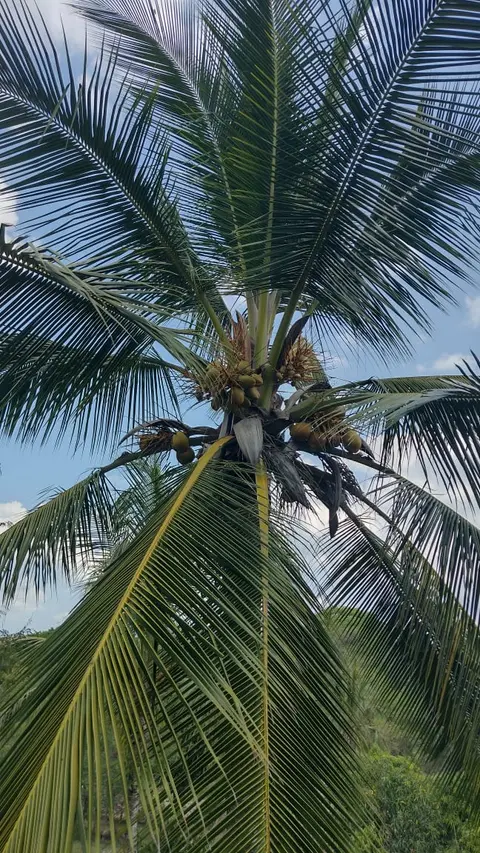
José Marín walked through the Los Guardianes sector this afternoon with his eyes turned skyward. The coconut palms rose against a blue sky of white clouds, their long, outstretched fronds cradling coconuts at every stage of life: the youngest ones nearly hidden from view, the ripe ones hanging heavy with that quiet certainty belonging only to fruit that has already fulfilled its time.
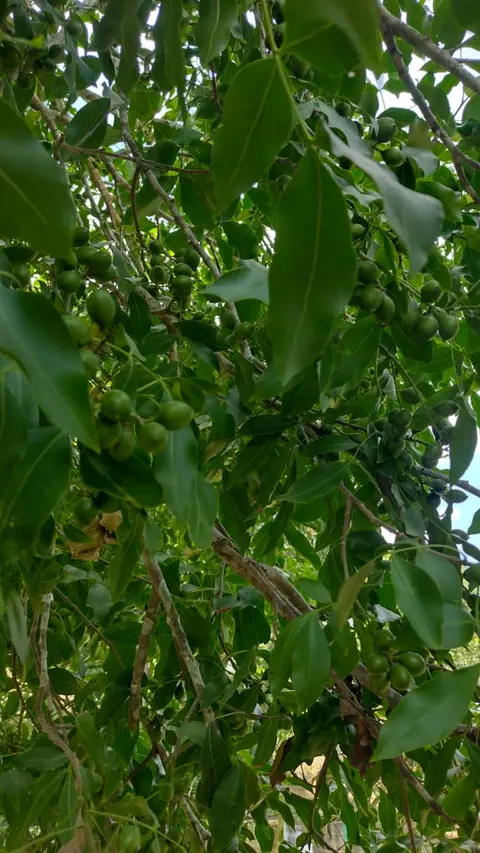
A few steps further, a mamón tree commanded all attention. Its branches bowed beneath the weight of hundreds of green fruits packed tight among glossy leaves, promising the harvest yet to come. Two coordinates, two trees, an afternoon in the field with nothing out of the ordinary — which, at the reserve, is sometimes the finest news of all.
That Thursday in March, José Marín was making his rounds through the reserve when he came across what so often hides itself within the foliage: two tanga tangas going about their business, feeding without hurry, indifferent to the world. He captured them on video before the moment could dissolve, and there in the background of the frame appeared Eder Ruiz crossing on horseback through the same stretch of land — as if the scene had needed that figure all along to feel complete.
The sighting was logged at coordinates 10.4451777, -75.264972, one more point on the living map of Fundación Loros. The two birds, calm and unhurried in their feeding, are a sign that the territory remains what it was always meant to be: a place where wild life finds room to exist without alarm.
José stayed out in the field for the rest of the day, eyes open, holding onto the quiet hope that the hours might still have something more to offer. That patience — the patience of the observer who walks without rushing and looks with care — is the very same thing that makes this record possible, and all the ones that will follow.
Field echoes
Event: March 22, 2026
Thirty-Three Photos with Cyrus in the UTV
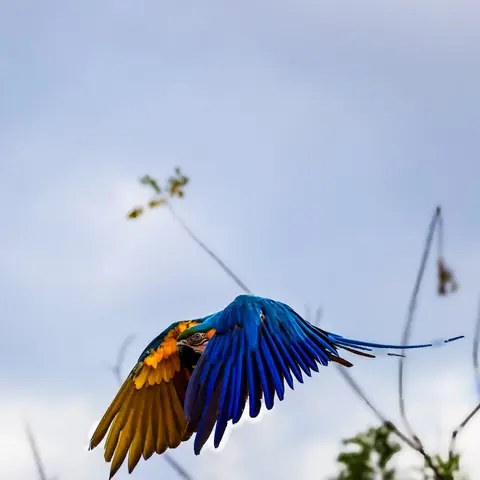
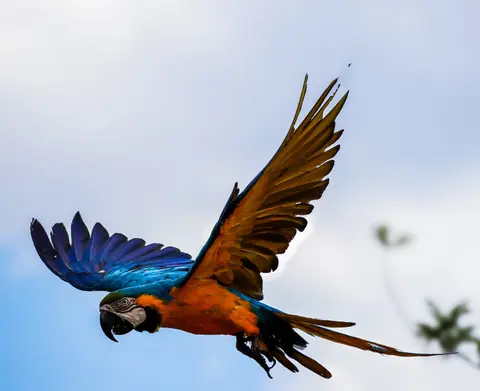
On Monday, March 23rd, Corina set out to tour the sanctuary in the UTV with Cyrus Bueche, a visitor who had come from the United States. The sky was clear, and the dirt paths carried the damp scent of vegetation in full bloom. They hadn't gone far when the chestnut-fronted macaws appeared — two Ara severus with wings outstretched, one of them banded with tag E101 — and then, further along, the ararauna in free flight, cleaving the blue air with that yellow that looks freshly painted.
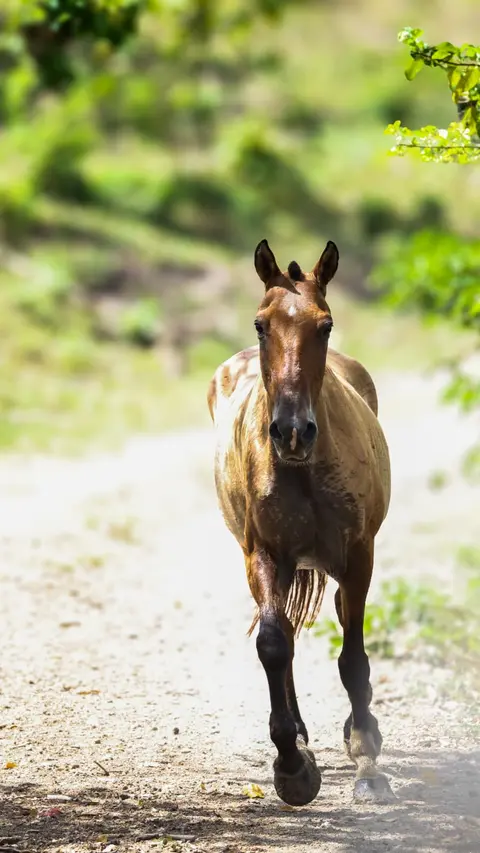
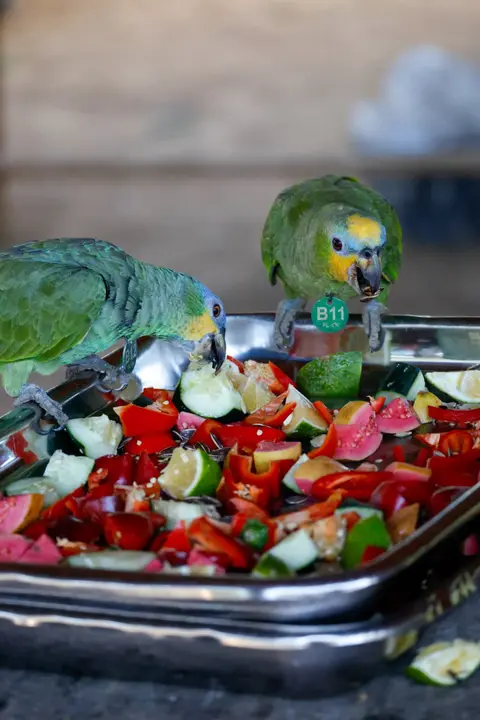
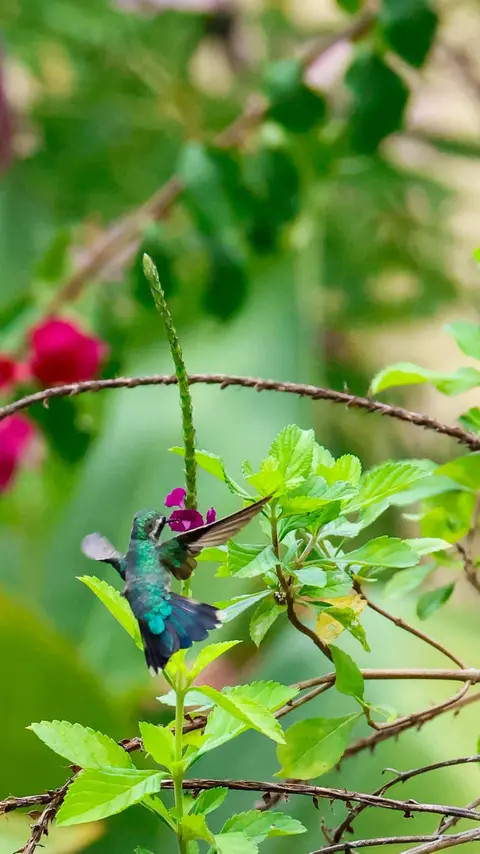
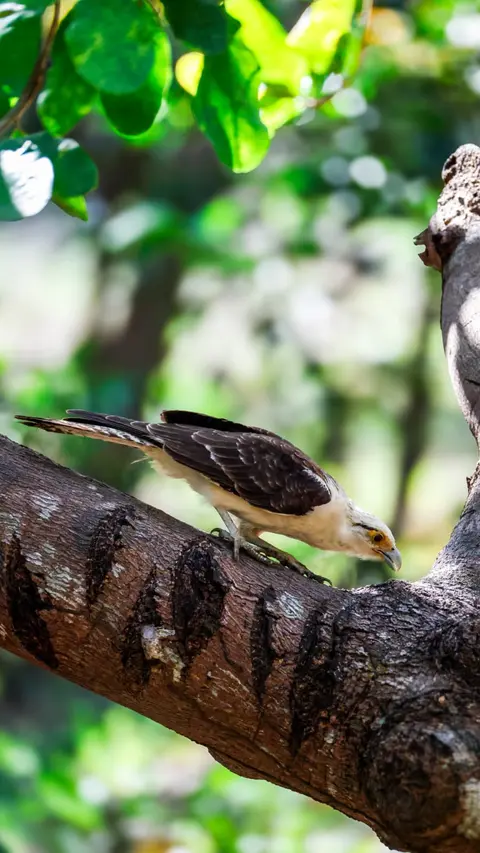
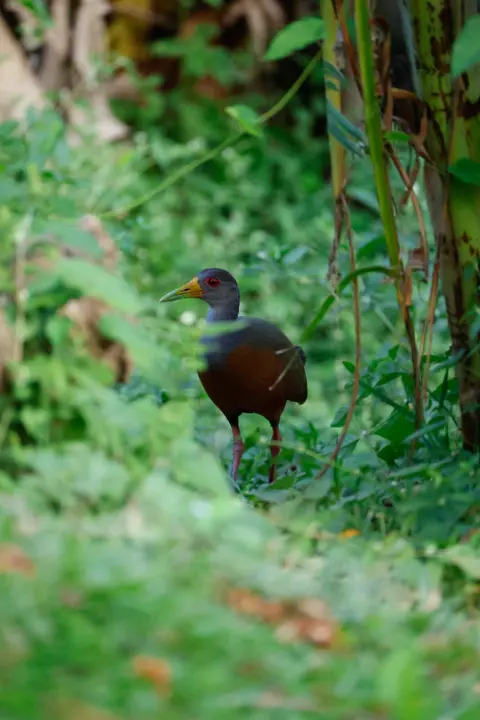
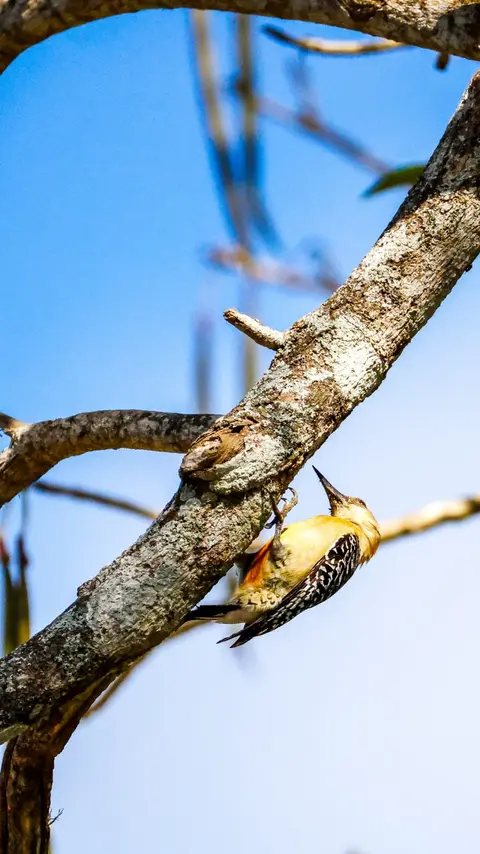
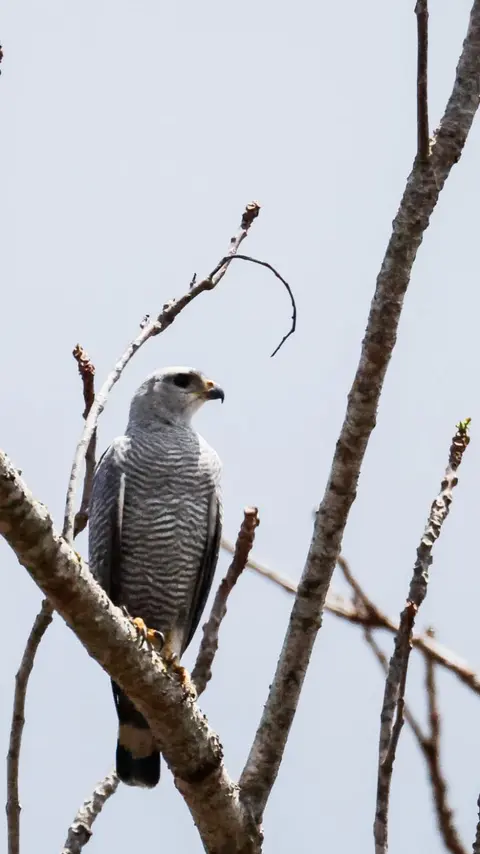
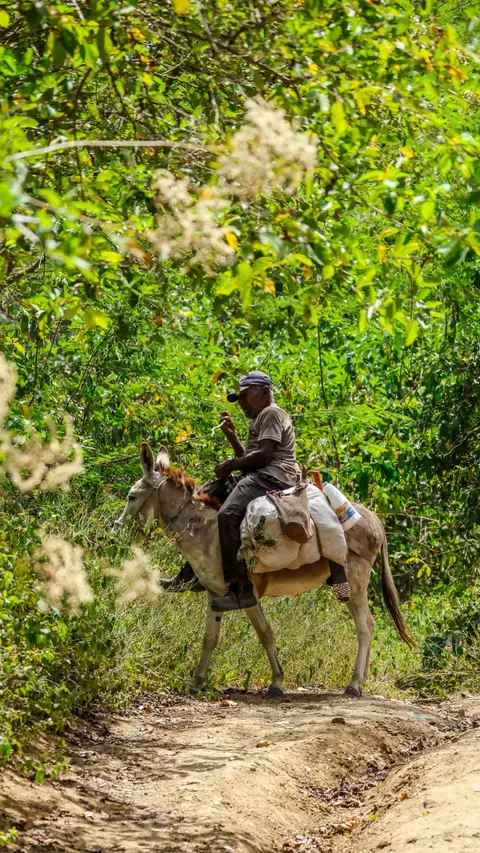
Along the way, a list took shape that no one had planned: four different raptors perched or in flight, a motmot with a russet breast watching from its branch, a rail slipping through the undergrowth, a woodpecker clinging to its tree, a green iridescent hummingbird suspended before a magenta flower. The Amazonian parrots — one wearing band B11 — pecked at cucumber and red bell pepper with a calm that made it seem as though the world held no further urgencies. On the paths, a reddish-brown horse walked unhurried toward the camera, and further on a donkey laden with sacks continued on its own way, unbothered.
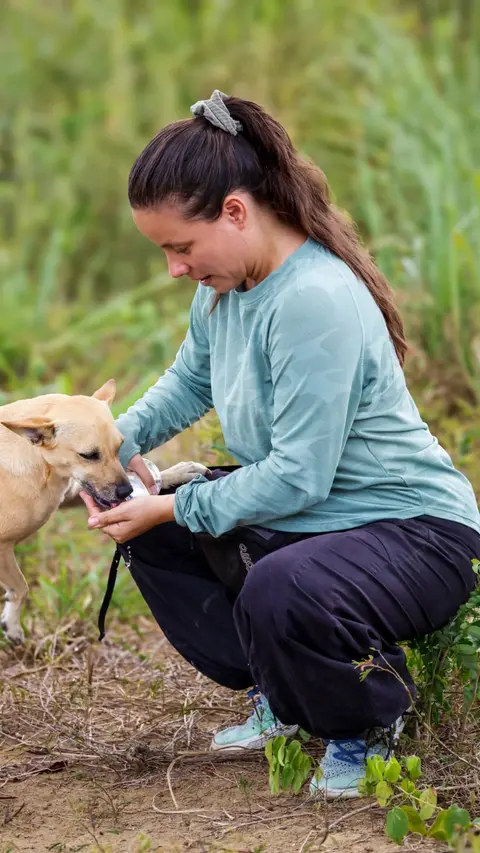
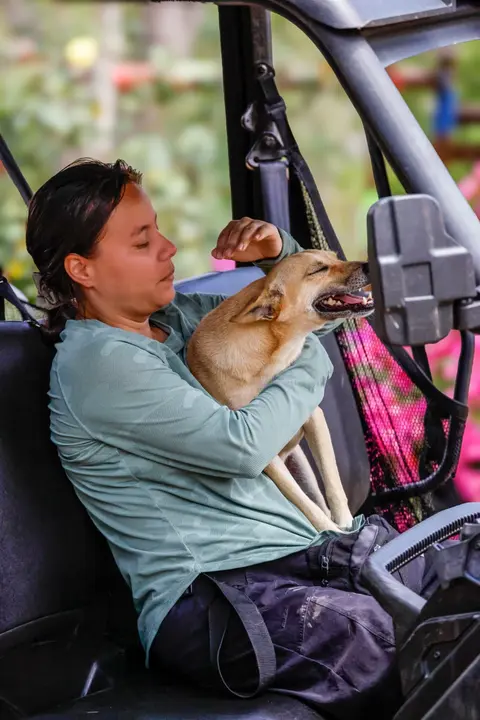
Corina stopped the UTV more than once to tend to the golden-coated dog that had accompanied them throughout the ride. Thirty-three photographs remained from that Monday: the memory of a sanctuary that needs no announcement to show what it holds.
Field echoes
Event: March 17, 2026
The Black-Mustached Chocorocoy
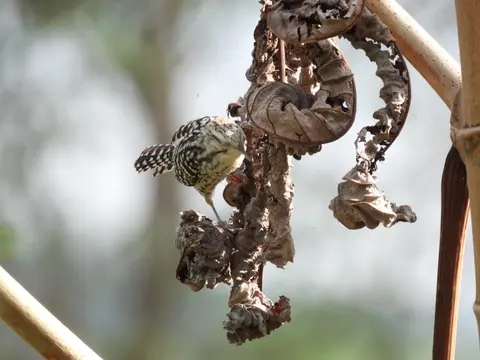
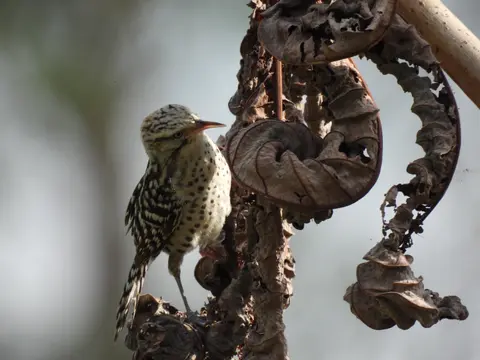
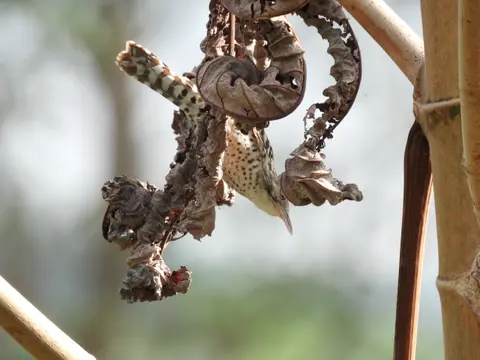
On March 18th, near the casa del paraíso, Maicol raised his camera with care and captured something he hadn't expected: a Stripe-backed Wren, Chocorocoy (Campylorhynchus nuchalis), foraging among dry branches and curled leaves, as though the world ceased to exist beyond that arid tangle. The bird moved slowly, unhurried, showing off its black-and-white mottled plumage as it nosed through the vegetation.
But it was one particular detail that kept Maicol's eye glued to the viewfinder: a black mustache, bold and clean, cutting across the bird's face with an almost comical elegance. In all his years walking the sanctuary, he had never seen that marking so pronounced on a Chocorocoy. He managed three shots before the bird vanished into the scrub.
Campylorhynchus nuchalis is a common species across the arid zones of northern Colombia, known for its boisterous character and unmistakable plumage. But that day, across the 520 hectares of Fundación Loros, one of them indulged itself — and became just a little more memorable than the rest.
Field echoes
Event: March 17, 2026
Four Birds at Casa del Paraíso
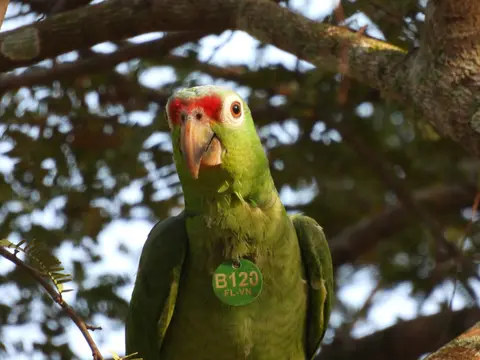
On March 18th, Maicol was making his rounds near Casa del Paraíso when he stumbled upon a small, unannounced gathering. There was B120, a red-lored amazon (Amazona autumnalis), her green tag plainly visible, and B67, a yellow-crowned amazon (Amazona ochrocephala), perched quietly on a dry branch. The two identification tags — green, understated — speak in silence of how long these birds have been on the sanctuary's radar.
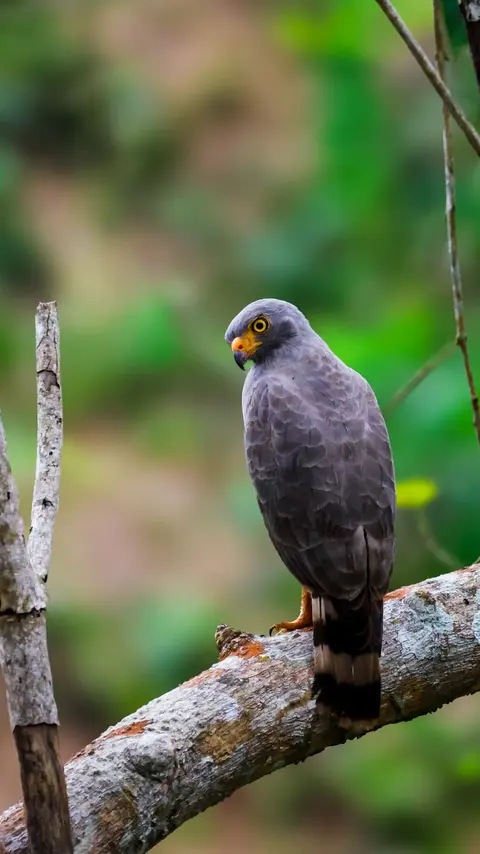
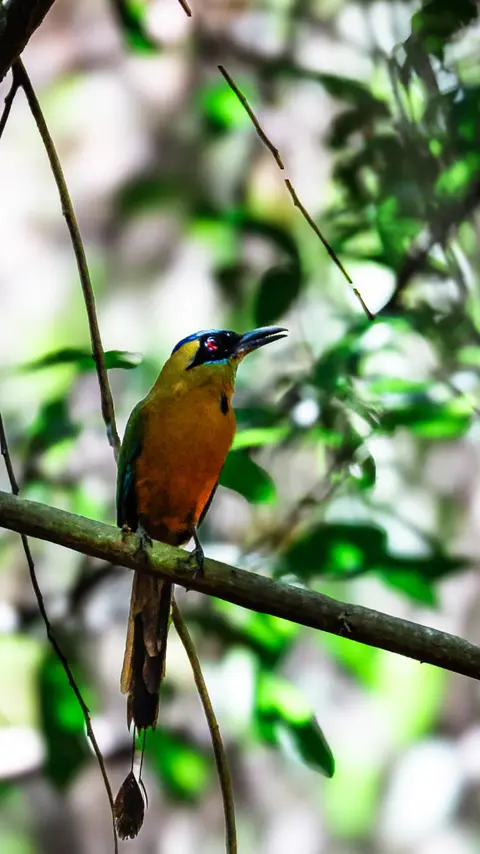
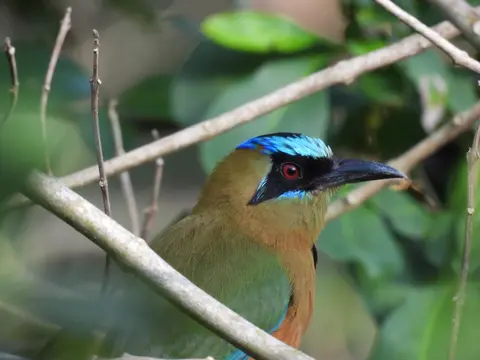
Not far from them, a cheja (Ara severus) rounded out the group with its deep green plumage, the white ring circling a yellow eye, and its own small tag hanging at the neck. And as an unidentified guest, a momoto (Momotus momota) appeared among the branches: electric blue crown, red eye, its curved bill like a finely crafted tool. Nothing out of the ordinary that day — just four birds going about their routine, and Maicol with his eye and his camera in exactly the right place at exactly the right time.
Somewhere between the canopy and the coordinates —10.4347, -75.2426, where Alejandro marked the spot from the field— Nicolás is setting up a new enclosure for the ARA program. There is a tree at that location, or so they believe, and for that reason the exact position needed to be confirmed before taking the work for granted. This is how the Fundación operates: first the map, then the hammer.
The enclosure is designed to house around twenty macaw individuals —blue-and-yellow or scarlet, depending on what the assessment confirms: Ara ararauna or Ara macao—. Twenty parrots of the kind that fill the sky with noise and color, birds that need space to recover before they can fly free again. The installation is still underway, and the point on the map remains pending verification.
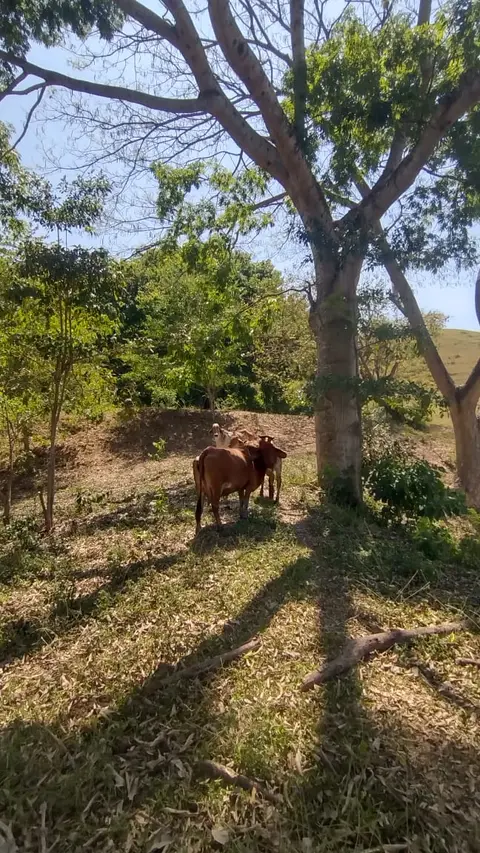
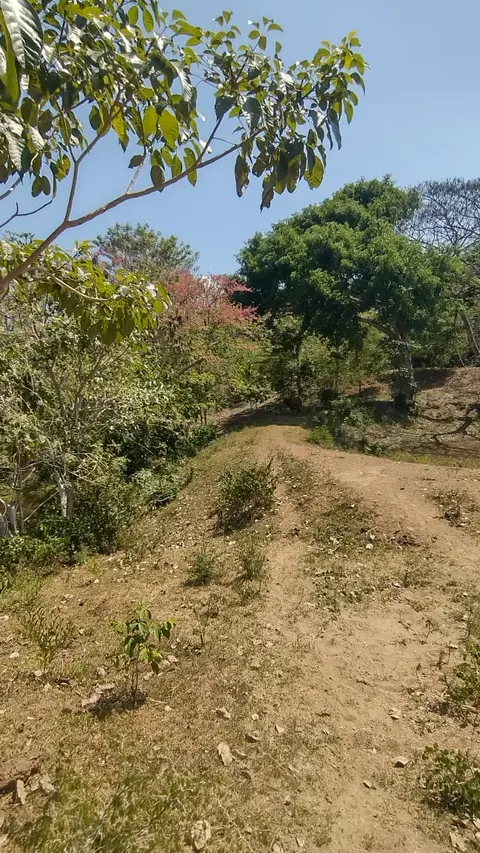
On Wednesday afternoon, José Marín set out to walk one of the Fundación's properties in the rural outskirts near Cartagena, where the sun bears down relentlessly and the pasture has gone weeks without rain. It didn't take long to find what he was looking for: two reddish-brown bovines, perfectly at ease, stretched out in the shade of a large tree. They belong to the Fundación, and they were exactly where you'd expect them to be on a scorching day — still, patient, indifferent to the world.
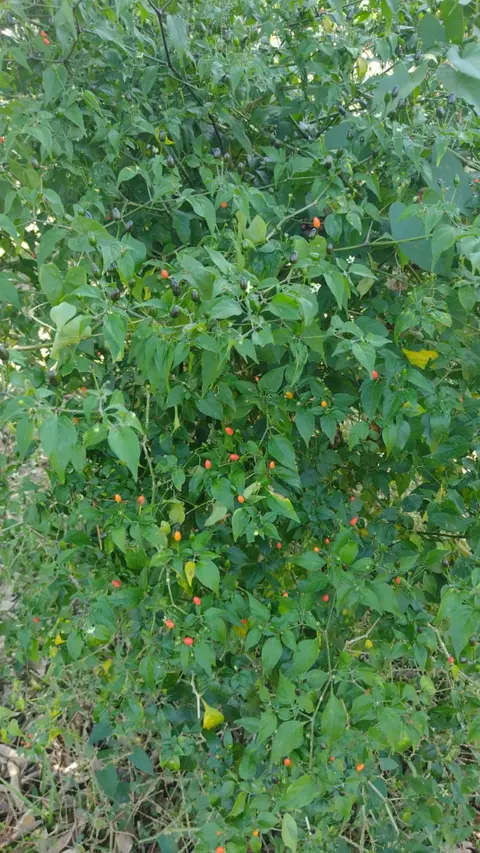
A few steps further along, among the dry vegetation and the trees lining the trail with their pink blossoms, José came across a wild ají picante plant heavy with fruit. The pods hung in glorious disorder: some red and orange, gleaming with ripeness; others deep purple, nearly black, moving at their own unhurried pace. A plant no one sowed, that grew on its own in that parched soil and decided to flower anyway.
It was an uneventful round, the kind that simply confirms the property is holding together. But sometimes that's enough — two cattle resting in the shade and a chili plant burning with color — for a day in the field to feel worth telling.
Field echoes
Event: March 20, 2026
The Day the Forest welcomed its Tenants
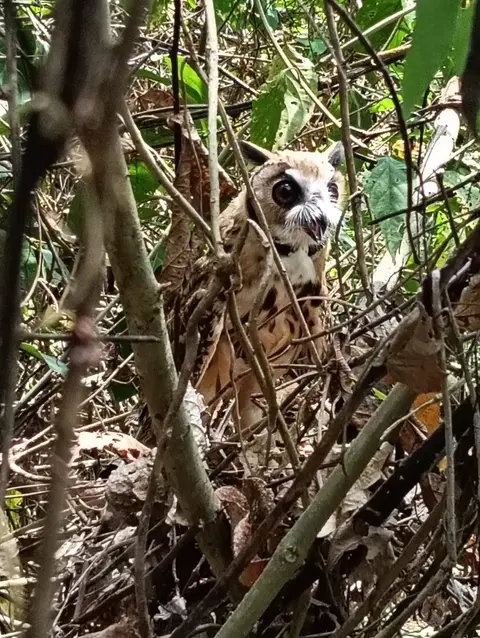
On March 20th, in a corner of humid forest belonging to the Fundación Loros, an unusual procession made its way through the understory: police officers, sailors from the Armada Nacional, officials from the EPA Cartagena, and the Foundation's own team, carrying transport cages through the leaf litter. Inside traveled young zarigüeyas — those sharp-snouted creatures with eyes like black buttons — along with turtles bearing dark grey shells, and an owl dressed in brown plumage that regarded the world with the solemn calm that belongs to nocturnal birds caught in daylight.
When the cages were opened, there was no ceremony. The zarigüeyas slipped between the leaves as though they had always known this was their place. The turtles moved slowly, at their own pace, toward the low vegetation. The owl found the lower branches of a tree and went still — camouflaged among the dry stems, waiting for the world to forget about it. Someone trailed behind with a phone in a blue case, trying to capture the moment before the forest swallowed them whole.
The official record detailing every species and exact count is still on its way — to be sent by the Centro de Atención de Primates — but the photographs already say enough: a forest that, on that afternoon, welcomed back some of its most unassuming tenants.
La Mella and the Cast That Came the Next Day
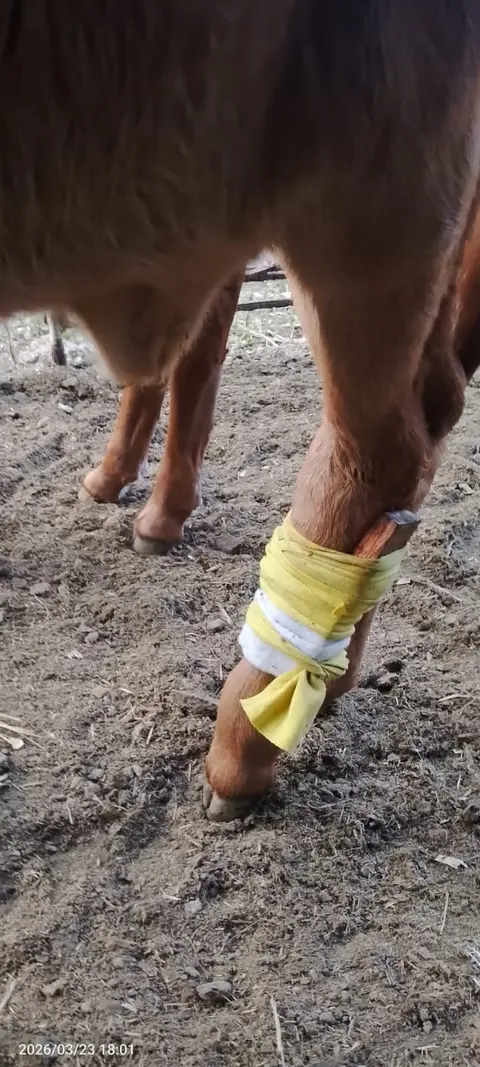
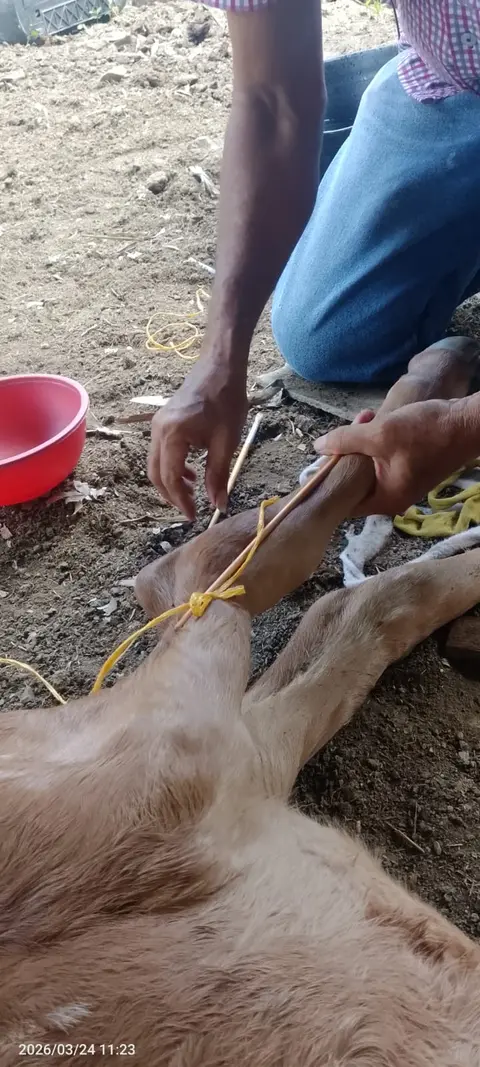
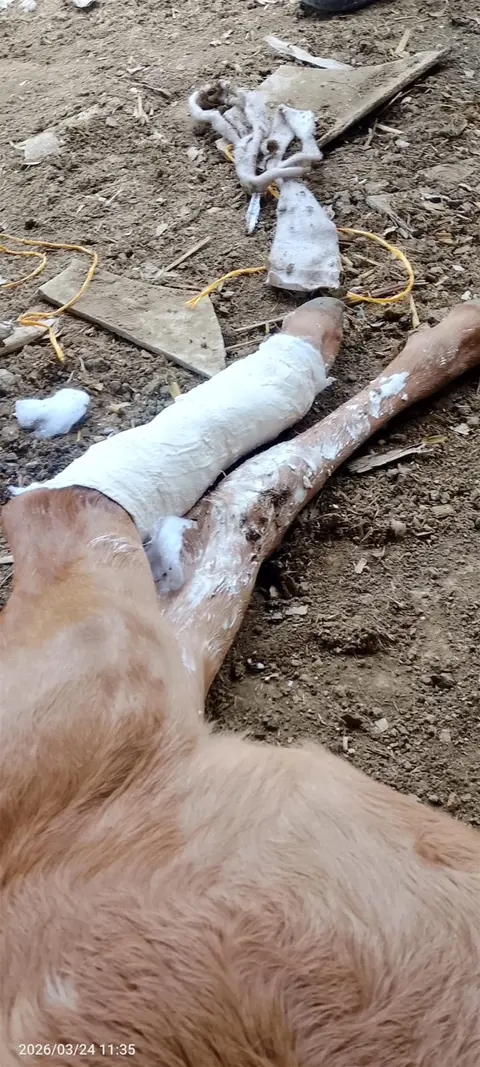
In the Vista Hermosa sector, the calf everyone calls La Mella woke on Monday with a fractured left hind leg. There was no malice in it — her own mother, in a careless moment, had stepped on her. To immobilize the break while the swelling came down, nilsonenrique74 fashioned an emergency splint from two wooden boards and a few strips of bandage — that humble, improvised fix that out in the field is sometimes all you have.
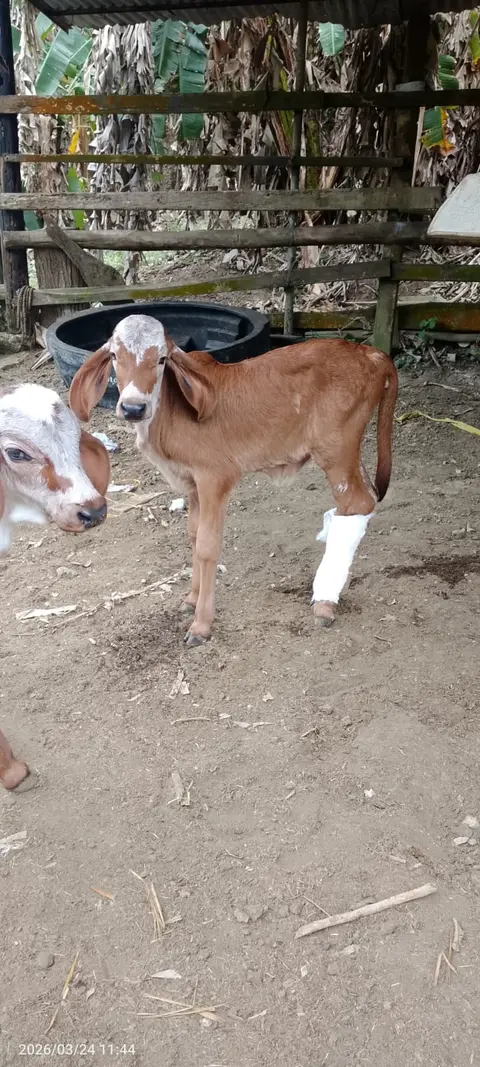
The following day, once the inflammation had subsided enough, it was time for the cast. Alberto Orozco, veterinary assistant, set about applying the definitive plaster to the limb. In the photos and videos that arrived from Vista Hermosa, La Mella can be seen lying on the dirt floor, her legs secured with yellow cabuya rope, while Orozco works steadily over the bandaged leg. In the final image she is already standing — the white cast visible, and an adult bovine poking its head in beside her through the weathered wooden fence of the rustic corral.
At the time of this report, La Mella is stable.
Field echoes
Event: March 20, 2026
The Day the Sanctuary Never Stopped Surprising
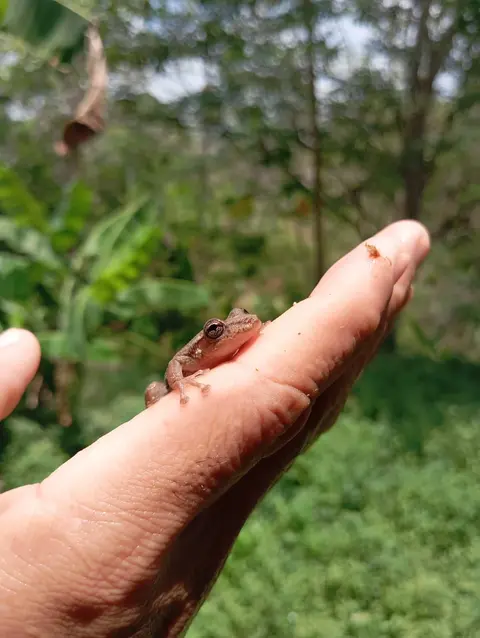
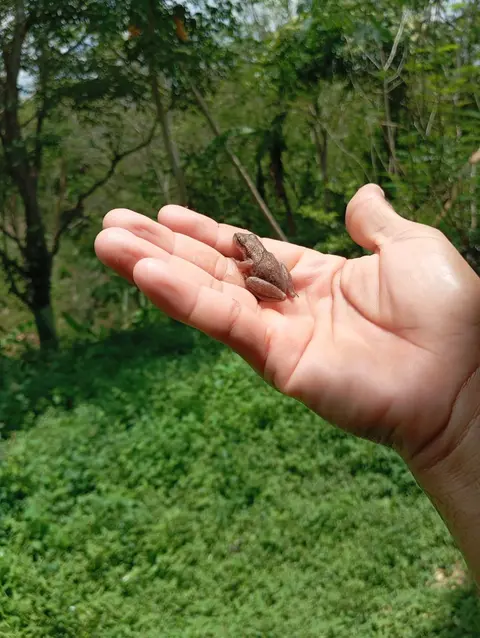
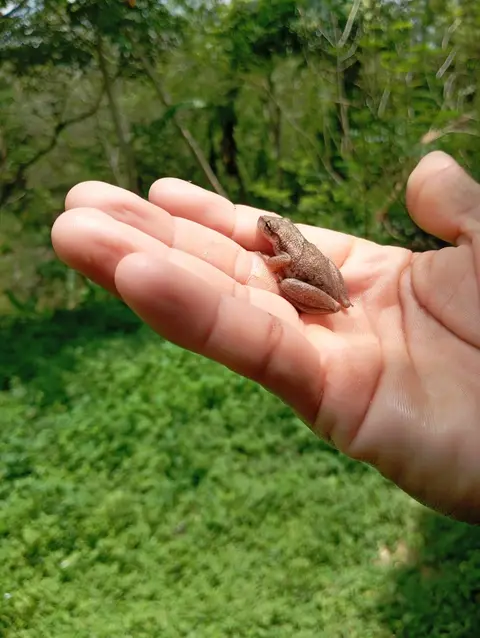
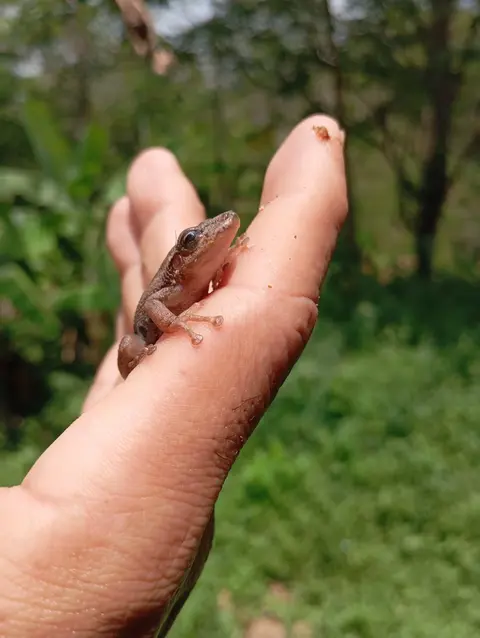
That Friday in March, Omar Enrique Berdugo Cabeza set out to walk the grounds of Fundación Loros and the sector of Los Guardianes as though the sanctuary itself had decided to put on a show. It all began while washing the bird trays: when he flipped one over, a tiny brown frog appeared, perfectly still on the palm of his hand, as calm as something posing for a portrait. Then came Negrillo, the parrot, who without any warning glided down and settled on his shoulder. In aviario 2, he found a livo pollero that had gotten trapped and couldn't find its way out; a little further on, all six titis were present and accounted for at feeding time. And on the walk back through Los Guardianes, an abandoned little house had kept its own surprise waiting for him — a juvenile golero that had grown up there, between walls that belonged to no one.
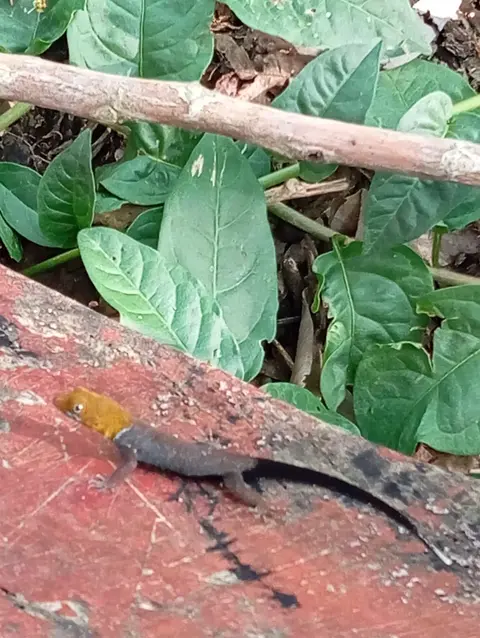
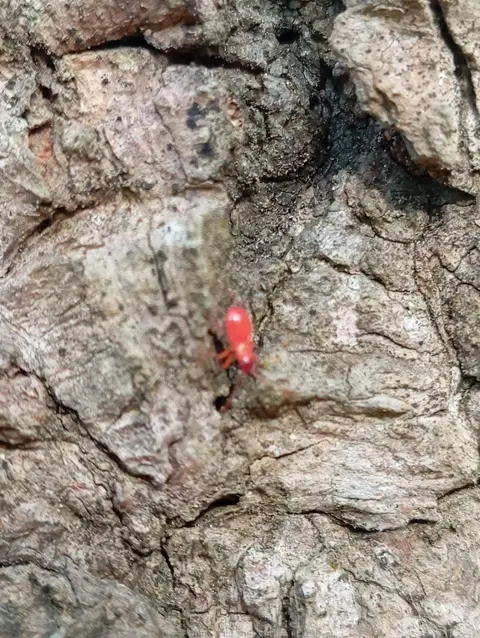
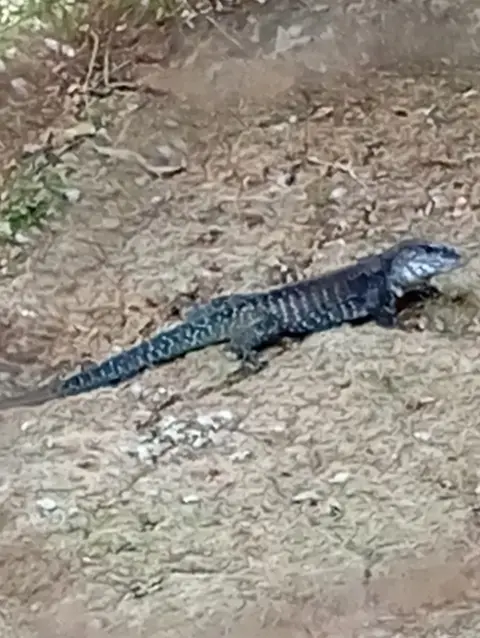
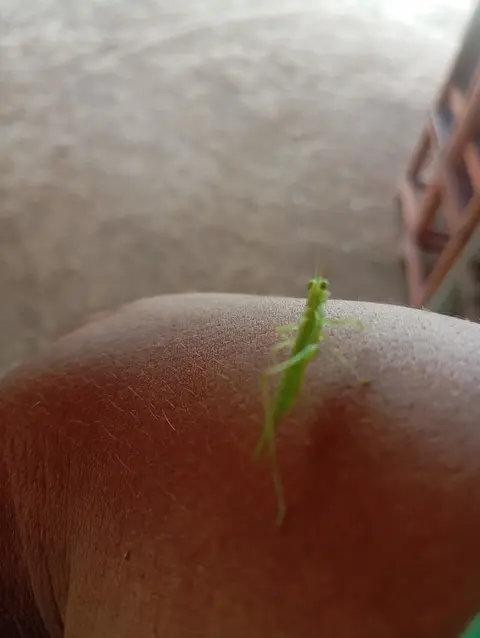
Back at the foundation, life kept appearing at every turn — an orange-headed gecko on the brickwork, a red mite like a drop of velvet on the bark of a tree, a praying mantis so small it fit on the tip of a finger, a green grasshopper resting on a knee, a black iguana half-hidden among the dry leaves, butterflies drifting between flowers, and a poyoneta paying a visit to the terrace. In a rubber tree, a bird with a yellow bill, yellow tail, and black plumage that no one had expected.
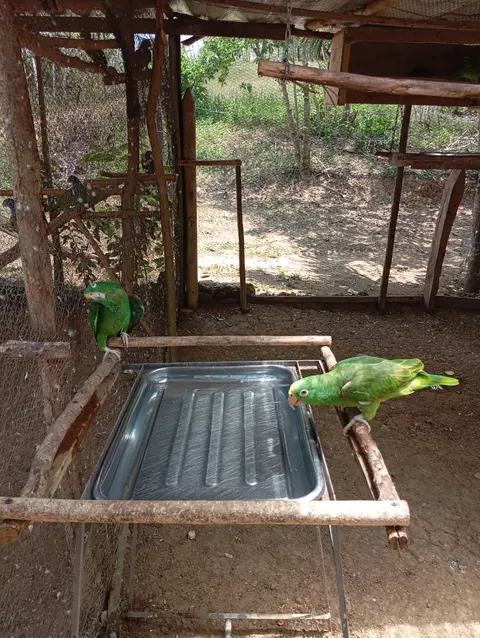
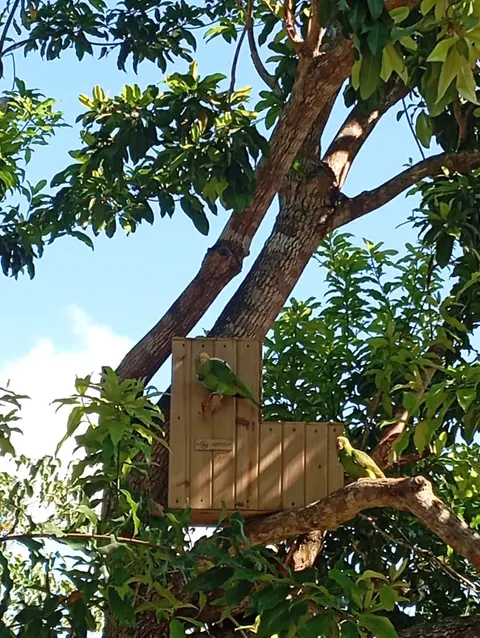
But the image of the day arrived at the very end: in a níspero tree, two wild parrots had chosen the donated nest box to make their own, calm and free, as though they had always known that space was theirs. Not far away, the parrots of aviarios 1 and 2 — warmed through by the dry-season heat — were receiving the stream of a garden hose, pressing themselves against the wet leaves so that the cool drops would settle deep between their feathers.
José Marín was walking through one of the forest sectors of the reserve when he saw it: a solitary tití cabeciblanco, perfectly still among the tangle of slender trunks and crossing branches. It was March 24th, and the forest was showing its dry-season signs — yellowing leaves, fallen branches, the sky sealed over in grey. The animal was alone, no trace of a group, watching from the dense vegetation with that particular blend of curiosity and caution that defines Saguinus oedipus.
Also recorded that day — and worth setting down here for the analyses that will eventually follow — is that this same sector holds five mango trees. It is not a minor detail: mangoes are a food source, and the titíes know this well. Perhaps that explains the animal's solitary presence at that exact spot, or perhaps it does not — but the coincidence deserves watching.
José documented the sighting with three photographs of the area. The species is listed as critically endangered, and every record gathered in the reserve adds another line to the story of what persists and moves here.
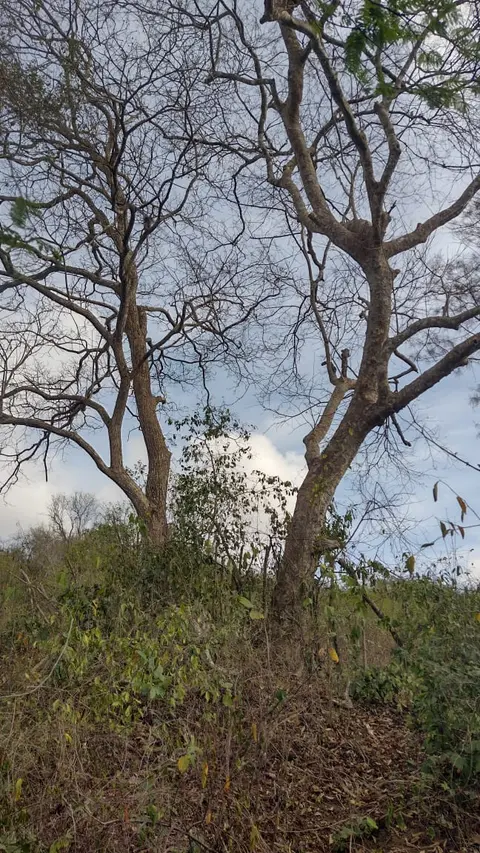
José Marín had been walking through the dry forest for a good while when the wilderness offered up a surprise. It was past midday and the trees already wore that gaunt, stripped look of the seasonal transition — white trunks, bare branches, the ground blanketed in crackling leaves — when, during one of his routine sweeps through the reserve, along the trail that skirts the southern edge of the Fundación Loros, a quick movement in the branches caught his eye. It was a tití cabeza blanca (Saguinus oedipus), alone.
And just like that, everything else — including a carpintero gigante he had recorded earlier at another point along the route — was pushed to the background. The individual was male, apparently young, and was moving at great speed through the branches with no group trailing behind him. For Marín, with all his years in the field, something about that didn't add up: the tití is a family animal, a creature of the troop, the kind that doesn't stray even when the forest is calm. Finding one alone suggests it was driven out by its group — behavior unusual enough to warrant close monitoring.
The five photographs he managed to take show the dry landscape and the individual threading through the branches. The video was still uploading when the day's survey came to an end.