On the foothill slope of the sanctuary, José Marín managed to pull out his phone just in time. What he recorded is not something you see every day: a tayra climbing with purpose up the trunk of a ceiba, heading straight for an owl's nest. Up in the branches, the chao chao were already calling — that nervous, repeated alarm that just last week rang out when a víbora patoco was prowling near Carlos. They warn like that, together, whenever something isn't right.
The tayra reached the nest without hesitation. It knocked the owlet to the ground. The small creature did not survive the fall. We still don't know what species of owl it was — that question will go unanswered for now — but the moment was preserved in two videos that José was fortunate enough to capture at precisely the right time.
What strikes you most is not only the predation itself, but the chain of signals that surrounded it: the chao chao working as a shared alarm system, alerting anyone who knew how to listen. On the piedemonte, the forest speaks before anything happens.
Two Reds at the Cerro Aviaries
This afternoon Carlos Mata looked up and found them there: two wild scarlet macaws, blazing in full red, circling the aviary zone at the Cerro where the birds of the Ara program make their home. They hadn't come through in passing. They were close — right at that place where the jungle and the aviaries touch.
No one knows for certain what drew them. Perhaps the call of their kin held in captivity, perhaps the memory of the territory itself. What was captured on video is this: two free *Ara macao* chose that corner of the 520 hectares to land today, April 5th, 2026. And that, on the long road of a reintroduction program, is no small thing.
Seventeen Guacamayas and a Cheja in the Surrounding Area
The morning of April 2nd arrived with more color than expected. Somewhere around the sanctuary, someone counted seventeen guacamayas and a cheja moving through the area — a sighting that doesn't go unnoticed even when the day is busy with other things. Alejandro logged it the following day, with the economy of words that belongs to someone who knows the numbers speak for themselves.
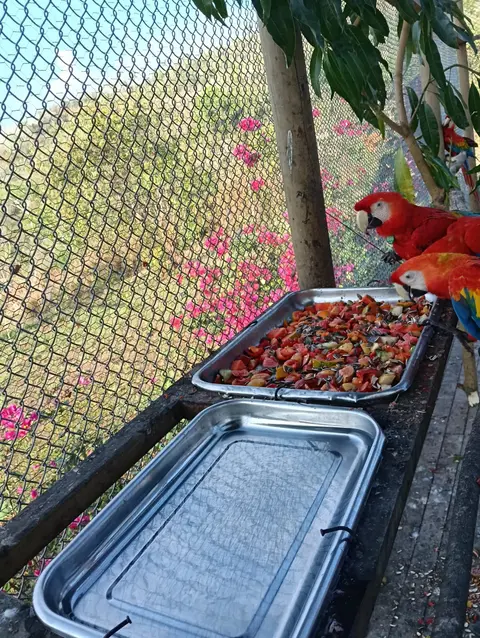
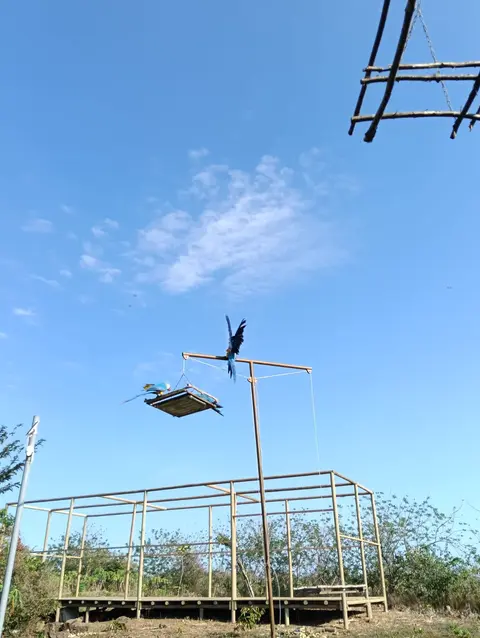
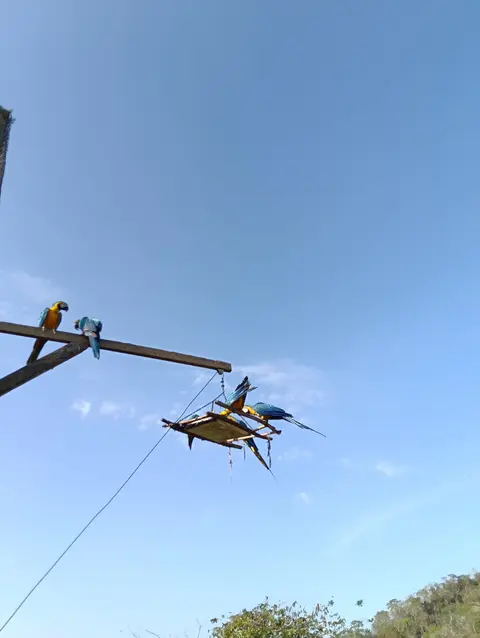
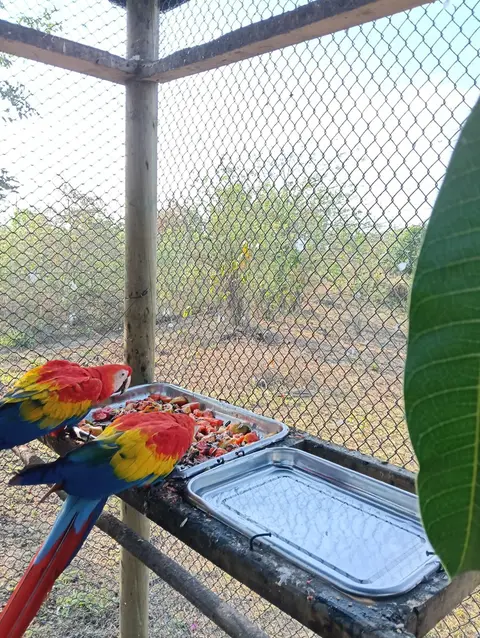
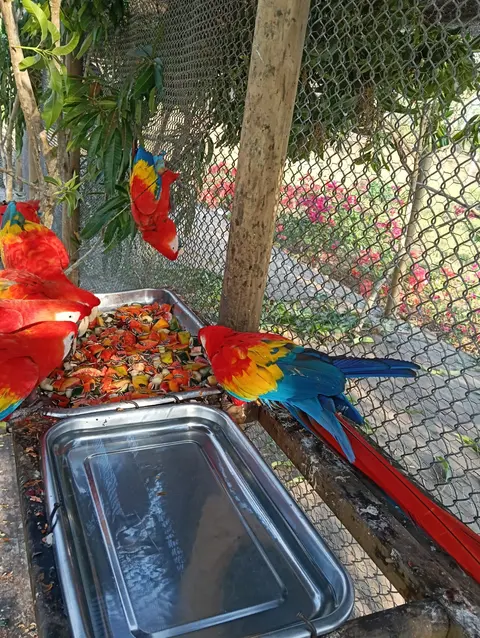
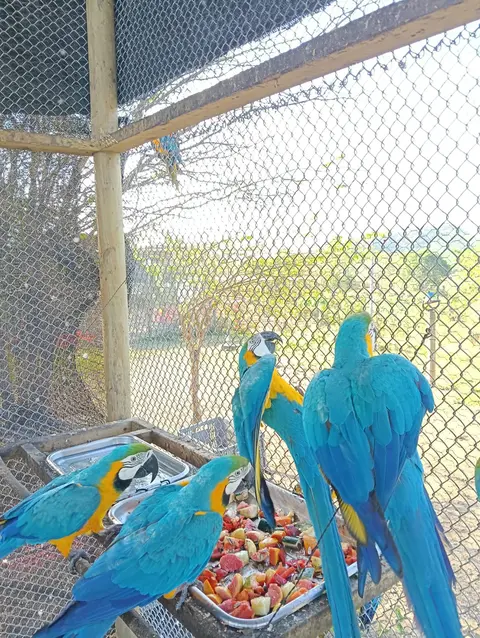
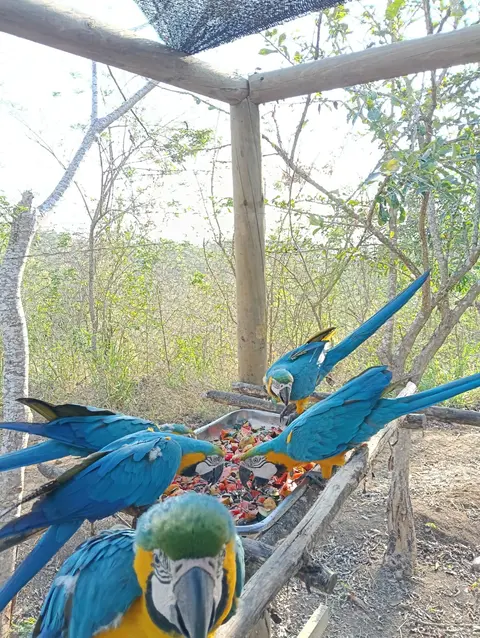
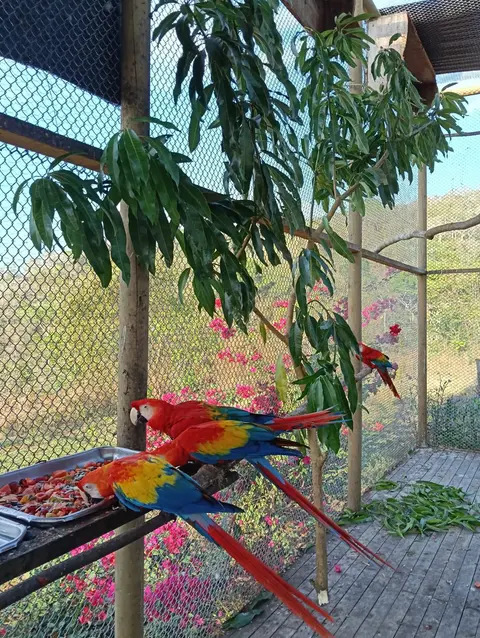
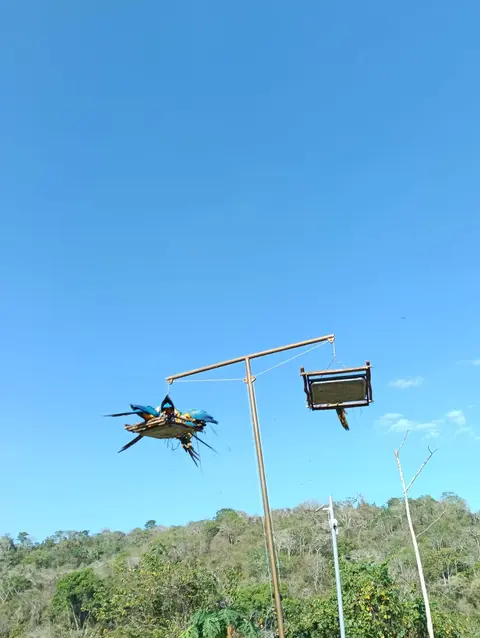
Inside the aviary, two scarlet macaws (Ara macao) were taking their time at the breakfast trays: chunks of tomato, cucumber, sunflower seeds. Behind the wire mesh, pink bougainvilleas bloomed as if they too wanted to be part of it. A little further on, in the area where the wooden frames of the new enclosure are still going up, two blue-and-yellow macaws (Ara ararauna) had settled onto a makeshift perch. One of them spread its wings wide open under the morning sun — unhurried, as if measuring the space it had ahead of it.
The Hybrid That Never Came to the Feeding Station
Yesterday afternoon she was there, moving among the scarlets and the ararauna, drifting through the sanctuary with that peculiar quality of hers — never quite belonging to either side. Alberto spotted her, as he had so many times before, and thought nothing more of it. But when they returned at dusk, her place on the perches was empty. This morning, the trays of watermelon and papaya filled once again with red and yellow beaks, and the hybrid — that is what we call her, no proper name, the way you recognize someone by the way they walk — never showed up.
Alberto made his rounds through the enclosures and sent the photos: clusters of Ara macao squabbling over the fruit, the ararauna lined up along the wooden beams with a blue sky behind them, everything in order except for her. Seven photographs, not one with the hybrid in it. The report came in this morning, April 3rd, and we have her on our radar now. If she comes back, we'll know.
Seven titis and a newborn at the lake
This week the Lago de los Titis was keeping a secret that didn't take long to reveal itself. Blanca and her companions — Mexican physicians visiting the sanctuary — were making their way toward the water's edge when the group appeared among the branches: seven titi monkeys moving slowly, with that nervous elegance that defines them. But what stopped the visitors in their tracks was the infant, born barely a week before, clinging to the body of one of the adults as though the entire world depended on that embrace.
Blanca documented the moment across four videos that capture the family group in their quiet routine, almost entirely indifferent to the eyes watching them from the shore. The footage now lives in the sanctuary's records as proof that the group carries on, that a new life has entered the world — and that sometimes the finest witnesses to such things arrive from very far away, without ever having planned it.
A Calf Standing Tall in Vista Hermosa
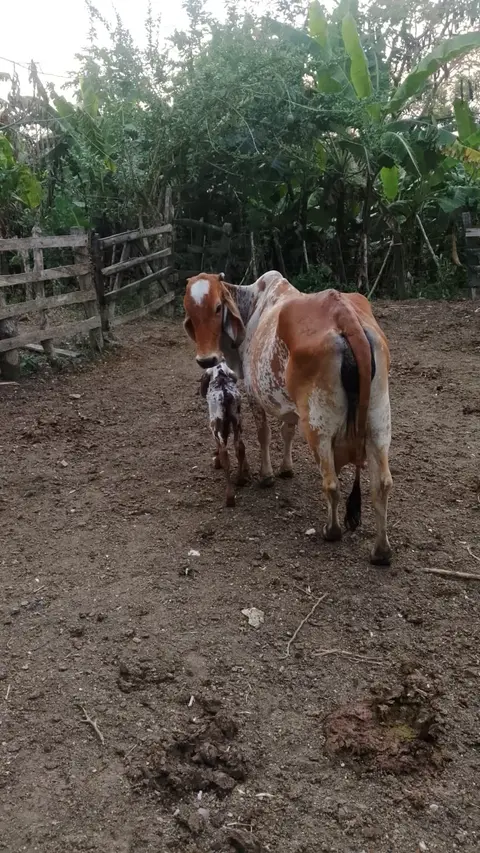
By the time Nilson reached the pen that night, the work was already done. There he was — the newborn — still damp, legs trembling but firm against the earth, while his mother, brown and white, ate in quiet contentment and licked him with the particular calm that only belongs to cows who know everything went just right. He was a male, and he was already on his feet. In Vista Hermosa, that's all you ever need to see.
Behind them, the rough wooden fence and the plantain trees framed the scene as though the tropics themselves had chosen to wrap their arms around the new arrival. There were no alarms, no interventions — only Nilson with his flashlight, the sounds of the night, and that calf standing in the world as if he had always known, from the very beginning, that he was here to stay.
Seven Cotton-top Tamarins and a Baby at Lago 2
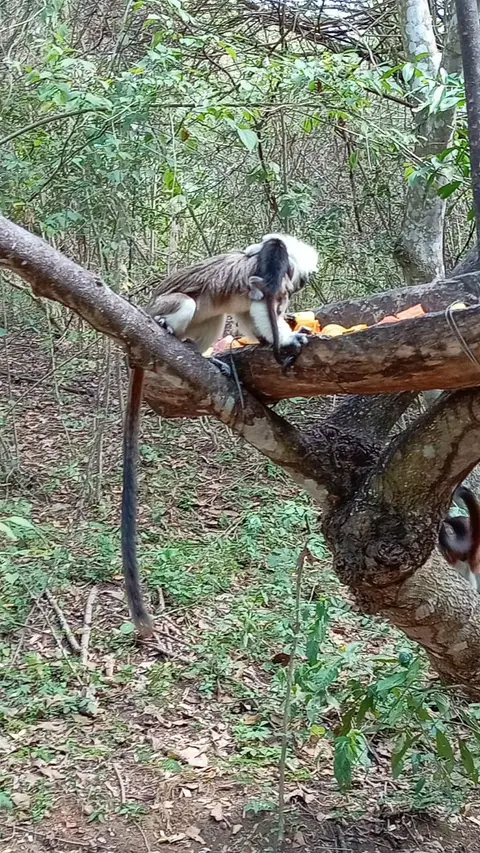
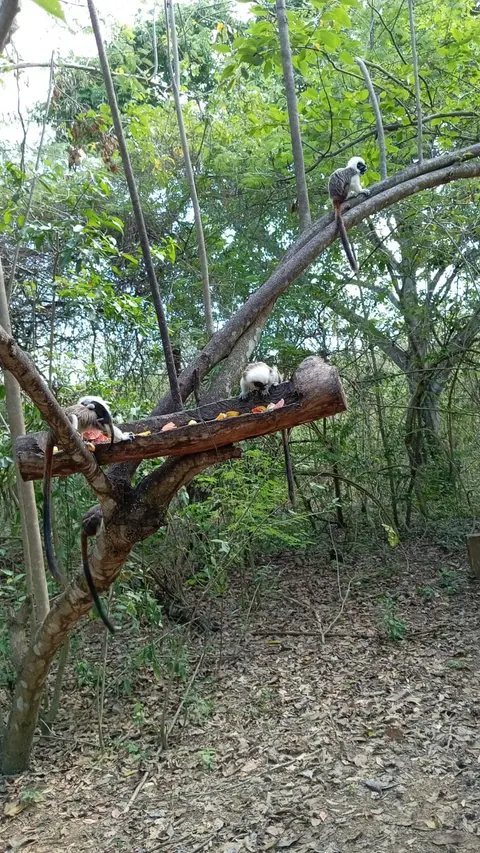
Carlos Andrés Matas Contreras was making his rounds through the Lago 2 sector of Finca El Paraíso when he saw them: seven cotton-top tamarins moving through the branches with that restless, electric agility that defines them. Among the group, a baby. One by one they took turns approaching the log set out as a feeding station — sliced watermelon and mango arranged on the wood — and they ate with quiet composure while the others waited in the branches above, their long dark tails swaying against the deep green of the forest.
The cotton-top tamarin — Saguinus oedipus, with that shock of brilliant white fur that crowns its head like a crest — is endemic to northern Colombia and listed among the world's most critically endangered primates. To see them like this, seven together and with a newborn, actively using this corner of tropical forest, speaks volumes about what is unfolding in silence among the trees of El Paraíso.
The Old Mamoncillo of Los Guardianes Bears Fruit Again
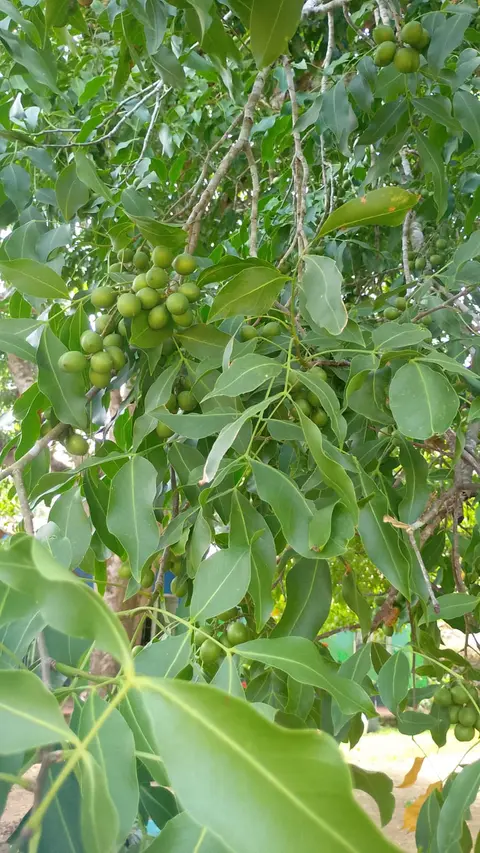
On Finca Los Guardianes, there is a mamoncillo tree that has spent many years as a silent witness to the life of the farm. This week, Angélica Cecilia Mármol Venegas noticed that its branches were bending again under the weight of the clusters: green fruits, tightly packed, shining like freshly polished marbles. It was the sign that the harvest of *Melicoccus bijugatus* had begun.
For the birds of Fundación Loros, the mamoncillo is more than just food — it is entertainment. They have to work for it: handle it, crack it open, extract that sweet orange pulp hiding beneath the hard shell. Angélica knows this well, which is why she calls the start of the harvest a grand occasion. For now the fruits remain on the tree, loosening at their own pace, but soon they will make their way to the aviaries.
There is something special about that ancient tree, which has long since become part of the landscape of Los Guardianes — a tree that has watched seasons, hands, and birds come and go, and that every year, without fail, keeps its promise.
It was his day off, but Omar Enrique Berdugo Cabeza cannot silence the guardian eye he carries within him. Standing on the terrace of his quarters, he noticed a young man from the neighborhood with his gaze fixed upward, toward the back yards. He followed that gaze, and there she was: the macaw B29, perched calmly on a banana plant, indifferent to the stir that her mere presence awakened.
The boy wanted to know if they could catch her. Omar explained, with the quiet patience of someone who understands these things, that macaws are free — that you enjoy them with your eyes, not your hands. The young man understood at once, but a different worry took hold of him: what if someone else caught her? So Omar guided the bird toward the grounds of the Fundación, and the boy, watching her glide off in that direction, let out a breath of relief: she's safe there, where no one will bother her.
In that back yard, without anyone seeking it, a small lesson in coexistence took place. The B29 continued on her way without knowing it, and a young man from the neighborhood learned to see the world a little differently.
Third Encounter with the King of the Hill
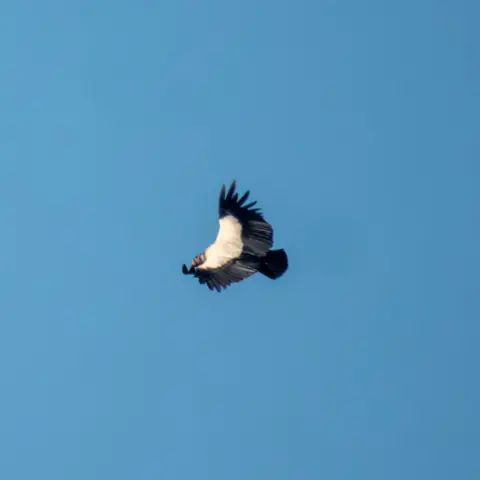
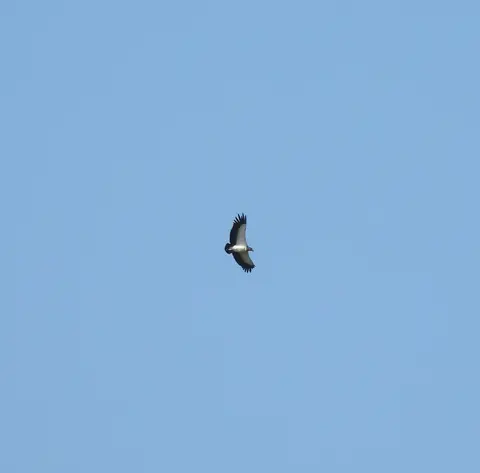
There are sightings you jot down in the logbook, and there are others that embed themselves in memory. The king vulture that Maicol spotted soaring above cerro El Peligro on a recent morning belongs to the second kind — all the more so because this is not the first time, nor the second, but the third time he has watched it glide over that very same spot. Above the hill it is common to see dozens, sometimes hundreds, of black vultures tracing slow circles in the warm air, but the Sarcoramphus papa — its white chest and broad black wings open wide against the blue sky — is another story entirely: a rare visitor that seems to have grown fond of that particular hill.
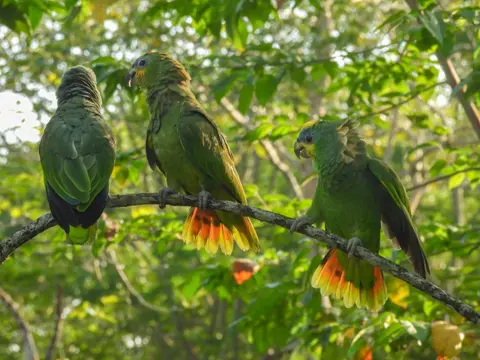
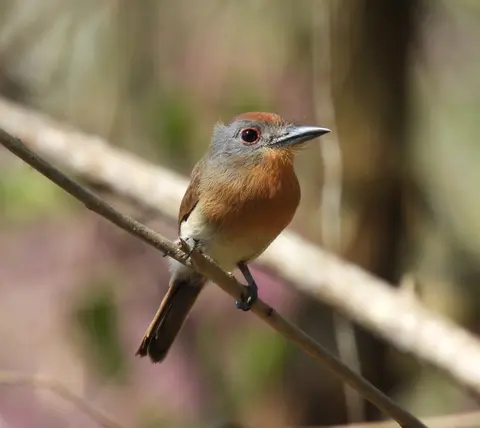
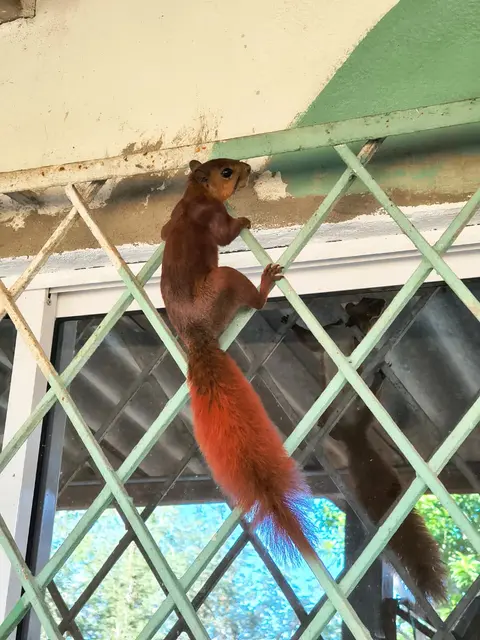
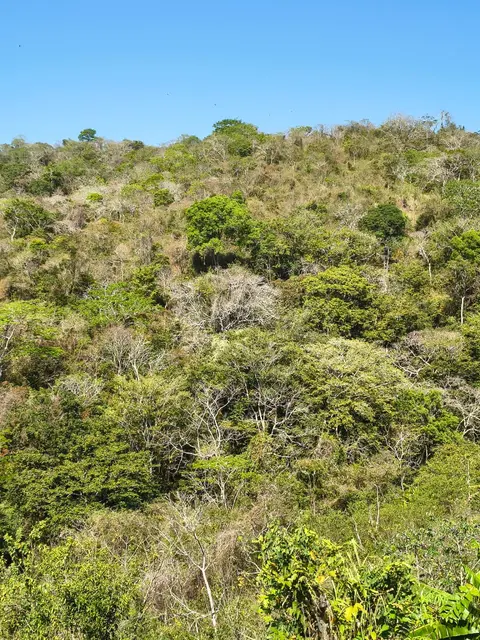
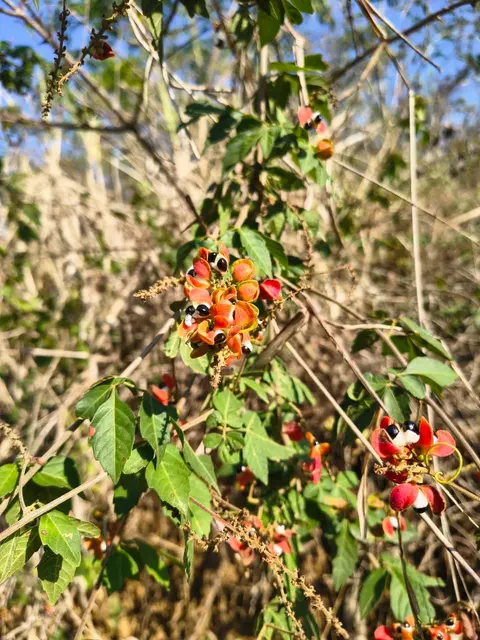
The day's route started from finca El Paraíso and climbed up to cerro El Peligro, along rocky trails hemmed in by dense vegetation at that peculiar moment when the forest has not yet made up its mind between dry season and wet. Along the way, Maicol also came across three green parrots perched on a branch — their tails a flash of yellow and burning orange amid the foliage —, a rusty-breasted nunlet (Nonnula frontalis) with its dark, bright eye, a large raptor gliding in silence, a reddish squirrel climbing with nimble ease, and the open pods of a legume from the genus Ormosia revealing their two-toned seeds, black and white, like small wild jewels. A full day, by any measure.
The White Bonga in the Thirsty Forest
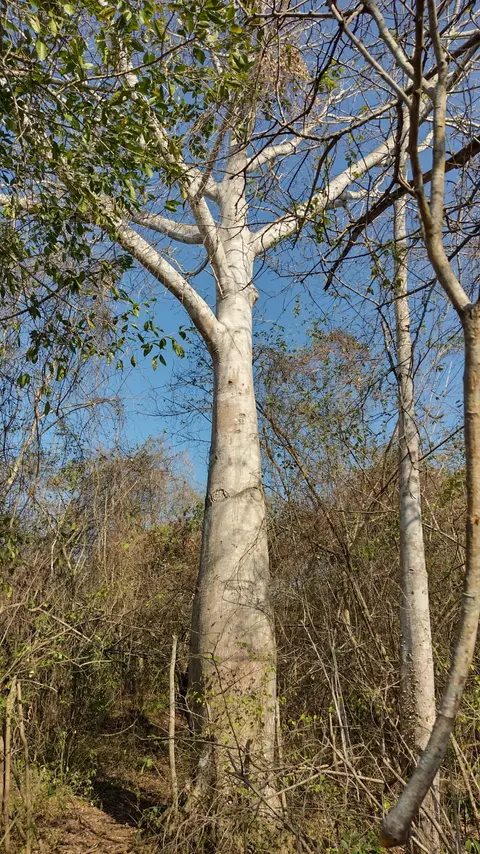
Somewhere in the dry scrubland of the reserve, where the vegetation crowds itself into low shrubs and the earth holds the heat of midday, a white trunk rises above everything else. It is a bonga — ceibo, palo borracho, call it what you will — and its pale bark stands in sharp contrast against the merciless blue of the April sky. José Marín managed to capture the image before the signal dropped, and the photograph took its time arriving, like so much news that travels slowly from the most remote corners of these 520 hectares.
The tree stands alone in its size. Around it, the branches of the surrounding shrubs appear bare, surrendered to the dry season, while it remains upright with that stillness that belongs only to very ancient trees. We don't yet know in which sector this bonga makes its home, nor who was the first to stop and look up at it. Those details will come when the signal returns. For now, what remains is the record of its presence: a white trunk, a blue sky, and the hot silence of the forest.
Shadow and Silence Beneath the Guásimo
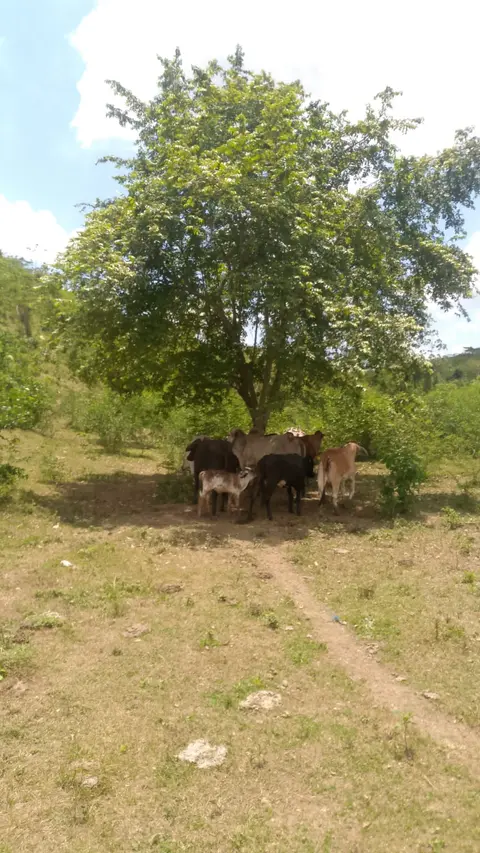
In the final days of summer, when the sun bears down on Valle Verde without mercy and the earth cracks open in silence, Eder came upon this sight: a cluster of cows and calves pressed together beneath a guásimo, still, as though the tree itself had told them this was where they belonged.
The guásimo — Guazuma ulmifolia, one of the most generous trees in the Caribbean landscape — had been standing there long before the heat of this season arrived. Its broad canopy and dense shade are, for the cattle of this region, the closest thing to shelter: no fence, no roof, only this tree that knows its purpose well. The ground around it told the whole story: dry, yellowed, the vegetation scattered and surrendered to the summer.
Eder captured the scene without interfering. The animals rested together, indifferent to the camera, wrapped in that heavy calm that settles over the midday hours. A simple postcard from Valle Verde — one that quietly reminds us why trees in pastures are never just decoration.
José Marín was walking through the reserve that Monday when the three deer appeared all at once from within the vegetation. The moment they sensed him, they leapt into the undergrowth with that nervous elegance they carry — but one of them, perhaps the most curious or the most hungry, turned back and resumed feeding as if nothing had happened. José had the presence of mind to record it all, and there it remained: a deer grazing calmly near point 10.4448616, its back turned to the one watching it.
A few minutes later, barely three hundred meters to the northeast, three toucans crossed the sky before settling in a roble. Still on the branches, with those disproportionate beaks that look like one of nature's jokes, they lingered long enough for José to raise his camera once more. Two videos, two records, one morning in the field that no one saw coming.