The Muñeco That Already Has Offspring
In a corner of dense vegetation within the reserve, beneath a sun filtering down through the canopy, Michel Salas and Jorge Alcalá paused before a Muñeco (*Cordia collococca*) standing some eight meters tall. The tree wore its bright red berries in abundance, and as they photographed it from different angles, a black bird — drawn in by the fruit — revealed itself among the branches. Five photographs remain as testament to that moment: the leafy crown, the cluster burning red, the winged visitor.
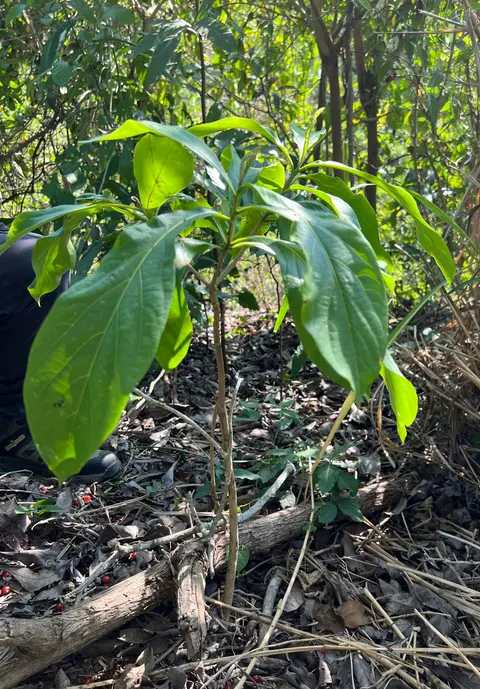
But the more understated story was below, among the dry leaves and remnants of the understory: a juvenile individual of the same species, its large green leaves pushing upward from the half-light. No one had planted it. It arrived on its own, the way things arrive when they find the conditions to stay.
The Muñeco is a species native to the Colombian Caribbean, and this record — a fertile adult alongside natural regeneration at the same site — confirms that in this part of the reserve, the species is not merely surviving: it is reproducing on its own terms.